Showing posts with label Thompson and Odell. Show all posts

Saturday, October 1, 2022

J. B. Treat Drum, ca. 1879

Joseph B. Treat was a well-known drummer and drum maker in Boston during the mid to late 19th century. A native of Connecticut, Treat arrived in Massachusetts by 1860 and briefly served as a drummer in Boston's Independent Corps of Cadets during the Civil War. A musician by vocation, he worked extensively in the musical instrument trade as well. Treat's most recognizable work as a maker was for Thompson & Odell during the 1880s and early 1890s.

Through much of the 1860s and 1870s, directory listings place Treat at addresses corresponding to the workplace of Asa Warren White suggesting that Treat worked alongside or was employed by White during these years. Signed makers labels offer further evidence that the two men were affiliated in some capacity well into the 1870s though they diverged shortly thereafter. Directories list Treat independently under 'Musical Instrument Makers' in 1879, and both Treat and White are absent from the Boston Business Directory in 1880 before reappearing at separate addresses the following year. Beginning in 1881 Treat's place work was 177 Washington Street confirming that he was by then employed by Thompson & Odell.

Treat likely produced the drum seen here during the narrow window of time after leaving White's shop, before landing at Thompson & Odell.

ca. 1879 J. B. Treat Drum
ca. 1879 J. B. Treat Drum Label
A large makers label inside the drum reads: "CIRCULAR / Having located at 50 Bromfield Street, Room 24, I am prepared to furnish Drums of any, and all descriptions, of the best materials throughout, also Rodger's Drum Heads, and Drum Findings of all descriptions, at the lowest possible prices. / Uniform sets of Drums, for Corps, made at the shortest notice. Old Drums remodelled and repaired in the best manner. / J. B. TREAT, / 50 BROMFIELD ST., ROOM 24 / I invite my old friends and customers to / "CALL ROUND." / Pin this up in the Band Room."
ca. 1879 J. B. Treat Drum
The drum is straightforward in construction, typical of military style drums manufactured in Boston during the decades following the Civil War. Formed from a single ply of maple, the shell is held at the seam by a line of small brass tacks. Slightly unusual is the orientation of the air vent and snare beds which are often placed further around the shell from the seam.

Do you have a drum made by J. B. Treat? I would love to hear from you! Email Lee anytime at lee@vinson.net. And for more on the early 20th century snare drum makers of Boston, Massachusetts please visit BostonDrumBuilders.com or follow @old_boston_drums on instagram.

Sunday, September 2, 2018

Who was O. A. Whitmore?

Featured here is a very early drum for Thompson & Odell by O. A. Whitmore, dating from about 1875. Thompson & Odell was only beginning to become established at the time, a fact underscored by the wording "successors to A .W. White" on the makers label.

ca. 1875 Drum by O. A. Whitmore for Thompson & Odell, Boston, MAca. 1875 O. A. Whitmore drum label for Thompson & Odell

Thompson & Odell's beginnings can be traced back to 1872 as "Woods & Odell". In 1873 J. Harrison Woods and Ira H. Odell took in a third partner in Charles W. Thompson forming "Woods, Odell, and Thompson" operating at 121 Court Street. Woods left the company by 1875 after which the remaining two partners established Thompson & Odell at 86 Tremont Street, the address most recently occupied by Asa Warren White and Louis P. Goullard under the moniker "White & Goullaud".

The drum dates from circa 1875 placing Whitmore as perhaps the first in a long succession of drum makers contracted by Boston's Thompson & Odell.

This drum being from right around 1875 places O. A. Whitmore as perhaps the first in a long succession of drum makers contracted by Thompson & Odell that would later include J. B. Treat, and Charles A. Stromberg. Whitmore's makers label also describes his business as specializing in E. B. Mansfield's banjo, a design for which Mansfield received a patent in 1872.

O. A. Whitmore settled north of Boston in Malden, Massachusetts around 1871 and was building drums and banjos at least as early as the mid 1870s. He is listed in the 1876 Boston Directory as a musical instrument maker producing drums and banjos at 282 Washington Street. Before this time, as early as 1871, Whitmore appears in the Directory with the occupation of "musician", but is not included under listings for musical instrument makers.

Around 1879 Whitmore opened his own shop at 178 Washington Street. As of 1880 he was in business with Peter J. Boris at the same address, the firm being known as "Whitmore & Boris". Boris, long active as a musical instrument importer and dealer, had previously been partnered with J. H Woods of Woods, Odell & Thompson. Whitmore and Boris' working arrangement was evidently short lived lasting only until about 1882. Perhaps their business interests merely evolved in a different direction, however, as the two are listed as assignees of an 1882 patent for fish nets of all things.

By 1883 Whitmore had essentially traded one partner for another now joining up with the aforementioned Eben B. Mansfield to form "Whitmore & Mansfield" still operating at 178 Washington Street. The two men together had previously secured a patent for a music stands a few years prior. In addition to manufacturing Mansfield's patent banjos, Whitmore & Mansfield also dealt brass instruments including cornets. But like Mansfield's previous joint business venture, the partnership was short lived. Whitmore & Mansfield vanishes from Boston directories after 1884 as do both individuals for a time.

Whitmore & Mansfield was short lived, vanishing from Boston directories after 1884.

It could be that Whitmore returned to the road for a few years, or that he simply didn't have a business address in Boston for a period of years. Nevertheless, his music store at 178 Washington Street changed hands at this point as a man named George M. Lane was selling musical instruments there in 1885. By 1886, Lane was gone and D. C. Hall was selling musical instruments at the same address as would be the case for the next several years.

O. A. Whitmore resurfaces in directory listings in 1888 as a music teacher at 179 Washington Street, a professional address shared by several others including J. H. Woods. Whitmore would continue to appear here through the 1890s while living in Malden.

Long before coming to Boston, Osceola Aurelius Whitmore was a native of Reading, Vermont. Born September 2, 1838, he would take up the clarinet at a young age and soon become well established with a variety of minstrel shows eventually taking on management positions and ownership stakes in several companies. This early chapter of Whitmore's life is well described by Frank H. Clark in "History of Reading, Windsor County, Vermont. Vol. II:


Whitmore & Clark's Minstrels
"The most famous musical organization which originated in Reading was undoubtedly Whitmore & Clark's Minstrels, a company that for more than a quarter of a century annually visited every part of New England, and parts of New York and the Provinces, and the memories of which will be remembered with pleasure by many an "old-timer". The company was organized at the close of the Civil war and was the successor of several similar organizations that had been more or less successful, S. A. Brock's Broadway Minstrels, Whitmore & Thompson's Minstrels and others."

"Of the proprietors of the company [Whitmore & Clark's Minstrels] only one, Osceola A. Whitmore, was a native of Reading. He was born on the old Whitmore place Sept. 2, 1838, a son of Capt. Nelson Whitmore, at one time captain of the militia company and Mrs. Lucy (Holden) Whitmore. Young Whitmore must have been inspired by the old time music of the fife and drums, which he says was the most important part, to him, of the annual June training. The players were Otis Foster, snare drum, Henry Megrath, fife and Capt. Nathan Sherwin, bass drum.

Mr. Whitmore began to play the clarinet at an early age, his first engagement in public being at the hotel in Hammondsville in 1855 for a dance, playing with Carlos Hawkins and for which he received for his valuable services the sum of twenty five cents. He received his first instructions on the clarinet from Alonzo Bond of Boston, who taught the Woodstock Band about this time, and was a member of the band in 1860 and '61, and went into camp at Rutland in May 1861 with the Woodstock Light Infantry. In the beginning of the war, when the first call for three months' men from President Abraham Lincoln was made the government did not employ bands, so the band returned to Woodstock when the company left for the seat of war. Afterwards he traveled with Barnum's Circus and was with the Whitmore and Clark troupe for twelve years after it was organized. The name was retained after Mr. Whitmore retired from the organization except for one or two seasons."

Whitmore & Clark's Minstrels was formed in 1866 with Whitmore himself reportedly staying on board until about 1878 before leaving the group to accept more solo clarinet work with various musical organizations in Boston and to pursue his interests in the musical instrument business.

At the time of his death in 1918, Whitmore was remembered foremost as a performing clarinetist and teacher. The final stages of his life perhaps overlapped with but apparently outlasted and overshadowed that of his banjo and drum manufacturing interests and certainly his early career with traveling minstrel shows.

A brief obituary from the Musical Courier published November 28, 1918 reads as follows: "Osceola A. Whitmore, at one time one of the worlds' most famous clarinetists, died Sunday, November 17, in Allston, Mass at the age of 80 years. Mr. Whitmore had been associated with Gilmore's, Carter's, Sousa's and the Germania Bands and the Boston Symphony Orchestra. He had been for twenty-seven years in charge of the orchestra at the Fabyan House in the White Mountains, and was also well known as a teacher and maker of clarinets. Mr. Whitmore passed the greater part of his active life in Malden, was a member of the common council for three years and a member of many fraternal organizations. He is survived by two married daughters."


This particular drum had previously suffered the indignancy of being converted into an end table of sorts. The conversion had been accomplished by screwing three drum sticks into the shell to serve as legs. The legs have now been removed and new heads tucked onto the existing flesh hoops restoring some semblance of respectability to this interesting historical piece.


The snare strainer looks to have been replaced once upon a time as the bottom hoop has been crudely gouged to accommodate a newer but similarly basic mechanism. The gut snares are held in place with a simple leather snare butt as is common for drums of this age.


Rustic condition aside, the construction methods implemented here are more crude than those commonly seen on drums from a decade or two later. Whitmore used not only a series of small tacks to hold the shell together along the seem, but the same is true of both the counterhoops and the re-inforcing rings. Yet signs of high end refinement are simultaneously present as seen in the beautifully polished rosewood grommet lining the air vent and faded remnant of a gilded scroll design ornamenting the black enameled counterhoops.


W. Lee Vinson is a classical percussionist, music educator, and snare drum historian. He is the author of BostonDrumBuilders.com, a website devoted to the late 19th and early 20th century drum makers of Boston, Massachusetts.


Tuesday, May 8, 2018

M. Woodman, Drummaker

One drum, two makers labels, three addresses. Depending on how all this information is interpreted, the drum featured here either originated from Boston's Thompson & Odell, or from the hands of a lesser known drum maker from Maine by the name of M. Woodman.

Thompson & Odell Drum, possibly by Manson Woodman ca. late 1870sThompson & Odell Drum, possibly by Manson Woodman ca. late 1870s

Directories list Thompson & Odell at 86 Washington Street from 1875 through 1879. Before this time, the fledgling firm had gone by the name Woods, Odell, & Thompson and in 1874 was listed at 121 Court Street. By 1880 Thompson & Odell had moved to 177 Washington Street where they would remain for the next five years. The drum seen below figures to have been produced in the late 1870s while the company was operating at the 86 Washington Street address.

From the very beginning, Thompson & Odell sold instruments from other manufacturers in addition to those made in house and it can sometimes be difficult to discern instruments produced by Thompson & Odell from those which were contract built and relabeled. Thompson & Odell's "Artist Drum" was a described as a "street instrument" intended for "military and semi-military purposes" and was crafted for many years by Joseph B. Treat and later Charles A. Stromberg. In the case of the drum featured here, there is no specific drum maker named by Thompson & Odell leaving open the possibility that someone other than Treat or Stromberg was the builder. An additional label found inside of the drum lists a separate maker and raises as many questions as it answers.

It could be that Manson Woodman did in fact build the drum or it could be that he was only a repairman in this case.

This second label bears the name of a lesser known drum manufacturer from Skowhegan, Maine by the name of M. Woodman. Handwritten on the upper half of Woodman's label is the wording "Thompson & Odell / 177 Washington Street / Boston Mass". This might suggest that Woodman produced the drum for Thompson & Odell, though the address on Woodman's label post dates the Thompson & Odell label bringing this assumption into question. It could be that Manson Woodman did in fact build the drum and that Thompson & Odell was using up an existing stock of labels listing their old address. Or it could be that he was only a repairman in this case who later added his name to the drum after servicing the instrument. It is impossible to know for sure. Woodman would in fact set up shop in Boston later in his life but wasn't known to have been an active drum maker in Boston until about 1883. Both makers labels present here predate this point in time.

Thompson & Odell Drum LabelThompson & Odell Label, ca. late 1870sM. Woodman Drum LabelM. Woodman Label ca. early 1880s

Manson Woodcock was born November 28th, 1816 in Sidney, Maine to George Woodcock and Maria Robinson Woodcock. In 1838 at the age of 22, Manson legally changed his last name to Woodman and by 1840 was living on his own, still in Sidney. He married Prudence Pitts Delano in 1843.

The 1850 and 1860 censuses show Manson Woodman living in Farmington, Maine and in 1861 "A Business Directory of the Subscribers to the New Map of Maine" lists Woodman as a drum maker there. A fascinating series of letters held in the Maine State Archives show Manson reaching out around this time to military officials seeking contracts to build drums for the Civil War effort. Despite several appeals, it does not appear that Woodman was ever able to secure such a contract. But Manson's letters are telling of his aspirations and the lengths to which he was wiling to go in an effort to grow his business as a drum builder.

A man of many trades, Woodman is listed as having had a variety of occupations over the course of his life including that of a machinist, a coffin and casket manufacturer, and as a maker of drums, banjos and tambourines. Further evidencing his entrepreneurial nature, he is credited with an 1867 patent for a "new and useful Improvement in Horse-Rakes". The patent filing goes on to state that the improvement in fact "relates especially to the horse-rake patented [in 1849] by Calvin Delano" who was Woodman's father-in-law.

A man of many trades, Woodman is listed as… a "Manufacturer to order of Coffin and Caskets in all styles of finish. Also of Drums of all kinds, Banjoes, and Tambourines at shortest possible notice."

Sometime in the 1870s Woodman relocated to Skowhegan, ME where he further established himself as a drum maker. The 1877 New England Business Directory lists Woodman as a Drum Manufacturer there. Many directories published around this time show Woodman having dual trades including the 1883 Atlas of Somerset County, Maine which lists Woodman as a "Manufacturer to order of Coffin and Caskets in all styles of finish. Also of Drums of all kinds, Banjoes, and Tambourines at shortest possible notice."

Around 1883 or 1884, Woodman relocated to Boston where he first appears in city directories in 1884 as a drum maker at the Abattoir Grounds. At this advanced stage in life, aged more than sixty years, Woodman seems to have focused his attention fully on drum making. The culmination of these efforts can be seen in his 1890 patent for a drum which aimed to "dispense with the “skin" or “flush” hoops hitherto used in connection with the “cord-hoops" for securing the drum-heads in place upon the shell, whereby the construction of the drum is simplified, its cost reduced, and a greater clearness and brilliancy of tone secured."

Manson Woodman Drum Patent

Less than one year after his patent was issued, on May 8, 1891, Manson Woodman passed away in Boston at the age of 74. He was laid to rest in his native Farmington, ME.

Spinning forward several decades, a 1921 letter written to Boston's S. A. Woods Machine Company and later published as part of a 1922 advertisement in "The Wood-worker" discusses Woodman's planer which had recently been refurbished and was still in use. This same planer was purportedly used by Woodman to construct a mammoth 10 foot bass drum for the "Peace Jubilee in Boston in the '70s". The World's Peace Jubilee and International Musical Festival was held in Boston in the Summer of 1872 and photographs from the well documented event indeed show a giant bass drum at the very center of the newly constructed Coliseum. The drum would have served as a grand centerpiece of the festival's musical offerings and a monument to Woodman's musical instrument building endeavors alike.


W. Lee Vinson is a classical percussionist, music educator, and snare drum historian. He is the author of BostonDrumBuilders.com, a website devoted to the late 19th and early 20th century drum makers of Boston, Massachusetts.


Sunday, November 1, 2015

ca. 1905 Stromberg Artist Drum

Swedish immigrant Charles A. Stromberg came to the United States in 1887 and found work at Boston's Thompson & Odell where he served as the foreman in their banjo, mandolin, and guitar factory. After Thompson & Odell went bankrupt in 1905, Stromberg went into business for himself. The Artist Drum seen here dates from sometime between April of 1904 and March of 1906 just as Stromberg was venturing out on his own.

ca. 1905 Charles A. Stromberg Artist Drum

Stromberg was careful to label this instrument as an "Artist" model so that it could not be confused with the higher end Invincible Orchestra Drum which featured patented separate tension lugs. The term "Artist" is a word borrowed from Thompson & Odell's advertising. To that end, Stromberg cut down one of his own paper labels and trimmed out the word "invincible" replacing it quite literally with a snippet from a Thompson & Odell label reading "Artist Drums". Another separate tiny strip of paper inside of the drum simply reads "CHARLES STROMBERG" in block lettering.

More interesting is a unique stamp reading "CHA. STROMBERG / DRUM MANUFACTURER / WASHINGTON STREET". Unfortunately the stamp is too faded to make out the street number, but it is worth noting that Stromberg evidently thought enough of his drum building business at this time to have a stamp identifying himself specifically as a drum manufacturer. Most fascinating is the pencil marking inside of the shell, in Stromberg's own handwriting, indicating that this drum employs his strainer and muffler design patented on April 5, 1904.


The strainer present on this drum is a very close match to Stromberg's original design. It very effectively tightens and loosens the snares though it lacks the ability to quickly engage or disengage the snares from the bottom head. Later versions, or possibly even concurrent ones, were equipped with a throw-off lever which could immediately switch the snares on or off. The strainer and butt seen here are both stamped "PAT. P'D'G", for patent pending, presumably indicating that the hardware was produced no earlier than July 20th, 1903, the date for which the patent was applied.

ca. 1905 Stromberg Artist Drum Snare Strainerca. 1905 Stromberg Artist Drum Snare Butt

Though this was not Stromberg's top of the line snare drum, it still bears his trademark crafstmanship from the beautifully figured maple shell, to the polished rosewood grommet lining the air vent, to the streamlined hoop clips which were more refined version of those used on earlier "Prussian" style drums. Another unique touch is a small brass plate reinforcing the snare side wooden hoop. Barely noticeable when the drum is assembled, this shows not only Stromberg's attention to detail, but his knowledge of the instrument in that this is typically a weak point where the hoop can easily crack.

ca. 1905 Stromberg Artist Drum Hoopca. 1905 Stromberg Artist Drum Grommet

The shell is one ply maple with narrow maple reinforcing rings which is typical for a Boston-made drum of this period. Most unusual is a fixed pinwheel-like wooden structure loosely suspended inside of the shell. The four 'paddles' are joined in the center while only two are attached to the shell. This very strange element seems to have no structural or functional purpose as it does not reinforce the shell and has nothing to do with how the snare strainer operates.

1905 Stromberg Artist Drum

In comparing this drum to nearly two dozen other known examples, nothing like this appears inside of any other Stromberg drum. Furthermore, neither of Stromberg's patents, both of which date from the same period during which this drum was built, mention or illustrate anything of this nature. So what was the purpose of this mysterious wooden pinwheel? Was this somehow intended to affect the sonic qualities of the drum? Was this a one-off experimental prototype or a standard production model? Is this possibly a feature borrowed from banjo construction that Stromberg was attempting to implement on drums? It is, in the end, a drum which presents more questions than answers.

Do you have a drum made by Charles A. Stromberg? I want to hear from you! Feel free to drop Lee an email anytime at lee@vinson.net. And for more on the early 20th century snare drum makers of Boston, Massachusetts, please visit BostonDrumBuilders.com.

Sunday, October 4, 2015

Prussian Drums

Towards the end of the 19th century, American musical instrument retailers began cataloging drums described as "Prussian" models. These were not generally instruments imported from Prussia, but rather early rod tension drums as opposed to the more traditional "regulation" style of drums which used rope and leather tugs to tune the heads.

Prussia was of coarse the powerful German state which in the 1860s and 1870s had claimed a series of resounding military victories including the Seven Weeks War in 1866 against Austria, and the Franco-Prussian War in 1870 - 1871 which ultimately lead to a united Germany. So labeling an American made instrument as "Prussian" at this time would have not only related it to the style of drums actually carried by the Prussian Army, but also would have held connotations of great strength and might.
Prussian Drum Advertisement

All of this being said, the most important takeaway is to know that the "Prussian" drums manufactured and sold during the 1880s and 1890s in the United States were some of the first widely produced rod tension drums. The Lyon & Healy Handbook of Musical Instruments (1896) further describes Prussian drums relative to the so called "regulation" drums of the day.

1890s Lyon & Healy Prussian Drum description

The American made Prussian style drums of the late 19th century may have been progressive in their use of metal hardware, but the instruments themselves weren't necessarily high end. Many were of the mass produced variety sold through band instrument dealers and mail order catalogs. These drums were often very basic in construction with crudely riveted metal shell seams and clumsily hammered snare beds. The metal hardware used to tension the drum was functional but typically rough and bulky.

C. Bruno & Sons CatalogC. Bruno & Sons Catalog


Labels applied inside Prussian drum shells usually list the retailer who sold the drum, but not necessarily the maker. Identical drums exist bearing differing labels thus the true origin of many drums is ambiguous. Shared catalog artwork between advertisers leaves the matter of determining a specific manufacturer even more dubious.

Prussian drums were sold by a vast number of music houses including John C. Church (Cincinnati), Oliver Ditson (Boston/New York), Lyon & Healy (Chicago), Thompson & Odell (Boston), J. W. Pepper (Philadelphia), Whaley & Royce (Toronto), John C. Haynes & Co. (Boston), the Rudolph Wurlitzer Company (Cincinnati), C. Bruno & Son (New York), Julius Bauer & Company (Chicago), and William Tonk & Bros (New York). Even mail order companies such Sears Roebuck & Company cataloged Prussian drums among their selection of musical instruments.

Sears Roebuck & Company Prussian Drum Advertisement

Based on the prevalence of surviving examples, metal shells appear to have been most popular. This in and of itself was a significant evolution as American made drums to this point had traditionally been formed from wood. Nickel, German silver, and brass shells were common for Prussian drums. Wooden shell Prussian drums are not uncommon however. Drums constructed around maple, white holly, or rosewood shells are typically offered alongside metal shell models in advertisements. Hoops were normally wooden, often painted black or stained in a faux rosewood finish. Gilded and more ornately decorated hoops were also offered in many catalogs.

Tensioning hardware was comprised of multiple sets of large square headed tension rods passing through claws clasping each hoop. The rods passed loosely through the claws holding the top hoop and threaded into claws grasping the bottom hoop. This was an efficient way to tighten or loosen both heads at the same time but lacked the ability to tune the heads independently.

Prussian models were often equipped with leg rests making it easier to play the drum while standing or marching. The leg rests commonly were connected to the metal drum claws. Snare strainers were simple allowing for the tightening and loosening of gut snares.


From these early rod tension snare drums, the modern snare drum would eventually evolve. As Prussian drums were smaller than regulation rope drums, "orchestra" models were more shallow than Prussian drums. Similar tensioning methods to those used on Prussian drums would soon be scaled down and refined giving rise to the more modern instruments of the early 20th century.

Sunday, September 6, 2015

Drum Catalogs from Yesteryear

Simply put, drum catalogs are an ephemeral form of advertising material. Small trade publications such as these were entirely disposable after a very short period of use. As soon as a new catalog was issued, the old one was irrelevant. Little thought was put into what would happen to these bound sheets of paper once their short term purpose had been fulfilled. But for those who collect and study antique drums and the now defunct companies that produced them, one hundred year old drum catalogs are a priceless treasure trove of information about long gone manufacturers and their wares.

The catalogs pictured below from John C. Haynes, F. E. Dodge, Thompson & Odell, Nokes & Nicolai, Oliver Ditson, and George B. Stone & Son depict a fairly broad view of drum making in Boston from the late 19th century up through the mid 1920s. And though all of these companies would in one way or another cease operation fairly soon after this time, the evolution of the snare drum can quite literally be be traced through the pages of these trade publications. Over a period of nearly 50 years, the snare drum morphed from an old fashioned, rope tensioned instrument during the mid 1800s, to a primitive single tension thumbrod style drum around the turn of the 20th century, and finally to an all but modern showpiece by the mid 1920s where finely crafted wooden and metal shell drums featured fully functioning snare throw-offs and separate tension lugs which allowed for either head to be tuned independently.

The Boston Drum Builders were at the same time experimental yet generally slow to evolve. The offerings pictured throughout these pages allow us to compare and contrast the instruments made in Boston with those of their Midwestern counterparts. In particular, Leedy of Indianapolis and Ludwig & Ludwig of Chicago were quicker to modernize and faster to grow allowing them to swiftly overtake the Boston makers in terms of size and influence. The relative scarcity of ephemera left behind by the Boston companies as compared to their peers is evidence of this trend.

The catalog cover photos shown below are a far from comprehensive depiction of the advertisements published by the Boston Drum Builders. Surely, many other trade publications exist. Stone published "Booklet L" sometime after Catalog K and presumably had printed something resembling Catalogs "A" through "F" before arriving at "G" sometime around 1912. It would be a logical assumption that some form of catalog preceded Nokes & Nicolai's "American Drummer No. 5". Perhaps Nos. 1 through 4 were printed earlier, or maybe picking up with number five indicates that F. E. Dodge had already issued four full catalogs before Nokes & Nicolai succeeded them in 1912. Many more J. C. Haynes & Company catalogs are known to have been published, mostly dating from the 1880s and 1890s and including a plethora of musical instruments, not just drums. The same is likely the case for Oliver Ditson whose "Wonderbook Number Four" (1910) corresponds with the volume number within a given year of publication rather than an issue in a chronological series.

The two more prominent boutique builders in Boston during the early 1900s, Harry A. Bower and Charles A. Stromberg, bear mention here as well though there are no catalogs to show. Neither maker left much behind in the way of advertising as compared to the other Boston makers. Some Bower advertising does appear in trade publications, but no full size drum catalogs by either Stromberg or Bower are known to exist. Stromberg appears to have hardly advertised his drums at all, perhaps because he was such a small, high end maker working with a broad diversity of instruments including harps, banjos, and finally guitars for which he would ultimately become best known.

Some of these catalogs are viewable online in part or in their entirety. The 1907 F. E. Dodge Catalog and Geo. B. Stone & Son Catalog K (1925) can be found at VintageDrumGuide.com. The 1883 J. C. Haynes Catalog, held by the Winterthur Museum Library in Wilmington, Delaware is viewable online at the Internet Archive. The remaining catalogs included here are from the authors collection.


Stone Catalog G - ca. 1912
George B. Stone & Son
Catalog G - ca. 1912

Stone Catalog H - ca. 1915
George B. Stone & Son
Catalog H - ca. 1915

Stone Catalog I - 1919
George B. Stone & Son
Catalog I - 1919

Stone Catalog K - 1925
George B. Stone & Son
Catalog K - 1925


F. E. Dodge Catalog - 1907
F. E. Dodge Company - 1907
Photo: VintageDrumGuide.com
Nokes & Nicolai Catalog Cover - mid 1910s
Nokes & Nicolai
The American Drummer No. 5 - mid 1910s

Nokes & Nicolai Catalog Cover - ca. 1918
Nokes & Nicolai
The American Drummer No. 6 - ca. 1918


Vega / Thompson & Odell Catalog
Thompson & Odell by Vega - ca. 1915
 
Oliver Ditson Company 1910
Oliver Ditson Company
Ditson Wonderbook Number Four - 1910
J. C. Haynes Company - 1883
J. C. Haynes & Company - 1883
 

Do you have a catalog from one of Boston's early 20th century drum makers? I would love to hear from you! Feel free to send Lee an email anytime at lee@vinson.net. And for more on the history of drum manufacturing in Boston, Massachusetts please visit BostonDrumBuilders.com.

Wednesday, April 15, 2015

The Celebrated Stromberg Invincible Orchestra Drum

Swedish immigrant Charles A. Stromberg was a cabinet maker turned musical instrument craftsman who came to America in 1887 and soon after began working for Thompson & Odell in Boston. In 1905, upon the bankruptcy of Thompson & Odell, Stromberg went out on his own manufacturing and repairing a wide assortment of musical instruments including banjos, mandolins, guitars, harps, and drums. According to Christine Merrick Ayars' Contributions to the Art of Music in America by the Music Industries of Boston 1640 - 1936 (New York: H.W. Wilson, 1937) Stromberg had by the mid 1930s produced "about 1000 banjos, 200 mandolins, 100 guitars all custom made and 400 drums."

Long before Charles and his youngest son Elmer would become famous for their big-body archtop guitars of the 1940s and 1950s, the elder Stromberg was catering to the needs of theater drummers in Boston's thriving Vaudeville scene. Today we take a look at a magnificent example of some of his very earliest independent work, a beautifully well preserved "Celebrated Stromberg Invincible Orchestra Drum" dated March, 30 1906.

Lee's Celebrated Stromberg Invincible Orchestra Drum1906 Charles A. Stromberg Invincible Orchestra Drum1903 Music Trade ReviewThe Music Trade Review - December, 1903

This drum was in many ways a decade or two ahead of its time and at least lap ahead of the local field as no maker in New England was making anything like this at the turn of the 20th century. Emile Boulanger's Duplex Manufacturing Company of St. Louis had patented a separate tension lug in 1883, but drummers and other drum makers were slow to embrace the concept. In 1906, the lowly snare drum was still more than a decade from being fully modernized at the hands of companies such as Ludwig & Ludwig and Leedy during the 1920s. At the time when Stromberg built this drum, Ludwig & Ludwig had not even been founded yet.

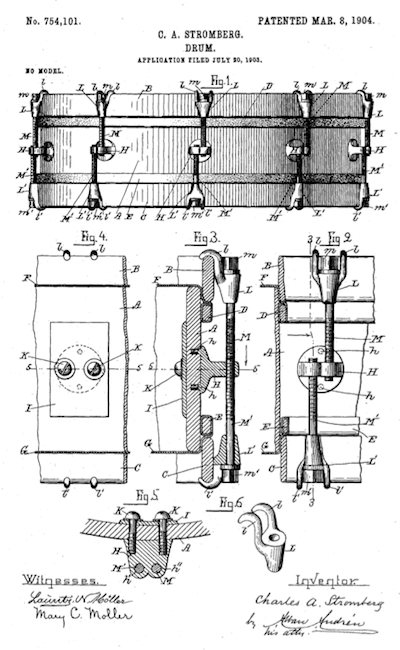
Stromberg applied for a two patents pertaining to snare drum construction, both of which were applied to his Invincible Orchestra Drum. The first patent, applied for on July 20, 1903 and granted on March 8, 1904, involved the method by which the drum is tensioned using claws, tension rods, and separate tension lugs. The second patent, also applied for on July 20, 1903 and then granted on April 5, 1904, related to the snare throw-off and snare butt. A somewhat updated version of this design is present on this drum though the patent date is still stamped into both the snare butt and the bracket which clamps the snares into the throw-off. Presumably, Stromberg continued to evolve his design after submitting it to the patent office almost three years earlier.

Stromberg Drum PatentStromberg Drum Patent

The significance of these patented designs cannot be understressed. The concept of separate tension, where either head can be tensioned independently of the other, was still a relatively new one at the turn of the 20th century and this drum was likely the first of its kind in Boston. And a fully functioning snare throw-off capable of not only tightening and loosening the snares, but fully engaging them with or releasing them completely from the bottom head with the turn of a single lever was almost unheard of at the time.

Stromberg's background as a cabinet maker is clearly on full display here. A beautiful outer ply of birds-eye maple, a perfectly turned ebony grommet, and engraved, faux rosewood counter hoops are all examples of his impressive craftsmanship. Such touches were not uncommon in the early decades of the 1900s, but Stromberg's work is of exceptionally high quality. The counterhoops for example have been painted to resemble rosewood veneer and have then been scored or engraved with a series of lines as ornamentation. This also gives the drum a more high end look and even a certain lightness in appearance considering the height of the wooden hoops necessary to maintain tension on the heads. Stromberg drums in general have a certain elegance about them and that characteristic is certainly apparent here.

Maybe the most astonishing feature of this drum is its staggered, THREE PLY maple shell with no reinforcing rings. Gretsch often claims that this is an innovation of their own dating from sometime in the 1920s and later popularized in the 1940s, but this drum provides us with hard evidence that Stromberg was forming such shells in his Boston workshop several decades earlier.
Lee's 1906 Charles A. Stromberg Invincible Orchestra Drum

Despite the rather rudimentary design of the separate tension lugs, they still have a certain low mass quality about them so as not to give the drum a bulky or heavy appearance. And the quality of construction in general is of the highest level. The three ply shell is as sturdy as the day it was built and the solid brass lugs, which maintain their bright nickel plating, function just as they should after 109 years.

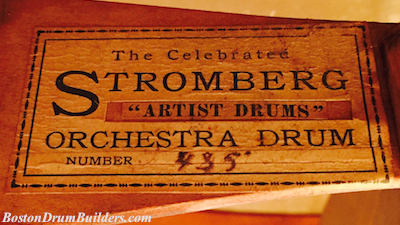
The makers label present inside of the drum shell is significant in its own right. It is in fact a Thompson & Odell label that has been modified with what was apparently Stromberg's own address at the time, 767 Washington St., Boston, Mass., U.S.A. The handwritten date, March 30, 1906, positions this as one of the first drums made by Stromberg after his departure from Thompson & Odell upon their bankruptcy in 1905.

1906 Stromberg Drum LabelStromberg Snare Throw-off
Stromberg Snare ButtStromberg Snare Drum Lug

The drum is outfitted with period correct calfskin heads and what looks to be the original gut snares which are quite thin and of high quality. This instrument won't receive any playing time as it will be preserved purely as a historical collectible, but a few light taps on the head produce a surprisingly bright sound due to the shallow three inch shell depth and firm head tensioning provided by the design of the drum.

Do you have a drum made by Charles A. Stromberg? I want to hear from you! Feel free to drop Lee an email anytime at lee@vinson.net. And for more on the early 20th century snare drum makers of Boston, Massachusetts, please visit BostonDrumBuilders.com.