Showing posts with label McIntosh. Show all posts

Wednesday, July 10, 2024

William F. McIntosh Snare Drum, ca. 1908

William F. McIntosh (1876 - 1950) lead a varied professional life working as a machinist, drum maker, musician, radio repairman, and electrician. He is perhaps best known for his snare strainer and muffler patented in 1909 and used extensively by Boston's George B. Stone & Son through the 1910s and 1920s. McIntosh's output as a maker was small but ranged across the first several decades of the 1900s and is known to include snare drums, bass drums, xylophones and traps such as whistles and ratchets. The separate tension snare drum featured here was likely produced around 1908 or 1909.
circa 1908 William F McIntosh Snare Drum
Lettering stamped into the snare mechanism indicates that a patent has been applied for but has not yet been granted. This helps pinpoint the likely date of manufacture to a narrow window of time between October of 1908 and February of 1909. Of course the drum could have been assembled later using earlier components, but the snare machanism at least dates to this very speicific timeframe. A superbly well preserved makers label inside the drum reads "Wm. F. McIntosh / MANUFACTURING DRUMMER, / HIGH GRADE / Drums, Traps and Drum Findings / Professional Xylophones & Orchestra Bells / a specialty, 6 ELWOOD STREET / CHARLESTOWN, MASS."

William F McIntosh Snare Strainer and Muffler
circa 1908 William F McIntosh Makers Label

The drum is outfitted with twelve single-post tube lugs, slotted tension rods, and cast brass hooks all of which have been nickel plated. Of note is the somewhat crudely formed metal shell with rolled over bearing edges and a soldered seam. A wooden band mounted inside the shell offers additional reinforcement while providing a sturdy backing for the mounting hardware. The counterhoops are single-ply maple with the exterior painted to emulate the look of a more exotic wood.

William F McIntosh Snare Drum Shell
circa 1908 William F McIntosh Snare Drum

Do you have a drum made by William F. McIntosh? I would love to hear about it! Feel free to send Lee and email at lee@vinson.net. And for more on the early 20th century snare drum makers of Boston, Massachusetts please visit BostonDrumBuilders.com and follow @old_boston_drums on instagram.

Thursday, September 1, 2022

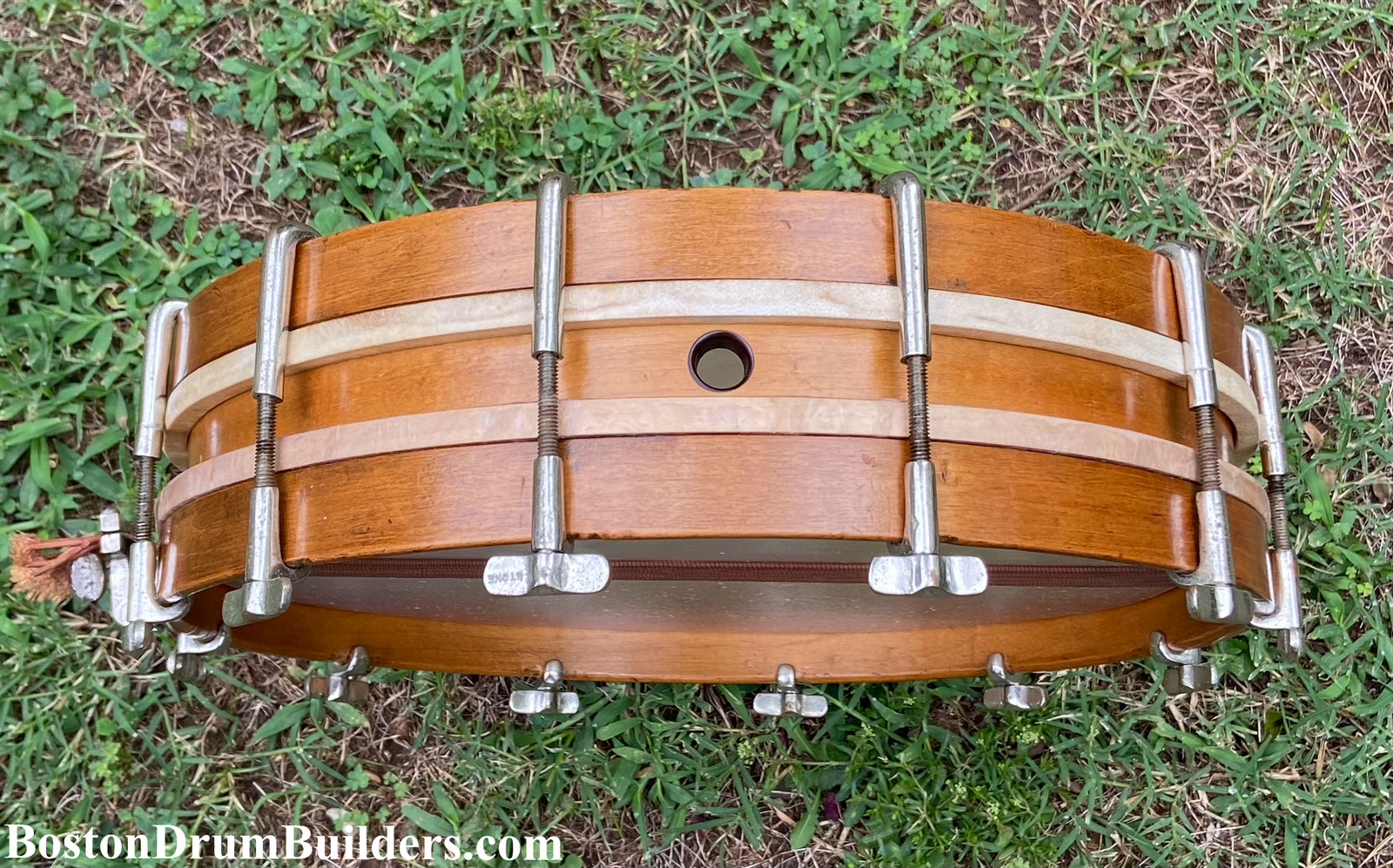
1912 George B. Stone & Son Thumbscrew Rod Orchestra Drum

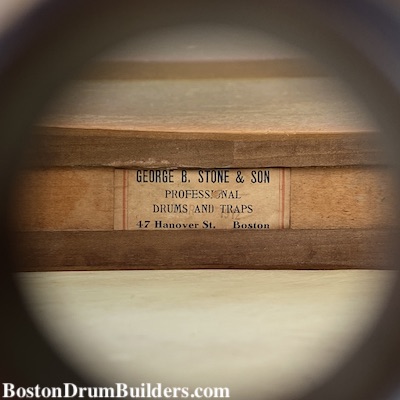
Boston's George B. Stone & Son manufactured a vast number of single tension, thunmbscrew rod drums during the early decades of the 1900s. The paper label inside of this example is date stamped March 1912, roughly a decade before the company reached its zenith.
1912 George B. Stone & Son Thumbscrew Rod Orchestra Drum
Of special interest here is the extremely shallow shell measuring only two inces in depth. The rosewood grommet is cleverly recessed into the shell to prevent it from obstructing the flesh hoops as the heads are tightened.
1912 George B. Stone & Son Thumbscrew Rod Orchestra Drum
1912 George B. Stone & Son Drum Label
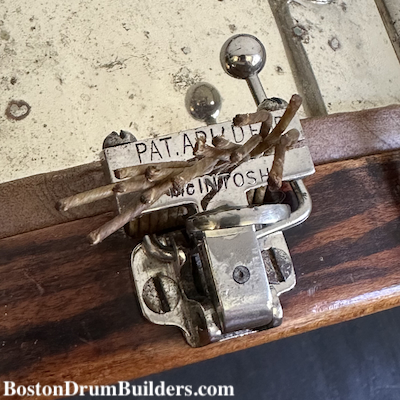
An early version of the Stone Patent Snare Strainer and Muffler is stamped with the inventor's name rather than "Stone" which is common on later examples. As is often the case, the original arm has broken off and gone missing. The original 'flexible waterproof woven' snares, however, remain intact.
McIntosh Snare Mechanism
1912 George B. Stone & Son Thumbscrew Rod Orchestra Drum
Do you have a Stone & Son drum? I would love to hear from you! Feel free to send Lee an email at lee@vinson.net. And for more on George B. Stone & Son and the other turn of the century Boston-based drum makers, please visit BostonDrumBuilders.com or follow us on Instagram: @old_boston_drums.

Wednesday, September 1, 2021

Early 1900s F. E. Dodge Street Drum

Preserving collector grade instruments is one way to honor Boston's drum building past. Another is to recondition and revive survivng examples as playable musical instruments giving voice to those makers who have been lost to time. The early 1900s F. E. Dodge Street Drum seen here is a case of the latter.
Early 1900s F. E. Dodge Snare Drum
F. E. Dodge Drum Label
Upon arrival, this drum was nothing but a shell. Bruised and crudely refinished, there was little remaining value from a collector standpoint other than the large makers label inside. Eventually a suitible conglomerate of parts was sourced and the drum was pieced back together breathing new life into a drum which had been silent for decades.

Rope Drum Ear 
Rope Drum Ear photo from 1907 Dodge Drum Catalogphoto: VintageDrumGuide.com

Cooperman Fife and Drums supplied the leather ears which were then stamped and stained to emulate those typically seen on drums by Dodge and others in Boston around the late 19th and early 20th century. (See above photo from the 1907 Dodge catalog.) Calderwood Percussion supplied the faux hemp rope which provides the strength of modern synthetic rope while giving the visual impression of period correct materials. And the wooden counterhoops and calfskin batter head were taken from a donor drum built many years ago by Eames Drum Shells. The finishng touch, a custom lathed wooden grommet, was made up by Mattoon Drums and Percussion.

McIntosh Snare Strainer
McIntosh Snare Strainer and Muffler as pictured in Stone Catalog K
The hoop mounted snare mechanism is not one originally found on Dodge drums but is an intriguing bit of history in itself. Clearly this is an example of the snare strainer and muffler designed by William F. McIntosh, but there are several inconsistancies between this version and the one typically seen on McIntosh's own drums and those by George B. Stone & Son who used it widely through the 1910s and 1920s. The most obvious difference is the coarse, unbuffed exterior which is devoid of plating. The version present here also shows no signs of having ever had a lever installed.

Do you have an drum made by the F. E. Dodge Company? I would love to see it! Feel free to send Lee an email anytime at lee@vinson.net. And for more on the early 20th century snare drum makers of Boston, Massachusetts please visit BostonDrumBuilders.com or follow @old_boston_drums on instagram.

Saturday, May 1, 2021

Stone Special Thumbscrew Rod Orchestra Drum, early 1910s

Before separate tension snare drums became widely accepted in New England, single tension drums ruled the market. Highly common during the 1910s, particularly in the early part of the decade, were thumbscrew models such as the orchestra drum seen here from Boston's George B. Stone & Son.
1910s George B. Stone Thumbscrew Rod Orchestra Drum
Early 1910s George B. Stone & Son Drum Catalog
The debate between single tension and separate tension was very much an open one around the time this drum was munufactured. George Burt Stone discussed the matter in a 1913 column for Jacobs' Orchestra Monthly and evidently found his own article relevant enough to republish it in George B. Stone & Son "Catalog H" (ca. 1915). Previously, Stone "Catalog G" (ca. 1912) lead off with the "Stone Special" Thumbscrew Rod Drum indicating its signifigance within the Stone product line.

Further inspection of Stone & Son's early catalogs reveal that badges first appeared around the mid 1910s. This characteristic, in addition to the early McIntosh strainer stamped with the inventor's name rather than Stone's, helps date this example to the early 1910s. A leather snare anchor holds the snare wires in place against the bottom counterhoop opposite of the strainer.

Early 1910s Geo. B. Stone Snare Strainer
Early 1910s Geo. B. Stone Snare Anchor
The single-ply maple counterhoops employed here feature a stained outer face recalling a motif often seen on late 19th century drums produced in and around Boston. This look gradually fell out of favor with Stone and others instead opting to use matching colored hoops and shells. A rapid move toward metal counterhoops followed, an evolution which Stone never embraced.

A diminutive makers label, not much larger than a postage stamp, is visible inside the drum. A larger label would not have fit inside the 3" deep, one-ply maple shell.

Upon arrival, the drum was outfitted with a Geo. B. Stone & Son 'Special Transparent' snare side head, a style last offered in Stone Catalog I (ca. 1919). Unfortunatly the head was split beyond repair, so a new skin was tucked onto the existing flesh hoop.

Early 1910s Geo. B. Stone Drum Label
1910s Geo. B. Stone & Son Drum Head
The drum is unfortunately highly out of round and when found was missing several tension rods and claws but is otherwise complete and in very good condition. A classy but simple overall appearance is offset by a polished rosewood grommet adorning the airvent.

The original 'flexible waterproof woven' snare wires are intact and in excellent working order. The sound achieved is something brighter than traditional gut, but darker and drier than coiled wire.

Early 1910s Geo. B. Stone & Son Snare Drum Grommet
Early 1910s Geo. B. Stone & Son Flexible Waterproof Woven Snare Wires

Do you have a Stone & Son drum? I would love to hear from you! Feel free to send Lee an email at lee@vinson.net. And for more on George B. Stone & Son and the other turn of the century Boston-based drum makers, please visit BostonDrumBuilders.com or follow us on Instagram: @old_boston_drums.

Saturday, May 23, 2020

1910s George B. Stone & Son Separate Tension Band Drum

This drum has been in the collection since before the days of the blog and is long overdue for a feature here. It's a nicely restored Separate Tension Band Drum from Boston's George B. Stone & Son. The before and after photos depict the dramatic overhaul.

1910s Stone & Son Band Drum Before RestorationLee's Stone Field Drum After Restoration

The drum was found in southern New Hampshire in 2009 and had been neglected for many years. A poorly applied aftermarket paint job masked the original shellac finish and a crack had developed running a third of the way around the shell. Several pieces of hardware were missing and the slotted tension rods on the bottom side of the drum were caked in mud where the drum had recently been placed on the ground. A thorough restoration was in order.

Paint was stripped from the shell, hoops, and hardware. The shell was sent to Joe McSweeney at Eames Drum Company in Saugus, Massachusetts who repaired the crack. After a light sanding on the wheel at Eames, the very same equipment used by Stone & Son generations ago, the shell and hoops were refinished to closely emulate what would have been the original color. The tube lugs were polished by hand and reinstalled with new mounting hardware as the original screws were badly stripped and rusted. New calfskins were sourced from America's last remaining drumhead tannery, Stern Tanning in Milwaukee, Wisconsin, and tucked onto the existing flesh hoops. The end result is a drum which may not hold as much collector value as an unmolested one, but is highly playable and remains a visually accurate representation of George B. Stone & Son's work.

George B. Stone & Son Drum BadgeGeorge B. Stone & Son Drum Label

Stone's Separate Tension Band Drums were constructed around thin single-ply shells, typically maple, and utilized four reinforcing rings - one at each bearing edge and one underneath each row of tube lug posts. Slotted tension rods attached to single-ply counterhoops using hooks cast from brass or bronze. A simple but functional Stone Patent Snare Strainer and Muffler allowed for the gut snares to be quickly engaged or disengaged from the bottom head.

William F. McIntosh Snare Strainer and MufflerBottom View of Stone Field Drum and Gut Snares

Stone & Son's Catalog K (1925) listed several models aimed at the band and drum corps market but the use of double post tube lugs is unique to the Separate Tension Band Drums. Far more common for this style of drum in the 1910s was the use of thumbscrew rods adjusted by hand from the underside of the drum thereby tuning both heads simultaneously. Catalogued by Stone under many different monikers through the years, sometimes with center posts and sometimes without, the design of these single tension models remained essentially unchanged from the early 1900s through the 1920s and even into the 1930s.

Stone & Son Catalog K - page 9Stone & Son Catalog K - page 13

Do you have a drum made by Geo. B. Stone & Son? I would love to hear about it! Drop Lee a note at lee@vinson.net. And for more on Boston's early 20th century drum makers, please visit BostonDrumBuilders.com.

Monday, July 1, 2019

Who was William F. McIntosh?

William F. McIntosh was a peripheral figure to Boston's early 20th century drum makers. He is likely best known for his patented snare strainer and muffler used widely by George B. Stone & Son and others through the 1910s and into the 1920s. McIntosh's career as a musician and drum maker was consistently interwoven with other lines of work with his drum building endeavors often running concurrent to other employment. Much of his professional life was spent as a machinist, a trade where he would have acquired the skill and knowledge to produce drum components and accessories of his own. McIntosh's later years were spent as a radio repairer and eventually an electrician.

William Francis McIntosh was born February 27th, 1876 in Boston, Massachusetts to parents recently immigrated from Canada. His father William was from Nova Scotia and of Scottish decent. His mother Celina was French Canadian with recent family roots in Ireland. Census records from 1880 show the elder William McIntosh to be a carpenter and his wife Celina as keeping house at 100 Endicott Street in Boston.

Tracing a young William Francis McIntosh through directory listings show him as a clerk at 478 Hanover Street in Boston during the early 1890s when he was still in his teens. Through the late 1890s he is listed as a musician living at 209 Endicott Street in Boston's North End. At the age of 19 he married Sarah Veronica Farren, also 19, on February 17, 1896. Their marriage certificate lists William as a musician and his new bride as a waitress.

The couple would have three children together: Ellen Salina born February 28, 1897, William born September 7, 1898, and John Joseph born March 28th, 1900. The family suffered its share of tragedy with youngest daughter Ellen dying shy of her second birthday in 1898, and Sarah being committed to the Medfield State Asylum by her early 30s. Sarah would remain in care of the State for decades to come with census records listing her there through at least 1940.

Around 1903 the family moved just across the Charles River settling along Elwood Street in Charlestown. While directory listings from this time label McIntosh as a machinist, it was evidently a fruitful period for his drum building ventures as well. Multiple examples of McIntosh drums can be dated to the first decade of the 1900s including orchestra drums and larger parade drums.

1903 William F. McIntosh Orchestra DrumWilliam F. McIntosh Drum, ca. 1903Wm. F. McIntosh Street Drum, ca. 1903

McIntosh Drum Label, ca. 1903Wm. F. McIntosh Makers Label

McIntosh's output as a drum builder was most likely something of a slow trickle with spurts of productivity and spells of inactivity. Directory listings and census records are frequently at odds when naming McIntosh's profession. For example, the 1910 Boston Directory shows him as a machinist while the United States Census taken the same year describes him as a musician working in an orchestra.

McIntosh's manufacturing output was not limited to drums. Accessories including drum sticks and bass drum pedals, and traps such as ratchets and bird whistles were also built and sold. McIntosh makers labels make mention of xylophones and orchestra bells too. His overhead bass drum pedal and patented snare strainer appear in George B. Stone & Son catalogs from the late 1910s raising the possibility that other products were distributed through larger, more established dealers as well. But his overall production was small and sporadic, spread out across decades, making it difficult to definitively date most McIntosh products.

Ratchet by William F. McIntoshBird Whistle by William F. McIntosh              image source: ebay

McIntosh Drumhead Stamp               image source: ebay1928 Advertisement from "100th Anniversary, St. Mary's Church, Charlestown, MA, 1828-1928"

McIntosh's World War I draft card offers a humanizing snapshot of his life in 1918. He is described as tall, medium build, with blue eyes and blond hair. He was then employed as a machinist by the F. M. Tanck Company at 170 Atlantic Avenue in Boston. His parents were by this time deceased and his closest living relative was his wife Sarah who resided at Medfield Hospital, a solemn reminder that he had raised two sons largely on his own. He would however remarry many years later.

Beginning in 1924 McIntosh worked from an address at 33 Main Street in Charlestown, a quick five minute walk from his home at 6 Elwood Street. For the next two years he is listed in city directories as a drum maker perhaps coinciding with a period of renewed focus on drum building. Regardless, by 1926 he is again listed as a radio repairman, a line of work he seems to have mostly kept with before branching out into electrical work towards the end of his life.

While McIntosh eventually turned his attention away from drum making, he remained prone to designing and building things. In 1936 he was granted two patents, one for an electrical receptacle and another for an electrical receptacle plug.


For all the years McIntosh spent supporting himself in other ways, he never stepped away completely from his drums. A 1941 newspaper article tells of McIntosh reclaiming one of his instruments in person at City Hall in Winchester, Massachusetts. The drum, made in 1914, had long sat unused and forgotten by the drummers club for which it was built before the drum was unearthed from a locked wooden box backstage by a custodian. After a write up appeared in the Winchester Star telling of the discovery, McIntosh showed up in person to collect it. Then in his mid 60s, he still held an affinity for the drums he had constructed decades before.

William Francis McIntosh passed away on May 20th, 1950 in Chelsea, Massachusetts and was laid to rest near his mother at Holy Cross in Malden. Perhaps deciding once and for all how he was to be remembered, his death certificate lists his occupation simply as 'musician'.


W. Lee Vinson is a classical percussionist, music educator, and snare drum historian. He is the author of BostonDrumBuilders.com, a website devoted to the late 19th and early 20th century drum makers of Boston, Massachusetts. Lee can be contacted by email at lee@vinson.net.


Sunday, March 3, 2019

1903 William F. McIntosh Orchestra Drum

William F. McIntosh was a peripheral figure to Boston's early 20th century drum making industry. Known best for his Patent Snare Strainer and Muffler, McIntosh also sold drums of his own making such as this orchestra drum dating from July of 1903.

1903 William F. McIntosh Snare Drum

A drum such as this could easily go unidentified if not for a handwritten makers label applied inside the shell opposite the air grommet. The homemade nature of the label is odd if not suspicious given that other extant McIntosh drums from the same era bear printed makers labels. There is, however, reasonable cause to assume that this drum was indeed from the hands of William F. McIntosh such as the strong resemblance it shares with a known 1903 parade drum.

The snare mechanism is an early Stromberg design which was patented in 1904. The parts are stamped "PAT. PDG.", or patent pending, which would suggest the hardware present here was minted sometime after Stromberg's patent was applied for on July 20, 1903 and before the time it was granted on April 5, 1904.

1903 William F. McIntosh Drum LabelCharles A. Stromberg Snare Strainer

Turn of the century drums were by their very nature experimental. This drum is no exception as the peculiarities abound. The shell measures just under 4 1/2" inches deep. Why choose 4" or 5" when only 4 1/2" will do? An oversized polished rosewood grommet is normal enough though it is installed somewhat off center sitting slightly closer to the bottom edge of the shell than the top. What was the need for this? And curiously, the bottom reinforcing ring is much more narrow than the top. Perhaps this was an oversight due to haste, or could there have been some logic behind the decision? These questions remain unanswered.


More quandaries arise after a look inside the drum. Several carefully cut wooden panels have been applied inside the shell, one each backing the snare mechanism and butt, and another at what appears to be a crack or weak point in the shell. It is unclear whether these are original to the drum or if they were later additions or repairs. The snare strainer and butt have been removed and then reinstalled in slightly different positions necessitating a little bit of added support seeing as they are attached using only wood screws. Scraps of paper poke out from behind the panel which backs the snare mechanism, but why?

Charles A. Stromberg Snare Butt1903 William F. McIntosh Snare Drum

Peculiarities in all, there is an admirable simplicity to the drum in appearance and function. It is not excessively designed or over complicated. Stromberg's snare mechanism which McIntosh chose to employ is forward thinking yet basic. And the tensioning hardware, modern as it may have been for the turn of the century, is uncomplicated and efficient. Not that McIntosh can be credited for any of the subtle advances in drum making technology on display with this instrument, but he was at the very least keeping up with the changing times. One is left to wonder what could have become of him had he spent a lifetime devoted to drum building. McIntosh's career would later pivot towards radio sales and repair, a far cry from his drum making endeavors of the early 1900s.

Do you have a drum made by William F. McIntosh? I would love to hear about it! Feel free to send Lee and email at lee@vinson.net. And for more on the early 20th century snare drum makers of Boston, Massachusetts please visit BostonDrumBuilders.com.


Friday, January 26, 2018

1903 William F. McIntosh Parade Drum

Perhaps best known for his Patent Snare Strainer and Muffler, William F. McIntosh also built drums of his own including this parade drum dating from 1903.

1903 William F. McIntosh Drum

Interestingly, the drum predates McIntosh's patented snare strainer design. The shell bears witness marks indicating that the original snare mechanism was of a design by Charles A. Stromberg. Only later was it removed and replaced by a McIntosh snare strainer which mounts to the snare side counterhoop. The original Stromberg butt end, however, remains in place and is stamped with the wording "PAT PDG", or patent pending. Stromberg's patent was granted in April of 1904 so the piece installed here must have been produced before that date. This makes sense as the drum appears to have been built in 1903.


The label is nicely preserved and reads: "Made by / Wm. F. McINTOSH / Manufacturing Drummer / High Grade / Drums, Traps and Drum Findings / Professional Xylophones and Orchestra Bells a Specialty / 6 Elmwood St., Charlestown, Mass." Handwritten on the upper right hand corner of the label is the date May 18, 1903 and the name Harry Cade. The date is scribed again in bold ink on the drum shell just above the label. While the handwriting in both cases is less than official looking, the date does seem to correspond precisely with the point in time when the drum was likely produced.

The snare wires are of an unusual design. The end of each strand is made from linen cord while the length that contacts the snare side head is made from coiled wire. It is a clever combination of materials where the linen chord provides flexibility for easier mounting while the coiled wire offers a brighter sound quality. And unlike natural gut, the more commonly used material for snare wires on larger drums, McIntosh's snares are not susceptible to changes in temperature or humidity.

Harry Folsom Cade (b. April 5, 1879) figures to be the original owner owner of the drum. The 1910 Census lists Cade as an orchestra musician living at 4 Warwick Park in Cambridge, MA with a wife and son. It is entirely plausible that a 24 year old Cade would have purchased the drum new from McIntosh in 1903. And Cade very well may have taken the drum back to McIntosh a few years later to have the snare strainer replaced. The two men lived less than five miles apart.

Whatever use the drum served for Cade and successive owners, it is a powerful instrument which would have been ideal for parading down the avenue with a drum corp, or possibly keeping the beat behind a large concert band or orchestra when a military type sound was desired. The drum has held up well for more than 114 years with only minor repairs. A gentle cleaning and a new snare side head now have this drum in very good condition for display.

Do you have a drum made by William F. McIntosh? I would love to hear about it! Feel free to send Lee and email at lee@vinson.net.