Showing posts with label Master-Model. Show all posts

Tuesday, November 1, 2022

The Last of the Master-Models

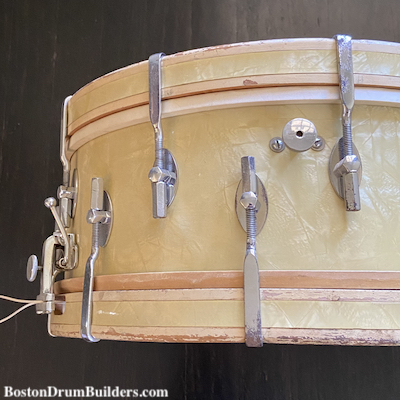
Boston's George B. Stone & Son manufactured more than 800 Master-Model Drums between the early 1920s and late 1930s. Over nearly two decades of production, many aspects of these instruments evolved making it possible to date most examples with some degree of accuracy. The final generation of Master-Models, those which date from the mid to late 1930s, displays several distinguishing characteristics.

Serial Numbers and Makers Labels

Master-Model drums dating from the mid to late 1930s have serial numbers in the mid 9000 range. Around serial number 9000, with nearly 700 Master-Models having already been manufactured, Stone ran out of makers labels the style of which had been in use since January of 1922. Rather than having new labels printed, the factory began using up old stock inclduing repair labels. For this reason, drums produced in the 1930s sometimes have labels matching pre-serial number drums from the late 1910s. In cases where repair labels are used in place of makers labels, the wording is often altered using ink stamps or pencil markings.

late 1910s Geo. B. Stone & Son Label
Geo. B. Stone & Son Label with 1930s Serial Number
Edited Stone & Son Repair Label          image source: Reverb
Edited Stone & Son Repair Label

Washers

Another telltale sign of late production Master-Models is the use of blank oval washers instead of those stamped "STONE & SON / BOSTON MASS". Unstamped washers began appearing on drums with serial numbers in the mid 9500 range.

early 1920s - mid 1930s
mid to late 1930s

Leedy Tone Controls

Often mistaken for an aftermarket addition, factory installed Leedy tone controls are common on Master-Model drums of the mid to late 1930s. Stone's use of tone controls roughly coincides with the introduction of blank washers on drums with serial numbers in the mid 9500 range.

Ten Lug Configurations

The use of ten tenioners per head, as opposed to twelve, becomes common on extremely late production Master-Models with serial numbers in the 9600 range. Ten lug models account for only the last few dozen drums manufactured around the late 1930s.

Other Characteristics

Though not exclusive to the final generation of Master-Models, later examples are more likely to feature pyralin wrapped finishes, deeper shell sizes and chrome plated hardware. Wrapped finishes are included in Stone & Son pricelists as early as 1928 and begin appearing on drums with serial numbers in the low 8000s. Chrome plating, which is not mentioned in Stone & Son's 1932 pricelist, does appear as an option in Booklet "L" published around 1935 suggesting this became an option sometime in the early-mid 1930s. Deeper shell sizes begin appearing on Master-Model drums with serial numbers in the mid 8000 range. Despite being cataloged in only one size (initially 5 1/4" x 14" and later 5"x14") deeper drums account for about 10% of Master-Models produced.

Do you have a Stone & Master-Model? I would love to hear from you! Feel free to drop Lee an email at lee@vinson.net. And for more on the early 20th century snare drum makers of Boston, Massachusetts please visit BostonDrumBuilders.com or follow @old_boston_drums on instagram.

Wednesday, December 1, 2021

1922 George. B. Stone & Son "All-Weather Drum"

First advertised in 1922 as the "All-Weather Drum", George B. Stone & Son's newly introduced flagship snare drum was renamed the "Master-Model Drum" later that year. Described as a "Combination Dance and Theater Model", the All-Weather Drum was initially offered in only one size, 5 1/4" x 14". The example shown here dating from August of 1922 precedes the adoption of the Master-Model name.
1922 Geo. B. Stone & Son All-Weather Drum
There are several characteristics of the All-Weather Drum which distinguish it from the vast majority of the more than 800 Master-Models produced from the early 1920s through the late 1930s. The earliest shells such as this one are formed from single-ply maple with a series of four reinfircing rings which span the entire depth of the shell. By mid-1923 this design would be supplanted a 3-ply, 5/8" thick maple shell which was used on all Master-Models and Separate Tension Orchestra Drums moving forward.

Geo. B. Stone Advertisement, September 1922
Geo. B. Stone & Son Advertisement, September 1922
Geo. B. Stone Advertisement, December 1922
Geo. B. Stone & Son Advertisement, December 1922

Most Stone drums of this era feature a metal badge affixed to the batter side counterhoop. Interestingly, while this drum has a makers label with a strong date stamp and serial number, it has no badge. This is likely because Stone was in the process of changing over from an older version to a newer badge which included lettering noting their recent incopration. Also, the Master-Model specific badges installed on most examples had not yet been introduced. While there are pencil markings present inside of the shell and underneath the counterhoops, they are not consistent with the numbering system later used by Stone to keep track of the total number of Master-Model drums produced.
Antique George B. Stone & Son All-Weather Drum
1922 Geo. B. Stone & Son Makers Label
The drum features an elongated, inverted version of William F. McIntosh's Patent Snare Strainer and Muffler which was standard on all Master-Model drums. The butt end seen here is patented design by Charles A. Stromberg which was used on Master-Model drums until about 1925.
Stone Patent Snare Strainer and Muffler
Charles A. Stromberg Snare Anchor
Do you have a drum made by Geo. B. Stone & Son? I would love to hear about it! Feel free to drop Lee an email at lee@vinson.net. And for more on the early 20th century snare drum makers of Boston, Massachusetts please visit BostonDrumBuilders.com or follow @old_boston_drums on instagram.

Sunday, August 1, 2021

Not a Master-Model

You can't judge a book by its cover. And in this case, you can't judge a drum by its badge. Regardless of what it says, this is not a Master-Model.
The mid-1930s were a time of resourcefulness and transition for Boston's George B. Stone & Son. With vaudeville theaters converting over to movie houses and the Great Depression taking it's toll, George Lawrence Stone began pouring more energy into teaching and gradually moved away from manufacturing.

It was during this period that Stone & Son mailed out their last known catalog, a sixteen-page, black and white booklet of recycled photographs illustrating a significantly stripped down product line. The iconic Master-Model drum is still spotlighted on the cover and in the opening pages, and several varieties of military drums are also offered, but no Master-Model field drum is mentioned. Serial numbers in the 9300 range are known to have been in use in late 1935 meaning that the drum seen here was likely produced in 1936 - the same year 'Booklet L' was distrubuted.

The drum is simple in construction featuring a thin, single ply maple shell with three reinforcing rings - one at each edge and a third underneath the tuning rod posts. The single-ply maple counterhoops and single tension thumbrods are virtually unchanged from those used two decades earlier. While single tension tuning systems and wooden counterhoops would remain in use into the mid 20th century, they were often indicative of lower priced models. Professional level drums dating from the same era commonly utilized separate tension tube lugs and metal counterhoops, features which had been in use since the 1920s.

Rather then evolve, Stone continued to equip drums with the 'Stone Patent Snare Strainer and Muffler' patented in 1909 by William F. McIntosh. As is typical for Stone, the snares are held in place opposite the strainer by a simple anchor. More advanced snare mechanisms were certainly available by the mid 1930s, but Stone's decision not to modernize is again evident here. But the most obvious indication of where this instrument fits within the timeline of Stone's manufacturing prowess is the use of a Master-Model badge on a drum which is clearly NOT a Master-Model.

Do you have a drum made by Geo. B. Stone & Son? I would love to hear about it! Feel free to drop Lee an email at lee@vinson.net. And for more on the early 20th century snare drum makers of Boston, Massachusetts please visit BostonDrumBuilders.com or follow @old_boston_drums on instagram.

Sunday, August 4, 2019

1925 Geo. B. Stone & Son Master-Model Drum

More than 800 Master-Model drums were produced by Boston's George B. Stone & Son between 1922 and the late 1930s. A wide variety of finishes were offered from black lacquer to white lacquer, and natural maple to marine pearl and sparkling pyralin wrap. But the most commonly seen configuration is the ever classy black lacquer with nickel plated hardware.

1925 George B. Stone & Son Master-Model Drum

Not every surviving drum can be a gem. The one featured here is a weathered example having sustained its share of bumps and bruises over the decades yet its three ply shell is no less strong and in round despite the obvious cosmetic flaws. The typical Master-Model badge is affixed to the top counterhoop positioned just above the air vent adorned with a ridged synthetic grommet.


The paper label applied inside of the shell is stamped with a four digit serial number per usual but lacks a detectable date stamp. Curiously, a second label hides underneath. The second label, mostly obscured from view, does bear a date stamp though it is not completely legible. But by referencing other dated examples, this drum can be pinpointed to the early months of 1925.

Workers at the Stone factory were keeping a running tally of each Master-Model produced. Pencil markings found inside of the shell and underneath the counterhoops identify this drum as the 334th Master-Model to be produced.


Do you have a Stone Master-Model? I'd love to hear from you! Feel free to send Lee an email at lee@vinson.net. And for more on George B. Stone & Son and the other early 20th century drum manufacturers of Boston, Massachusetts, please visit BostonDrumBuilders.com.


Wednesday, December 19, 2018

Geo. B. Stone & Son Silver Sparkle Pyralin Master-Model

Christmas came early this year with the arrival of a very special drum earlier this Fall, a circa late 1920s George B. Stone & Son Master-Model drum in sparkling silver pyralin wrap.

Geo. B. Stone & Son Master-Model Snare Drum

Stone & Son offered a "Pyralin" Master Model at least as early as 1928. Aside from sliver sparkle, surviving examples are known to exist in gold sparkle and white marine pearl. Much more common however are drums featuring a natural maple finish or the ubiquitous black lacquer. The factory original silver sparkle wrap applied here is a very fine pattern which has mellowed slightly over the years to a subtly warmer hue. Depending on the lighting it can appear more gold or copper like in color, or at times even greenish.


No doubt this was a special drum to roll off the assembly line as extra care was taken in other ways besides the addition of the silver sparkle wrap. For one, the shell interior was finished with a clear coat of lacquer, a characteristic highly atypical of Stone & Son who normally left the inside of their shells unfinished and occasionally even rough.


The badge and label present here are typical of late 1920s Master-Models. Stone ceased date stamping their makers labels sometime in 1925 so we are left to guesstimate the exact age of this drum. The Master-Model number is penciled inside of shell just below the air vent, and also stamped into the underside of the counterhoops.


Do you have a Stone Master-Model? I'd love to hear from you! Feel free to send Lee an email anytime at lee@vinson.net. And for more on George B. Stone & Son and the other early 20th century drum manufacturers of Boston, Massachusetts, please visit BostonDrumBuilders.com.

Thursday, December 1, 2016

ca. 1936 George B. Stone & Son White Marine Pearl Master-Model Drum

One drum could never tell the complete story of a company whose life spanned decades, but the drum featured here could write its own chapter on both what could have been, and what had become of Boston's George B. Stone & Son by the late 1930s. Clearly, the potential existed for Stone & Son to have remained a respected manufacturer of professional level drums. The craftsmanship is proof of this. Yet rather than evolve with the times, George Lawrence Stone had chosen his company's fate. Having never fully modernized its production capabilities or instrument designs, Stone & Son was being left in the dust.

Very little had changed about the Geo. B. Stone & Son Master-Model drums since they were first introduced in 1922. Through the 1920s and into the 1930s, the industry had completely passed Stone by. While Leedy, Ludwig, and Slingerland had all moved to double post tube lugs, metal counterhoops, and state of the art snare mechanisms, Stone continued to use an impractical tuning system, wooden counterhoops, and a snare throw-off patented in 1909.

What is so stunning about this mid-late 1930s Master-Model aside from the brilliant chrome plated hardware and white marine pearl wrap, is just how well the whole instrument is constructed. There is absolutely nothing shoddy about the execution, nothing lacking in the way of quality workmanship to hint at Stone's long fading prowess as a drum builder.

1936 George B. Stone & Son Master-Model Drum

Smaller details about the drum do indicate that the end was near for Stone. The label fixed to the inside of the shell is actually a repair label. Faintly ink-stamped across the top of the label is the word "Manufactured". This is a clear sign that Stone was no longer producing a high volume of drums and that their priorities had shifted towards repair and maintenance of existing instruments. That a repair label rather than a manufacturers label was used on such a high end drum as this one speaks volumes about how late in the life of Geo. B. Stone & Son this drum was produced.

Stone did apparently have a few Master-Model badges left sitting around the shop, albeit the silver variety as opposed to the typical bronze badges with a recessed blackened background. The silver version applied here was typically reserved for special drums such as pearl wrapped models and the rare all-metal Master-Models.

Late 1930s George B. Stone & Son Drum Label

Late 1930s George B. Stone & Son Drum Label

Geo. B. Stone Master-Model Drum Badge

George B. Stone & Son Master-Model Drum Badge


There are a few interesting differences between this example and earlier Master-Model drums. The most dramatic is the use of ten 'lugs' per side (20 total) as opposed to twelve (24 total). Anything other than a twenty-four lug Master-Model is almost unheard of, the notable exception being the aforementioned all-metal Master-Models which employed metal counterhoops and only eight lugs per side.

Another subtle but profound difference here is the use of washers which lack the usual "STONE & SON / BOSTON MASS" stamping. This suggests that Stone's builders had run out of stamped washers and did not expect to churn out enough more Master-Models to warrant having another batch of washers made up with the Stone imprint.

Stone Master-Model Nuts and Washers ca. mid 1920s - mid 1930s

Stone Master-Model Nuts and Washers ca. mid 1920s - mid 1930s

Stone Master-Model Nuts and Washers ca. late 1930s

Stone Master-Model Nuts and Washers ca. late 1930s


Small signs of Stone keeping up with the times are evident in the use of chrome plating, and with the factory installation of a Leedy tone control. Ludwig and Leedy, both owned by Conn at this time, had begun installing tone controls on snare drums beginning in the early-mid 1930s.

It should also be noted that wrapped examples of Stone Master-Model drums are quite scarce. Most Master-Models featured a black lacquer finish. Next most common is a natural maple finish. A "Pyralin Master-Model" was offered as early as 1928, but the number of existing wrapped drums suggests that they were produced only in small numbers, likely on a custom order basis. These were expensive drums after all. A 1932 price list offered the Pyralin Master-Model for $50 which equates to more than $800 today.

As is typical for Stone, the four digit serial number is both imprinted inside of the shell and ink-stamped onto the label. A serial number in the 9600 range places this drum around 1936. A three digit Master-Model number is also stamped inside of the shell in a smaller font. The number, 820, is extremely high, the highest among more than four dozen other recorded examples again confirming just how late this drum was produced.

Stone Serial Number

George B. Stone & Son Serial Number

Stone Master-Model Number

Stone Master-Model Number


Most earlier Stone drums including Master-Models would have been outfitted with individual strands of snappy wire, wire wound silk, or natural gut. This being a drum from the late 1930s, the James Snappy Wires installed on the drum at present may well be original. New calfskin heads bring this drum back right back to 1936, just before Stone & Son was done for good.

Do you have a Stone Master-Model? I would love to hear about it! Shoot Lee an email at lee@vinson.net. And for more on George B. Stone & Son and all of the early 20th century drum makers of Boston, Massachusetts, please visit BostonDrumBuilders.com.



Saturday, October 15, 2016

Johnny Williams' Stone Master-Models

John Francis Williams, popularly known as Johnny Williams, was born in Watertown, Massachusetts on November 15th, 1905. If the name rings a bell, it may be because he was the father of famed film composer John Williams. The elder Williams became a well known drummer in the 1930s through his work with the CBS Radio Orchestra in New York and then with the famed Rayomnd Scott Quintet.

The oddly named six-piece group was assembled in late 1936 and was highly prolific from 1937 - 1939. Scott would go on to form and lead a variety of ensembles under different names through the 1940s and into the 1950s (some of which involved Williams) and was the regular orchestra leader on classic 1950s television show Your Hit Parade. But Scott's earliest fame came with his original 'quintet' and their late 1930s studio recordings of such songs as "Powerhouse", "Twilight in Turkey", and the highly recognizable "The Toy Trumpet".

As a member of the Raymond Scott Quintet, Johnny Williams appeared in several Hollywood films during the late 1930s including Rebecca of Sunnybrook Farm (1938) starring Shirley Temple. The Scott Quintet's involvement was apparently significant enough that the musical group was featured along with Temple in photographs promoting the movie. The handsome fellow at bottom left of the below picture sharing a glance with Shirley Temple is none other than Johnny Williams with his Stone Master-Model drum.


Whether or not Williams played the same drum on the Raymond Scott Quintet recordings, we may never know. But clearly Williams had an affection for Stone snare drums as he appears in many other photographs from the same time period with Master-Model drums at the center of his outfit. And he must have had more than one because pictures show Williams with Master-Model drums in at least two colors - likely white marine pearl, and black diamond pearl.


By 1939 Johnny Williams had signed on with the larger, more modern Leedy Drum Company. Most signs point to George B. Stone & Son being all but out of the manufacturing business by the late 1930s anyhow so it's surprising that Williams stuck with Stone as long as he did. As George Lawrence Stone had begun to devote his attention almost entirely to his drum school and related activities such as teaching and writing, Stone & Sons' drum making interests faded. So Williams' move to a company that could more readily supply his needs was a logical one. Leedy must have been proud of their new endorser as they touted him prominently on the cover of Leedy Drum Topics #28 in October 1939.


Do you have a George B. Stone & Son Master-Model drum? I would love to hear about it! Drop Lee a note at lee@vinson.net. And for more on Boston's early 20th century drum makers, please visit BostonDrumBuilders.com.

Saturday, April 2, 2016

Blond Master-Model with Provenance

Boston's George B. Stone & Son produced more than 800 Master-Model Drums after its introduction as the company's flagship snare drum offering in 1922. The most commonly applied finish is what Stone cataloged as "Black De Luxe". Second most common is the natural maple finish seen here.

Geo. B. Stone & Son Catalog K (1925)George B. Stone & Son - Catalog K, 1925
Geo. B. Stone & Son Master-Model DrumGeorge B. Stone & Son Master-Model Drum

Stone & Son heralded their Master-Model as "The Ace of All Orchestra Drums" proclaiming that it was "easiest playing and best tone snare drum in the world." The three ply maple shell, a feature unique to Stone at that time, was "guaranteed not to split, warp, or crack." Describing how the drum was set up before leaving the factory, Catalog K (1925) states "Both heads are of the most durable, first quality calf, specially selected and treated to withstand dampness" and that "Each Master-Model is equipped with snare strainer and muffler attachment of a new design, also the best coiled wire snares". True to Stone's intentions, the original snare wires and new calfskin heads adorn this example. And note the small metal tab attached to the strainer which keeps the knob securely in place - a small piece which frequently goes missing or is removed and misplaced.

Stone Master-Model Snare StrainerStone Master-Model Snare Butt

Equally as interesting as the period correct setup is the provenance associated with this drum. So often the story is lost over the decades of who originally owned the drum. In this case however, we can trace ownership all the way back to the beginning because the drum remained with the family for nearly 90 years before it was purchased from the owner's granddaughter.

Ernest Rhys Llewellyn was born in Auburn, Massachusetts on July 2, 1888. A patent attorney by trade, Llewellyn was also something of an inventor himself receiving three patents for designs of his own pertaining to locking screws and a power transmitting mechanism. According to his family, he was also an architect, a Free Mason, an award winning field dog breeder, a small arms instructor for the U. S. Coast Guard during the second World War, and at one time owned an office equipment retail store in Manchester, New Hampshire. And somehow in addition to all of this, he apparently found time to play drums.

Mr. Llewellyn lived out his later years in Arlington, Massachusetts, his possessions eventually ending up in a wooden shipping crate relegated to the basement for storage after his death. His timpani were long ago donated to a local Massachusetts high school, and his snare drum has now found its way into the author's personal collection. As a nice touch, included with the drum were several pairs of sticks complete bearing the etched initials of Llewellyn's granddaughter who briefly played the drum as a junior high school student.


Do you have a drum made by George B. Stone & Son? I'd love to hear from you! Feel free to send Lee an email anytime at lee@vinson.net. And for more on George B. Stone & Son Inc. and the other early 20th century drum manufacturers of Boston, Massachusetts, please visit BostonDrumBuilders.com.
Ernest Rhys Llewellyn