Showing posts with label Stone. Show all posts

Tuesday, October 1, 2024

Stone Separate Tension Orchestra Drum, ca. mid 1910s

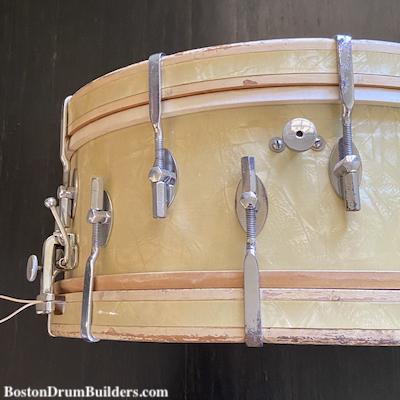
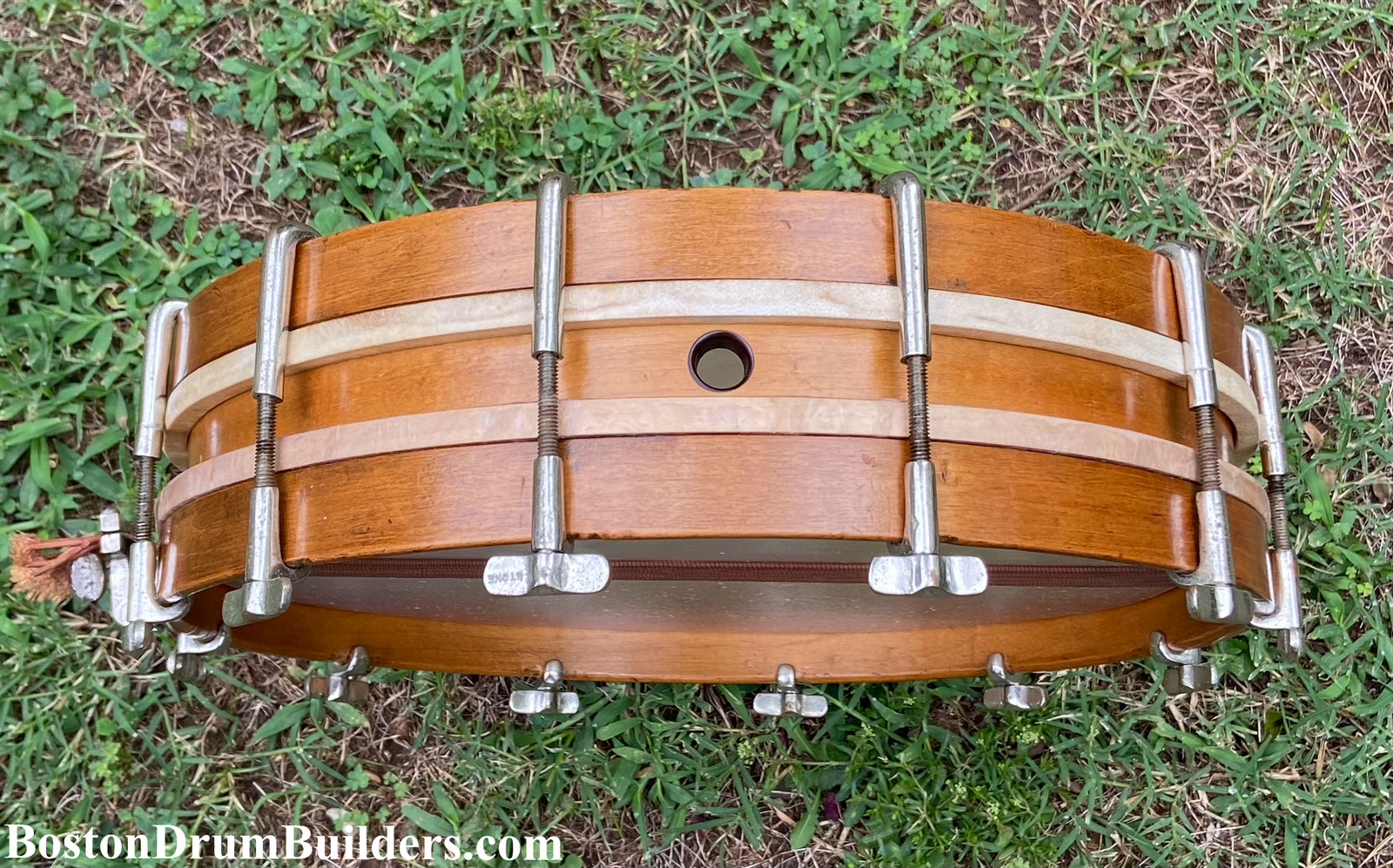
The Separate Tension Orchestra Model was George B. Stone & Son's premier snare drum offering through the 1910s and into the early 1920s. The example featured here, dating from the early to mid 1910s, is typical in many ways but quite uncommon in others. Immediately noticeable is something not often seen from Stone & Son - a mahogany shell.
mid 1910s George B Stone and Son Separate Tension Snare Drum
The overwhelming majority of Stone drums feature maple shells. Mahogany, however, as well as oak and walnut were offered in early Stone catalogs including Catalog H, circa 1915. By the time Catalog I was published in 1919, only maple was listed.

Also in contrast with later Stone drums is the recessed rosewood grommet intended to prevent obstructing the flesh hoops as the heads are tightened. Lastly, the single-ply maple counterhoops are stained around the outer face to approximate the color of mahogany.

Stone Catalog H circa 1915
mid 1910s George B Stone and Son Separate Tension Snare Drum
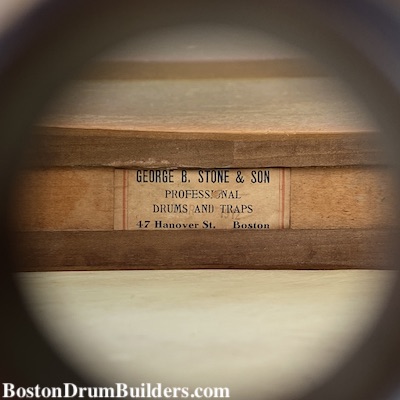
Though badly torn, an original Stone "SPECIAL TRANSPARENT" snare side head remains intact. A well-preserved makers label inside the drum is consistent with other Stone drums from the early to mid 1910s. The drum has no metal badge as the practice had not yet been adopted by Stone & Son.
George Stone drumhead stamp
mid 1910s George Stone drum makers label
The snare mechanism is William F. McIntosh's 1909 patent snare strainer and muffler and the original "Wire Wound Waterproof Snares" are held in place on the opposite side by a simple leather anchor.
mid 1910s George B Stone and Son Separate Tension Snare Drum
Do you have a Geo. B. Stone & Son drum? I would love to hear from you! Feel free to email Lee at lee@vinson.net. And for more on Stone and the other turn of the century Boston-based drum makers, please visit BostonDrumBuilders.com or follow @old_boston_drums on Instagram.

Tuesday, November 1, 2022

The Last of the Master-Models

Boston's George B. Stone & Son manufactured more than 800 Master-Model Drums between the early 1920s and late 1930s. Over nearly two decades of production, many aspects of these instruments evolved making it possible to date most examples with some degree of accuracy. The final generation of Master-Models, those which date from the mid to late 1930s, displays several distinguishing characteristics.

Serial Numbers and Makers Labels

Master-Model drums dating from the mid to late 1930s have serial numbers in the mid 9000 range. Around serial number 9000, with nearly 700 Master-Models having already been manufactured, Stone ran out of makers labels the style of which had been in use since January of 1922. Rather than having new labels printed, the factory began using up old stock inclduing repair labels. For this reason, drums produced in the 1930s sometimes have labels matching pre-serial number drums from the late 1910s. In cases where repair labels are used in place of makers labels, the wording is often altered using ink stamps or pencil markings.

late 1910s Geo. B. Stone & Son Label
Geo. B. Stone & Son Label with 1930s Serial Number
Edited Stone & Son Repair Label          image source: Reverb
Edited Stone & Son Repair Label

Washers

Another telltale sign of late production Master-Models is the use of blank oval washers instead of those stamped "STONE & SON / BOSTON MASS". Unstamped washers began appearing on drums with serial numbers in the mid 9500 range.

early 1920s - mid 1930s
mid to late 1930s

Leedy Tone Controls

Often mistaken for an aftermarket addition, factory installed Leedy tone controls are common on Master-Model drums of the mid to late 1930s. Stone's use of tone controls roughly coincides with the introduction of blank washers on drums with serial numbers in the mid 9500 range.

Ten Lug Configurations

The use of ten tenioners per head, as opposed to twelve, becomes common on extremely late production Master-Models with serial numbers in the 9600 range. Ten lug models account for only the last few dozen drums manufactured around the late 1930s.

Other Characteristics

Though not exclusive to the final generation of Master-Models, later examples are more likely to feature pyralin wrapped finishes, deeper shell sizes and chrome plated hardware. Wrapped finishes are included in Stone & Son pricelists as early as 1928 and begin appearing on drums with serial numbers in the low 8000s. Chrome plating, which is not mentioned in Stone & Son's 1932 pricelist, does appear as an option in Booklet "L" published around 1935 suggesting this became an option sometime in the early-mid 1930s. Deeper shell sizes begin appearing on Master-Model drums with serial numbers in the mid 8000 range. Despite being cataloged in only one size (initially 5 1/4" x 14" and later 5"x14") deeper drums account for about 10% of Master-Models produced.

Do you have a Stone & Master-Model? I would love to hear from you! Feel free to drop Lee an email at lee@vinson.net. And for more on the early 20th century snare drum makers of Boston, Massachusetts please visit BostonDrumBuilders.com or follow @old_boston_drums on instagram.

Thursday, September 1, 2022

1912 George B. Stone & Son Thumbscrew Rod Orchestra Drum

Boston's George B. Stone & Son manufactured a vast number of single tension, thunmbscrew rod drums during the early decades of the 1900s. The paper label inside of this example is date stamped March 1912, roughly a decade before the company reached its zenith.
1912 George B. Stone & Son Thumbscrew Rod Orchestra Drum
Of special interest here is the extremely shallow shell measuring only two inces in depth. The rosewood grommet is cleverly recessed into the shell to prevent it from obstructing the flesh hoops as the heads are tightened.
1912 George B. Stone & Son Thumbscrew Rod Orchestra Drum
1912 George B. Stone & Son Drum Label
An early version of the Stone Patent Snare Strainer and Muffler is stamped with the inventor's name rather than "Stone" which is common on later examples. As is often the case, the original arm has broken off and gone missing. The original 'flexible waterproof woven' snares, however, remain intact.
McIntosh Snare Mechanism
1912 George B. Stone & Son Thumbscrew Rod Orchestra Drum
Do you have a Stone & Son drum? I would love to hear from you! Feel free to send Lee an email at lee@vinson.net. And for more on George B. Stone & Son and the other turn of the century Boston-based drum makers, please visit BostonDrumBuilders.com or follow us on Instagram: @old_boston_drums.

Wednesday, December 1, 2021

1922 George. B. Stone & Son "All-Weather Drum"

First advertised in 1922 as the "All-Weather Drum", George B. Stone & Son's newly introduced flagship snare drum was renamed the "Master-Model Drum" later that year. Described as a "Combination Dance and Theater Model", the All-Weather Drum was initially offered in only one size, 5 1/4" x 14". The example shown here dating from August of 1922 precedes the adoption of the Master-Model name.
1922 Geo. B. Stone & Son All-Weather Drum
There are several characteristics of the All-Weather Drum which distinguish it from the vast majority of the more than 800 Master-Models produced from the early 1920s through the late 1930s. The earliest shells such as this one are formed from single-ply maple with a series of four reinfircing rings which span the entire depth of the shell. By mid-1923 this design would be supplanted a 3-ply, 5/8" thick maple shell which was used on all Master-Models and Separate Tension Orchestra Drums moving forward.

Geo. B. Stone Advertisement, September 1922
Geo. B. Stone & Son Advertisement, September 1922
Geo. B. Stone Advertisement, December 1922
Geo. B. Stone & Son Advertisement, December 1922

Most Stone drums of this era feature a metal badge affixed to the batter side counterhoop. Interestingly, while this drum has a makers label with a strong date stamp and serial number, it has no badge. This is likely because Stone was in the process of changing over from an older version to a newer badge which included lettering noting their recent incopration. Also, the Master-Model specific badges installed on most examples had not yet been introduced. While there are pencil markings present inside of the shell and underneath the counterhoops, they are not consistent with the numbering system later used by Stone to keep track of the total number of Master-Model drums produced.
Antique George B. Stone & Son All-Weather Drum
1922 Geo. B. Stone & Son Makers Label
The drum features an elongated, inverted version of William F. McIntosh's Patent Snare Strainer and Muffler which was standard on all Master-Model drums. The butt end seen here is patented design by Charles A. Stromberg which was used on Master-Model drums until about 1925.
Stone Patent Snare Strainer and Muffler
Charles A. Stromberg Snare Anchor
Do you have a drum made by Geo. B. Stone & Son? I would love to hear about it! Feel free to drop Lee an email at lee@vinson.net. And for more on the early 20th century snare drum makers of Boston, Massachusetts please visit BostonDrumBuilders.com or follow @old_boston_drums on instagram.

Sunday, August 1, 2021

Not a Master-Model

You can't judge a book by its cover. And in this case, you can't judge a drum by its badge. Regardless of what it says, this is not a Master-Model.
The mid-1930s were a time of resourcefulness and transition for Boston's George B. Stone & Son. With vaudeville theaters converting over to movie houses and the Great Depression taking it's toll, George Lawrence Stone began pouring more energy into teaching and gradually moved away from manufacturing.

It was during this period that Stone & Son mailed out their last known catalog, a sixteen-page, black and white booklet of recycled photographs illustrating a significantly stripped down product line. The iconic Master-Model drum is still spotlighted on the cover and in the opening pages, and several varieties of military drums are also offered, but no Master-Model field drum is mentioned. Serial numbers in the 9300 range are known to have been in use in late 1935 meaning that the drum seen here was likely produced in 1936 - the same year 'Booklet L' was distrubuted.

The drum is simple in construction featuring a thin, single ply maple shell with three reinforcing rings - one at each edge and a third underneath the tuning rod posts. The single-ply maple counterhoops and single tension thumbrods are virtually unchanged from those used two decades earlier. While single tension tuning systems and wooden counterhoops would remain in use into the mid 20th century, they were often indicative of lower priced models. Professional level drums dating from the same era commonly utilized separate tension tube lugs and metal counterhoops, features which had been in use since the 1920s.

Rather then evolve, Stone continued to equip drums with the 'Stone Patent Snare Strainer and Muffler' patented in 1909 by William F. McIntosh. As is typical for Stone, the snares are held in place opposite the strainer by a simple anchor. More advanced snare mechanisms were certainly available by the mid 1930s, but Stone's decision not to modernize is again evident here. But the most obvious indication of where this instrument fits within the timeline of Stone's manufacturing prowess is the use of a Master-Model badge on a drum which is clearly NOT a Master-Model.

Do you have a drum made by Geo. B. Stone & Son? I would love to hear about it! Feel free to drop Lee an email at lee@vinson.net. And for more on the early 20th century snare drum makers of Boston, Massachusetts please visit BostonDrumBuilders.com or follow @old_boston_drums on instagram.

Saturday, May 1, 2021

Stone Special Thumbscrew Rod Orchestra Drum, early 1910s

Before separate tension snare drums became widely accepted in New England, single tension drums ruled the market. Highly common during the 1910s, particularly in the early part of the decade, were thumbscrew models such as the orchestra drum seen here from Boston's George B. Stone & Son.
1910s George B. Stone Thumbscrew Rod Orchestra Drum
Early 1910s George B. Stone & Son Drum Catalog
The debate between single tension and separate tension was very much an open one around the time this drum was munufactured. George Burt Stone discussed the matter in a 1913 column for Jacobs' Orchestra Monthly and evidently found his own article relevant enough to republish it in George B. Stone & Son "Catalog H" (ca. 1915). Previously, Stone "Catalog G" (ca. 1912) lead off with the "Stone Special" Thumbscrew Rod Drum indicating its signifigance within the Stone product line.

Further inspection of Stone & Son's early catalogs reveal that badges first appeared around the mid 1910s. This characteristic, in addition to the early McIntosh strainer stamped with the inventor's name rather than Stone's, helps date this example to the early 1910s. A leather snare anchor holds the snare wires in place against the bottom counterhoop opposite of the strainer.

Early 1910s Geo. B. Stone Snare Strainer
Early 1910s Geo. B. Stone Snare Anchor
The single-ply maple counterhoops employed here feature a stained outer face recalling a motif often seen on late 19th century drums produced in and around Boston. This look gradually fell out of favor with Stone and others instead opting to use matching colored hoops and shells. A rapid move toward metal counterhoops followed, an evolution which Stone never embraced.

A diminutive makers label, not much larger than a postage stamp, is visible inside the drum. A larger label would not have fit inside the 3" deep, one-ply maple shell.

Upon arrival, the drum was outfitted with a Geo. B. Stone & Son 'Special Transparent' snare side head, a style last offered in Stone Catalog I (ca. 1919). Unfortunatly the head was split beyond repair, so a new skin was tucked onto the existing flesh hoop.

Early 1910s Geo. B. Stone Drum Label
1910s Geo. B. Stone & Son Drum Head
The drum is unfortunately highly out of round and when found was missing several tension rods and claws but is otherwise complete and in very good condition. A classy but simple overall appearance is offset by a polished rosewood grommet adorning the airvent.

The original 'flexible waterproof woven' snare wires are intact and in excellent working order. The sound achieved is something brighter than traditional gut, but darker and drier than coiled wire.

Early 1910s Geo. B. Stone & Son Snare Drum Grommet
Early 1910s Geo. B. Stone & Son Flexible Waterproof Woven Snare Wires

Do you have a Stone & Son drum? I would love to hear from you! Feel free to send Lee an email at lee@vinson.net. And for more on George B. Stone & Son and the other turn of the century Boston-based drum makers, please visit BostonDrumBuilders.com or follow us on Instagram: @old_boston_drums.

Monday, March 1, 2021

The George B. Stone & Son Separate Tension Orchestra Drum - Part 2: Dating Guide

General Overview | Dating Guide

Boston's George B. Stone & Son manufactured hundreds of "Separate Tension Drums" during the 1910s and 1920s. Not all examples can be precisely dated, but there are several defining characteristics of these instruments which evolved over time making it possible to approximate the age of many drums.

1922 George B. Stone & Son Separate Tension Orchestra Drum advertisement
George B. Stone & Son Catalog I Supplement, 1922

SHELLS

The overwhelming majority of Stone & Son's Separate Tension Drums were formed around maple shells. Exceptions do exist, however, and catalogs from the early 1910s offer walnut and mahgony for an additional price. Before 1922, the Separate Tension Drums were built from thin, single-ply shells with solid maple reinforcing rings at the outer edges as well as underneath each row of tube lug posts. Depending on shell depth and the number of tube lug posts, drums typically had a total of three or four reinfocing rings.

Shortly after the Master-Model Drum was introduced, Stone & Son began using the same three-ply, 5/8" thick maple shells on Separate Tension Orchestra Drums. Larger 'Band Drums' continued to feature a thinner, lighter one-ply shell with solid maple reinforcing rings.

1910s Stone snare drum shell interior
1910s - 1923
1920s Stone drum shell interior
1923 - 1930s
GROMMETS

Geo. B. Stone & Son commonly lined each drum's air vent with a grommet. Before 1924 these grommets were always formed from wood. Grommets found on drums built in the early and mid 1910s are sometimes formed from lighter colored woods and can be bulkier in appearance. Wooden grommets used during late 1910s and early 1920s were commonly made from highly polished rosewood and often have a thinner outerfacing lip. Sometime in 1924, Stone began installing ridged, black synthetic grommets which screwed into a threaded vent hole. These threaded grommets remained in use on Stone & Son's higher end drums, including the Separate Tension models, for the rest of the company's existence.

wooden grommet
early 1900s - 1924
synthetic grommet
1924 - 1930s
BADGES

Stone & Son began applying badges to their drums sometime in the early to mid 1910s. Drums built before this time had no badges at all. It was standard practice by about 1915 to mount a metal, oval shaped badge to the batter side counterhoop of each snare drum, oriented on the panel above the air grommet. Some mid 1910s examples have a second badge applied inside of the shell instead of a label. By autumn of 1922, new badges began appearing with the letters "INC" added to denote the company's legal incorporation a few years prior.

1910s George B. Stone & Son Drum Badge
Geo. B. Stone & Son Drum Badge, mid 1910s - 1922
1920s George B. Stone & Son Drum Bagde
Geo. B. Stone & Son Drum Badge, 1922 - early 1930s

LABELS & SERIAL NUMBERS

A variety of different makers labels were applied inside of Geo. B. Stone & Son's Separate Tension Drums through the years. Some examples from the mid 1910s, however, instead had a second badge fixed to the inside of the shell. (example 1) One commonly seen label from the late 1910s featured the company name in an ornate, old-fashioned font (example 2) and is sometimes trimmed to fit inside of narrow shells or between mounting hardware. This label reappears in the mid 1930s with stamped serial numbers in the 9000 range.

Labels from the very late 1910s and early 1920s tout Stone's newly published Catalog I. (example 3) New serial numbered labels began appearing in January of 1922. (example 4) The serial numbers began at 5000 and were initially accompanied by date stamps. While serial numbers climbed into the upper 9000 range by the mid 1930s, date stamping ended sometime in 1925.

Stone & Son Drum Badge, circa mid 1910s
ex. 1 - circa mid 1910s
Stone & Son Drum Label, circa mid to late 1910s
ex. 2 - circa mid to late 1910s
Stone & Son Drum Label, ca. 1919 to 1921
ex. 3 - ca. 1919 to 1921
Stone & Son Drum Label, 1922 to early 1930s
ex. 4 - 1922 to early 1930s

The Seperate Tension drums were manufactured in dwindling quantities through the late 1920s and were included in Stone & Son pricelists as late as 1932.

Do you have a Stone Separate Tension drum? I would love to hear from you! Feel free to send Lee an email at lee@vinson.net. And for more on George B. Stone & Son and the other turn of the century Boston-based drum makers, please visit BostonDrumBuilders.com.