Showing posts with label Bower. Show all posts
Monday, August 1, 2022
1921 Harry A. Bower Drum
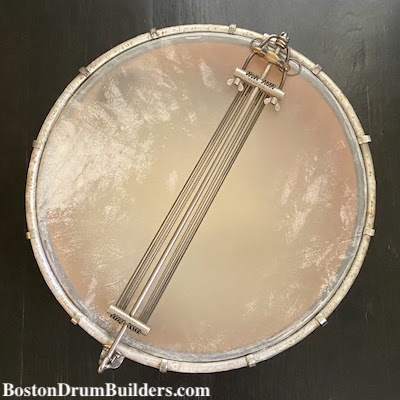
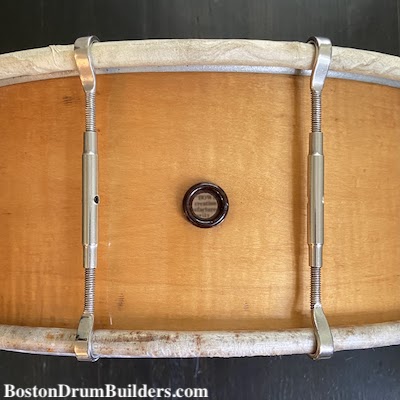
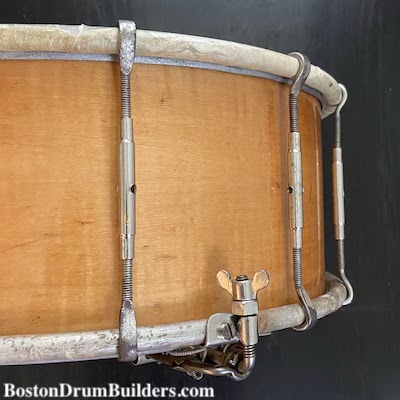
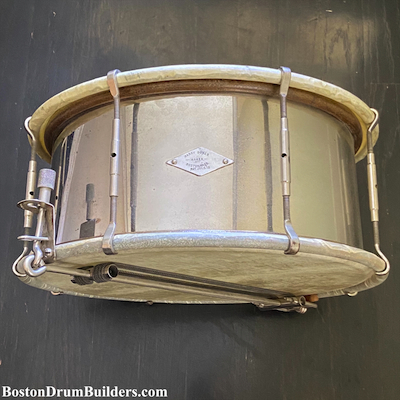
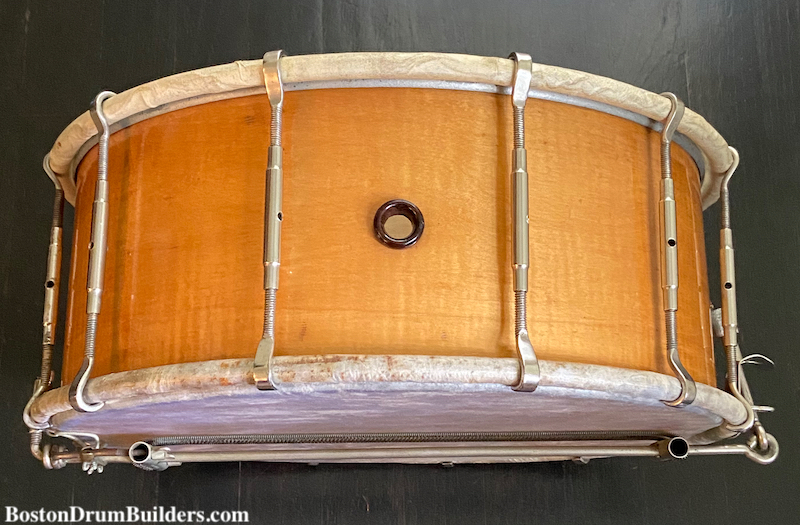
Harry Augustus Bower (1866 - 1948) was a prolific theater drummer, Vaudeville performer, xylophone soloist, method book author, teacher and inventor with more than a dozen patents to his name. His most prolific period as a maker was during the late 1910s and early 1920s before relocating to Southern California in 1924. The drum featured here is dated February 14, 1921.
Many of Bower's instruments were eccentric even for their time. In particular, the use of a frame mounted snare system and tubular counterhoops which doubled as flesh hoops were unique to Bower drums.
Many variables exist between one Bower drum and the next as the maker was constantly editing and evolving his own inventions. This example is formed around a figured maple shell with metal bands lining the bearing edges. A finely turned rosewood grommet adorns the air vent and an oversized makers label is applied inside of the drum.
Most Bower drum shells have no snare beds instead relying on the snare frame to keep the wires in contact with the bottom drum head. In this case, however, the shell has deeply cut beds which dictate that either the strainer or butt must be oriented directly underneath the badge. This must have been intentional on the makers part and probably explains why many Bower drums have conspicuously dented badges where the strainer often rests against the shell when engaged.
Do you have a Bower drum? I'd love to hear from you! Feel free to send Lee an email at lee@vinson.net. And for more on the early 20th century snare drum makers of Boston, Massachusetts please visit BostonDrumBuilders.com or follow @old_boston_drums on instagram.
Thursday, April 1, 2021
1921 Harry A. Bower Snare Drum
One hundred years ago today this Harry A. Bower snare drum was individually numbered and dated. Handwriting found inside the shell reads "Apr 1/21". The oversized makers label humbly states:
Bower was a well-traveled performer on the Vaudeville circuit, a one-time member of the Boston Symphony Orchestra, and the author of two widely used method books in the early part of the 20th century. He was also prolific inventor having been granted no fewer than thirteen patents, seven of which pertained to the snare drum. His designs were odd even for their time commonly utilizing hollow, tubular counterhoops which doubled as flesh hoops for the drumheads. Shells were often made from an unusual composite material as is the case with this example.
Bower's patented snare system was also highly unique in that the wires remained under tension via a frame which could be engaged with or disengaged from the bottom head using a simple but efficient throw-off mechanism.
Do you have a Bower drum? I'd love to hear from you! Feel free to send Lee an email at lee@vinson.net. And for more on Harry A. Bower and the other early 20th century drum manufacturers of Boston, Massachusetts, please visit BostonDrumBuilders.com or follow us on Instagram: @old_boston_drums.
The "BOWER" Drum / TRADE MARK / The "BOWER" DRUM is a new creation. Invented and manufactured by the world's authority on drums and drumming, and the author and publisher of the "Harry A. Bower System." / No. 577 / Harry A. Bower / Boston, MA"
Wednesday, December 18, 2019
Harry A. Bower "Special Artists Orchestra Drum"
It's been several years now since this rope tension drum labeled by Harry A. Bower floated across eBay and into a private collection. Best known for his influential method books and unusual snare drum designs, Bower was granted more than a dozen patents between 1897 and 1933 pertaining mostly to the design and construction of snare drums, timpani, and other percussion instruments. This older style drum raises the possibility that he may have been an active instrument maker before his more modern designs had been imagined and brought to life.


Bower was adamant in stamping his name and patent numbers all over his instruments. And while this drum bears his name on both an oval shaped badge and a paper label inside the shell, there is no visible mention of patents. Bower's earliest snare drum patent was applied for in 1903 and granted in 1904. If this drum were to predate that time, it would be one of Bower's earliest known surviving instruments.
The snare mechanism present here is of a simple, traditional style nothing like those seen in any of Bower's patents. However, extra holes in the bottom hoop indicate that some other mechanism was once installed. One of the few apparent similarities to Bower's later drums is a synthetic grommet adorning the air vent. If original, this would be highly unusual for a drum built around the turn of the century which again raises suspicion of possible after market modifications.
The semicircular snare gate is a somewhat unique trait shared by several other Boston drum builders of the early 1900s. But overall, the drum appears to have more in common with the work of Boston's late 19th century band instrument makers than Bower's own drums of a few decades later. One last mystery here is a series of witness marks or plugged holes in the shell, partially obscured from view by the snare strainer, which are suggestive of an ornamental tack pattern seen on earlier rope tension drums, a cosmetic feature sometimes echoed by Bower on his metal wrapped synthetic shell drums of the 1910s and '20s.


Do you have a Bower drum? I'd love to hear from you! Feel free to send Lee an email at lee@vinson.net. And for more on Harry A. Bower and the other early 20th century drum manufacturers of Boston, Massachusetts, please visit BostonDrumBuilders.com.
Sunday, May 4, 2014
Harry A. Bower Drumline
| From a reader in Maine comes pictures of a Harry A. Bower field drum in a white finish with the American Legion Logo applied to the shell. More interesting is that this drum is reportedly one of EIGHT in a complete set which was at one time used to outfit the local Legion's drum & bugle corps. The drums have consecutive serial numbers in the very low 1100 range, an extremely high number for Bower. It is doubtful that he actually produced that many instruments even over the long span of time during which he was active as an assembler of drums. In the late 1920s Harry A. Bower relocated from Boston, where the Vaudeville scene was drying up, to California where there was a burgeoning music and entertainment industry. Most of Bower's drums date from the late 1910s and early 1920s which appears to have been the height of his success as a drum builder. He largely disappears from the manufacturing and retailing scene after about the late 1920s. The label inside of this drum appears to date the instruments to 1932 which would be very late for an instrument of this design. Bower's patented tensioning system was an odd one where both heads were tuned concurrently by turning the nuts on the side of the drum. The major disadvantages of this system were that the heads could not be adjusted independently, and that there was nothing holding the rods in place. Should one set of claws lose tension for whatever reason, the drums tended to literally fall apart! What makes these particular instruments so strange is that not only are they of an outdated design, but they were apparently produced well after Bower had left Boston and his musical instrument building operation behind. Is it possible that the parts for these drums were left sitting around back in New England where an associate was able to build out a full set of drums for an American Legion corps? Or did Bower take his remaining stock with him to California only to later sell them to an old connection back on the east coast? There are questions to which answers are not likely to be found, but it is interesting to ponder how Bower came to outfit an entire drumline in 1932. Do you have a drum by Harry A. Bower? I want to hear from you! Send Lee an email at lee@vinson.net | ![]() ![]() |
Sunday, May 26, 2013
F. E. Dodge Timpani
| From Jim Davey in Norfolk, Massachusetts come photos of a turn of the century timpano by the F. E. Dodge Company. The pair of drums, one of which is shown here, was acquired several years ago at a large outdoor antique show in New England and now sees regular use with Southeastern Massachusetts Community Concert Band. Of note is that the drums are constructed around "Silver-Aluminum Bell-Metal Seamless Kettles". This is unusual in that timpani are traditionally built around copper bowls. The tuning system on these Dodge drums is also somewhat unusual as the handles used to tension the heads pull against metal bands which stretch fully around the outside of the shell and connect at the bottom of the drum. More conventional designs apply tension to brackets attached to the side of the kettles. The heads, I am told, originally were tucked directly onto the counterhoops as is the case with many antique timpani. However, to more easily facilitate modern performance applications, plastic heads have now been fitted onto the drum. The badge affixed to the drum is not one I have come across before. Perhaps it is of an earlier design and or a badge used exclusively for large instruments such as timpani. The drums rest on a simple three legged cradle and would have been suitable for use with theater orchestras or larger performing ensembles of the day. The drums were modeled around a patented design by Harry A. Bower. Timpani illustrated in the 1907 Dodge Catalog are of a more common design. The catalog page seen at right is taken from Nokes & Nicolai American Drummer no. 5, circa 1914. Nokes & Nicolai succeeded the Dodge Company in 1912 and continued to produce and market many of Dodge's products under their original names. Bower's design included both an external and internal tuning mechanism. The production model appears to use only the external system while the internal mechanism is absent from both the cataloged drum and the surviving example seen here. | ![]() |
![]() | ![]() |
![]() | ![]() |
Do you have a percussion instrument made by the F. E. Dodge Company? I want to hear from you! Send Lee an email at lee@vinson.net.
Monday, November 5, 2012
The Harry A. Bower "Dowelaphone"
I was recently pointed by a fellow vintage instrument enthusiast to an unusual Harry A. Bower mallet instrument in the collection of Los Angeles Percussion Rentals. Not unlike Bower's snare drums, this instrument looks to be unusual bordering on bizarre. Most if not all of Bower's instruments serve as little more than evolutionary oddities to us today. But apparently you can rent this one and play it if you really want to!

Photo: Los Angeles Percussion Rentals
Playing this "Dowelaphone" (or Dowel-A-Phone, or Dowel Xylophone) would appear to present some interesting challenges. The rounded over keys would make for awkward mallet ricochets, and the wooden slats placed between the accidentals could easily lead to disorientation when moving across the instrument.
Having studied so many of Bower's patent applications, there was undoubtedly a great deal of thought put into its design. How much of that translates into a practical instrument for performance purposes? Perhaps the ultimate answer lies in how little resemblance any modern keyboard instrument shows a resemblance to the Bower "Dowelaphone"!
Do you have an instrument built by Harry A. Bower? I want to hear from you! Send Lee an email at lee@vinson.net
Sunday, October 7, 2012
Where Did They Go?
During the early 1920s, four of the Boston Drum Builders were at or near their prime. Over the next two decades, each would disappear from the drum making map for different reasons.
Harry A. Bower was more of an assembler than a manufacturer per se. Many if not all of his instruments are presumed to have been produced largely by third parties such as machine shops or local craftsmen. Bower certainly was active in the designing and patenting of his creations, and was purported to have been quite the promoter of his wares, but he is not known to have ever had a factory full of workers under his command. So when Bower followed the rapidly evolving entertainment business to Southern California around 1925, his drum building efforts seem to have subsided. The last dated Bower drum I am aware of is from December of 1924. Bower did apply for and receive three patents while living in California in the late 1920s and early 1930s, but it is unknown whether any instruments implementing these designs were ever produced, much less marketed and sold.
Nokes & Nicolai's ending was relatively simple and concise. It is well documented in trade publications of the era that Nokes & Nicolai along with local string instrument maker Joseph Pancheco merged with the Liberty Rawhide Company of Chicago in 1926 to form The Liberty Musical Instrument Company. The looming question then is 'Why did Nokes & Nicolai chose to essentially sell their company?' We have no answer for that.
It would appear that Nokes & Nicolai was doing reasonably well at the time producing high quality professional level instruments well into the 1920s. They were financially stable enough just a few years earlier in 1922 to have purchased the F. E. Cole banjo business. And with both of Nokes & Nicolai's namesakes staying on with the new venture in Chicago, it doesn't appear that either man was looking to get out of the industry. Perhaps business has become bad for Nokes & Nicolai in Boston by 1926. Perhaps the two owners felt that the industry was passing them by. Or perhaps they just got an offer too good to refuse. We may never know.
The Liberty Musical Instrument Company was short lived, failing within two years time and was soon acquired by the Slingerland Company, also of Chicago. So in some small way Nokes & Nicolai lived on well into the 20th century, though to be honest, few if any of the instruments built by Slingerland bore any resemblance whatsoever to those being sold by Nokes & Nicolai in Boston only a few years earlier.
George B. Stone & Son was a family operation in name only by the 1920s with the elder Stone, George Burt, having passed away in 1917. But under the younger George Lawrence's oversight the company reached it's peak by the early to mid 1920s both in quantity and quality of instruments being turned out. It appears, however, to have been mostly downhill from there. The late Ralph Eames may have described the circumstances best in an interview with Rick Mattingly for Modern Drummer Magazine in 1985:
And there you have it in a nutshell. Stone never modernized. Case in point: Stone was producing drums employing wood hoops and an archaic tensioning system for more than a decade after the major players in the industry had moved to metal hoops and standardized tension rods. It was impossible for Stone to keep up like that and eventually they just stopped trying. By the very end, the company was assembling only basic single tension drums with whatever parts were left in the shop making for a sad end to a manufacturing business that once made professional quality, state of the art instruments.
We know that Stone was still building drums, albeit it in dwindling numbers, into the mid 1930s but the factory was closed for good by the late 1930s or early 1940s and the drum making equipment sat dormant for the next decade before it was purchased by Raplh Eames in 1950. Eames Drum Company of Saugus, Massachusetts, which is still in operation today, is owned and operated by Joe MacSweeney just a few miles north of Boston and represents the closest thing to a direct lineage shared between any modern drum maker and the Boston Drum Builders of the early 20th century.
And last but not least we have Charles A. Stromberg. It wasn't that Stromberg disappeared so much as that he and his son Elmer simply shifted their focus away from building drums, harps, and banjos to the making of guitars for which they would ultimately become renowned. By the late 1920s, Stromberg's snare drums had evolved into the most modern of any built by a Boston maker of the day. Solid aluminum hoops, elegant separate tension tube lugs, and a fully functional (if slightly over-built) snare throw-off easily separated Stromberg's drums from their local competitors. But as Stromberg was basically a two man operation, their output was very small with the total number of drums produced by the 1930s said to have been only in the 400 range. It would make sense that Stromberg was drawn not only to the more popular instruments of the day for which there was more demand, but where the profit margin was higher for each instrument sold. Though Stromberg's later drums are not numbered or dated, it appears that they were fazed out through the late 1920s and early 1930s as their guitars began increasing in notoriety and popularity. Charles and Elmer Stromberg would continue building guitars until their deaths in 1955.
Do you have a drum built by one of the early 20th century Boston makers? I want to hear from you! Send Lee an email at lee@vinson.net.

Harry A. Bower was more of an assembler than a manufacturer per se. Many if not all of his instruments are presumed to have been produced largely by third parties such as machine shops or local craftsmen. Bower certainly was active in the designing and patenting of his creations, and was purported to have been quite the promoter of his wares, but he is not known to have ever had a factory full of workers under his command. So when Bower followed the rapidly evolving entertainment business to Southern California around 1925, his drum building efforts seem to have subsided. The last dated Bower drum I am aware of is from December of 1924. Bower did apply for and receive three patents while living in California in the late 1920s and early 1930s, but it is unknown whether any instruments implementing these designs were ever produced, much less marketed and sold.
Nokes & Nicolai's ending was relatively simple and concise. It is well documented in trade publications of the era that Nokes & Nicolai along with local string instrument maker Joseph Pancheco merged with the Liberty Rawhide Company of Chicago in 1926 to form The Liberty Musical Instrument Company. The looming question then is 'Why did Nokes & Nicolai chose to essentially sell their company?' We have no answer for that.
It would appear that Nokes & Nicolai was doing reasonably well at the time producing high quality professional level instruments well into the 1920s. They were financially stable enough just a few years earlier in 1922 to have purchased the F. E. Cole banjo business. And with both of Nokes & Nicolai's namesakes staying on with the new venture in Chicago, it doesn't appear that either man was looking to get out of the industry. Perhaps business has become bad for Nokes & Nicolai in Boston by 1926. Perhaps the two owners felt that the industry was passing them by. Or perhaps they just got an offer too good to refuse. We may never know.
The Liberty Musical Instrument Company was short lived, failing within two years time and was soon acquired by the Slingerland Company, also of Chicago. So in some small way Nokes & Nicolai lived on well into the 20th century, though to be honest, few if any of the instruments built by Slingerland bore any resemblance whatsoever to those being sold by Nokes & Nicolai in Boston only a few years earlier.
George B. Stone & Son was a family operation in name only by the 1920s with the elder Stone, George Burt, having passed away in 1917. But under the younger George Lawrence's oversight the company reached it's peak by the early to mid 1920s both in quantity and quality of instruments being turned out. It appears, however, to have been mostly downhill from there. The late Ralph Eames may have described the circumstances best in an interview with Rick Mattingly for Modern Drummer Magazine in 1985:
| "When mechanization hit the drum industry it sort of passed Mr. Stone by. His business was primarily a handmade operation, and he didn't want to convert to the equipment that would have been necessary for him to compete with companies like Ludwig, Slingerland, and Gretsch. So the business gradually petered out." |
And there you have it in a nutshell. Stone never modernized. Case in point: Stone was producing drums employing wood hoops and an archaic tensioning system for more than a decade after the major players in the industry had moved to metal hoops and standardized tension rods. It was impossible for Stone to keep up like that and eventually they just stopped trying. By the very end, the company was assembling only basic single tension drums with whatever parts were left in the shop making for a sad end to a manufacturing business that once made professional quality, state of the art instruments.
We know that Stone was still building drums, albeit it in dwindling numbers, into the mid 1930s but the factory was closed for good by the late 1930s or early 1940s and the drum making equipment sat dormant for the next decade before it was purchased by Raplh Eames in 1950. Eames Drum Company of Saugus, Massachusetts, which is still in operation today, is owned and operated by Joe MacSweeney just a few miles north of Boston and represents the closest thing to a direct lineage shared between any modern drum maker and the Boston Drum Builders of the early 20th century.
And last but not least we have Charles A. Stromberg. It wasn't that Stromberg disappeared so much as that he and his son Elmer simply shifted their focus away from building drums, harps, and banjos to the making of guitars for which they would ultimately become renowned. By the late 1920s, Stromberg's snare drums had evolved into the most modern of any built by a Boston maker of the day. Solid aluminum hoops, elegant separate tension tube lugs, and a fully functional (if slightly over-built) snare throw-off easily separated Stromberg's drums from their local competitors. But as Stromberg was basically a two man operation, their output was very small with the total number of drums produced by the 1930s said to have been only in the 400 range. It would make sense that Stromberg was drawn not only to the more popular instruments of the day for which there was more demand, but where the profit margin was higher for each instrument sold. Though Stromberg's later drums are not numbered or dated, it appears that they were fazed out through the late 1920s and early 1930s as their guitars began increasing in notoriety and popularity. Charles and Elmer Stromberg would continue building guitars until their deaths in 1955.
Do you have a drum built by one of the early 20th century Boston makers? I want to hear from you! Send Lee an email at lee@vinson.net.
Sunday, September 2, 2012
Harry A. Bower Serial Numbers
Below is a table listing the Harry A. Bower drums of which I am aware along with their corresponding serial numbers and dates of manufacture. Not all Bower drums have serial numbers and not all are dated, so undated drums are included in this table with approximate dates based on which patents are applied to the drum, patent dates stamped onto the hardware when present, and where the serial numbers fit into the established pattern.
All of the serial numbers here fit the pattern. And taken at face value, Bower may have produced more than 1000 drums by the end of 1924. Whether or not this is true, we have no way of knowing. For one, we don't know where the serial numbers begin. They could have started at number 100, or 200, or even 300. Also, it is entirely possible that numbers were skipped along the way for any number of reasons such as the assigning of a specific number to a certain date, or the starting of each new batch at a fixed number. Any such manipulation of the serial numbers would completely skew the data graphed at bottom.

Do you have an instrument built by Harry A. Bower? I want to hear from you! Send Lee an email at lee@vinson.net
All of the serial numbers here fit the pattern. And taken at face value, Bower may have produced more than 1000 drums by the end of 1924. Whether or not this is true, we have no way of knowing. For one, we don't know where the serial numbers begin. They could have started at number 100, or 200, or even 300. Also, it is entirely possible that numbers were skipped along the way for any number of reasons such as the assigning of a specific number to a certain date, or the starting of each new batch at a fixed number. Any such manipulation of the serial numbers would completely skew the data graphed at bottom.
| ![]() |

Do you have an instrument built by Harry A. Bower? I want to hear from you! Send Lee an email at lee@vinson.net
Friday, July 13, 2012
The Bower Practice Drum
Harry A. Bower was an active performer, teacher, author, and inventor in Boston during the early 1900s and into the 1920s. Bower's designs for new percussion instruments, while innovative, were often eccentric bordering on impractical. But this early practice pad, referred to by Bower as a "Practice Drum", has a certain simplicity about it. Bower, always the entrepreneur, apparently went so far as to patent this design and license it to Art C. Higham of Los Angeles, California for production.
Bower relocated from Boston to Southern California sometime in the early to mid 1920s. We know that much based just on the patents credited to Bower and the addresses he was using at the time for which the patents were applied. Once in California, Bower must have established a relationship with Hingham who, according to the paper label affixed to the underside of this example, was the "Sole Manufacturer of Bower Practice Drums, Drum Sticks and other drum specialties." The patent for Bower's "Practice Drum" was applied for on February 27th, 1919 and was granted on July 13th, 1920 which would be exactly 92 years ago today.
Pictured above is a very nice example of "The Bower Practice Drum" from collector Mike Curotto. The large black and white drawings below are from Bower's patent application, the full version of which is viewable online at FreePatentsOnline.com
Do you have an instrument built by Harry A. Bower? I want to hear from you! Send Lee an email at lee@vinson.net
![]() | ![]() |
Bower relocated from Boston to Southern California sometime in the early to mid 1920s. We know that much based just on the patents credited to Bower and the addresses he was using at the time for which the patents were applied. Once in California, Bower must have established a relationship with Hingham who, according to the paper label affixed to the underside of this example, was the "Sole Manufacturer of Bower Practice Drums, Drum Sticks and other drum specialties." The patent for Bower's "Practice Drum" was applied for on February 27th, 1919 and was granted on July 13th, 1920 which would be exactly 92 years ago today.
Pictured above is a very nice example of "The Bower Practice Drum" from collector Mike Curotto. The large black and white drawings below are from Bower's patent application, the full version of which is viewable online at FreePatentsOnline.com
![]() |
Do you have an instrument built by Harry A. Bower? I want to hear from you! Send Lee an email at lee@vinson.net
Subscribe to:
Posts (Atom)