Showing posts with label J. B. Treat. Show all posts

Saturday, October 1, 2022

J. B. Treat Drum, ca. 1879

Joseph B. Treat was a well-known drummer and drum maker in Boston during the mid to late 19th century. A native of Connecticut, Treat arrived in Massachusetts by 1860 and briefly served as a drummer in Boston's Independent Corps of Cadets during the Civil War. A musician by vocation, he worked extensively in the musical instrument trade as well. Treat's most recognizable work as a maker was for Thompson & Odell during the 1880s and early 1890s.

Through much of the 1860s and 1870s, directory listings place Treat at addresses corresponding to the workplace of Asa Warren White suggesting that Treat worked alongside or was employed by White during these years. Signed makers labels offer further evidence that the two men were affiliated in some capacity well into the 1870s though they diverged shortly thereafter. Directories list Treat independently under 'Musical Instrument Makers' in 1879, and both Treat and White are absent from the Boston Business Directory in 1880 before reappearing at separate addresses the following year. Beginning in 1881 Treat's place work was 177 Washington Street confirming that he was by then employed by Thompson & Odell.

Treat likely produced the drum seen here during the narrow window of time after leaving White's shop, before landing at Thompson & Odell.

ca. 1879 J. B. Treat Drum
ca. 1879 J. B. Treat Drum Label
A large makers label inside the drum reads: "CIRCULAR / Having located at 50 Bromfield Street, Room 24, I am prepared to furnish Drums of any, and all descriptions, of the best materials throughout, also Rodger's Drum Heads, and Drum Findings of all descriptions, at the lowest possible prices. / Uniform sets of Drums, for Corps, made at the shortest notice. Old Drums remodelled and repaired in the best manner. / J. B. TREAT, / 50 BROMFIELD ST., ROOM 24 / I invite my old friends and customers to / "CALL ROUND." / Pin this up in the Band Room."
ca. 1879 J. B. Treat Drum
The drum is straightforward in construction, typical of military style drums manufactured in Boston during the decades following the Civil War. Formed from a single ply of maple, the shell is held at the seam by a line of small brass tacks. Slightly unusual is the orientation of the air vent and snare beds which are often placed further around the shell from the seam.

Do you have a drum made by J. B. Treat? I would love to hear from you! Email Lee anytime at lee@vinson.net. And for more on the early 20th century snare drum makers of Boston, Massachusetts please visit BostonDrumBuilders.com or follow @old_boston_drums on instagram.

Sunday, September 2, 2018

Who was O. A. Whitmore?

Featured here is a very early drum for Thompson & Odell by O. A. Whitmore, dating from about 1875. Thompson & Odell was only beginning to become established at the time, a fact underscored by the wording "successors to A .W. White" on the makers label.

ca. 1875 Drum by O. A. Whitmore for Thompson & Odell, Boston, MAca. 1875 O. A. Whitmore drum label for Thompson & Odell

Thompson & Odell's beginnings can be traced back to 1872 as "Woods & Odell". In 1873 J. Harrison Woods and Ira H. Odell took in a third partner in Charles W. Thompson forming "Woods, Odell, and Thompson" operating at 121 Court Street. Woods left the company by 1875 after which the remaining two partners established Thompson & Odell at 86 Tremont Street, the address most recently occupied by Asa Warren White and Louis P. Goullard under the moniker "White & Goullaud".

The drum dates from circa 1875 placing Whitmore as perhaps the first in a long succession of drum makers contracted by Boston's Thompson & Odell.

This drum being from right around 1875 places O. A. Whitmore as perhaps the first in a long succession of drum makers contracted by Thompson & Odell that would later include J. B. Treat, and Charles A. Stromberg. Whitmore's makers label also describes his business as specializing in E. B. Mansfield's banjo, a design for which Mansfield received a patent in 1872.

O. A. Whitmore settled north of Boston in Malden, Massachusetts around 1871 and was building drums and banjos at least as early as the mid 1870s. He is listed in the 1876 Boston Directory as a musical instrument maker producing drums and banjos at 282 Washington Street. Before this time, as early as 1871, Whitmore appears in the Directory with the occupation of "musician", but is not included under listings for musical instrument makers.

Around 1879 Whitmore opened his own shop at 178 Washington Street. As of 1880 he was in business with Peter J. Boris at the same address, the firm being known as "Whitmore & Boris". Boris, long active as a musical instrument importer and dealer, had previously been partnered with J. H Woods of Woods, Odell & Thompson. Whitmore and Boris' working arrangement was evidently short lived lasting only until about 1882. Perhaps their business interests merely evolved in a different direction, however, as the two are listed as assignees of an 1882 patent for fish nets of all things.

By 1883 Whitmore had essentially traded one partner for another now joining up with the aforementioned Eben B. Mansfield to form "Whitmore & Mansfield" still operating at 178 Washington Street. The two men together had previously secured a patent for a music stands a few years prior. In addition to manufacturing Mansfield's patent banjos, Whitmore & Mansfield also dealt brass instruments including cornets. But like Mansfield's previous joint business venture, the partnership was short lived. Whitmore & Mansfield vanishes from Boston directories after 1884 as do both individuals for a time.

Whitmore & Mansfield was short lived, vanishing from Boston directories after 1884.

It could be that Whitmore returned to the road for a few years, or that he simply didn't have a business address in Boston for a period of years. Nevertheless, his music store at 178 Washington Street changed hands at this point as a man named George M. Lane was selling musical instruments there in 1885. By 1886, Lane was gone and D. C. Hall was selling musical instruments at the same address as would be the case for the next several years.

O. A. Whitmore resurfaces in directory listings in 1888 as a music teacher at 179 Washington Street, a professional address shared by several others including J. H. Woods. Whitmore would continue to appear here through the 1890s while living in Malden.

Long before coming to Boston, Osceola Aurelius Whitmore was a native of Reading, Vermont. Born September 2, 1838, he would take up the clarinet at a young age and soon become well established with a variety of minstrel shows eventually taking on management positions and ownership stakes in several companies. This early chapter of Whitmore's life is well described by Frank H. Clark in "History of Reading, Windsor County, Vermont. Vol. II:


Whitmore & Clark's Minstrels
"The most famous musical organization which originated in Reading was undoubtedly Whitmore & Clark's Minstrels, a company that for more than a quarter of a century annually visited every part of New England, and parts of New York and the Provinces, and the memories of which will be remembered with pleasure by many an "old-timer". The company was organized at the close of the Civil war and was the successor of several similar organizations that had been more or less successful, S. A. Brock's Broadway Minstrels, Whitmore & Thompson's Minstrels and others."

"Of the proprietors of the company [Whitmore & Clark's Minstrels] only one, Osceola A. Whitmore, was a native of Reading. He was born on the old Whitmore place Sept. 2, 1838, a son of Capt. Nelson Whitmore, at one time captain of the militia company and Mrs. Lucy (Holden) Whitmore. Young Whitmore must have been inspired by the old time music of the fife and drums, which he says was the most important part, to him, of the annual June training. The players were Otis Foster, snare drum, Henry Megrath, fife and Capt. Nathan Sherwin, bass drum.

Mr. Whitmore began to play the clarinet at an early age, his first engagement in public being at the hotel in Hammondsville in 1855 for a dance, playing with Carlos Hawkins and for which he received for his valuable services the sum of twenty five cents. He received his first instructions on the clarinet from Alonzo Bond of Boston, who taught the Woodstock Band about this time, and was a member of the band in 1860 and '61, and went into camp at Rutland in May 1861 with the Woodstock Light Infantry. In the beginning of the war, when the first call for three months' men from President Abraham Lincoln was made the government did not employ bands, so the band returned to Woodstock when the company left for the seat of war. Afterwards he traveled with Barnum's Circus and was with the Whitmore and Clark troupe for twelve years after it was organized. The name was retained after Mr. Whitmore retired from the organization except for one or two seasons."

Whitmore & Clark's Minstrels was formed in 1866 with Whitmore himself reportedly staying on board until about 1878 before leaving the group to accept more solo clarinet work with various musical organizations in Boston and to pursue his interests in the musical instrument business.

At the time of his death in 1918, Whitmore was remembered foremost as a performing clarinetist and teacher. The final stages of his life perhaps overlapped with but apparently outlasted and overshadowed that of his banjo and drum manufacturing interests and certainly his early career with traveling minstrel shows.

A brief obituary from the Musical Courier published November 28, 1918 reads as follows: "Osceola A. Whitmore, at one time one of the worlds' most famous clarinetists, died Sunday, November 17, in Allston, Mass at the age of 80 years. Mr. Whitmore had been associated with Gilmore's, Carter's, Sousa's and the Germania Bands and the Boston Symphony Orchestra. He had been for twenty-seven years in charge of the orchestra at the Fabyan House in the White Mountains, and was also well known as a teacher and maker of clarinets. Mr. Whitmore passed the greater part of his active life in Malden, was a member of the common council for three years and a member of many fraternal organizations. He is survived by two married daughters."


This particular drum had previously suffered the indignancy of being converted into an end table of sorts. The conversion had been accomplished by screwing three drum sticks into the shell to serve as legs. The legs have now been removed and new heads tucked onto the existing flesh hoops restoring some semblance of respectability to this interesting historical piece.


The snare strainer looks to have been replaced once upon a time as the bottom hoop has been crudely gouged to accommodate a newer but similarly basic mechanism. The gut snares are held in place with a simple leather snare butt as is common for drums of this age.


Rustic condition aside, the construction methods implemented here are more crude than those commonly seen on drums from a decade or two later. Whitmore used not only a series of small tacks to hold the shell together along the seem, but the same is true of both the counterhoops and the re-inforcing rings. Yet signs of high end refinement are simultaneously present as seen in the beautifully polished rosewood grommet lining the air vent and faded remnant of a gilded scroll design ornamenting the black enameled counterhoops.


W. Lee Vinson is a classical percussionist, music educator, and snare drum historian. He is the author of BostonDrumBuilders.com, a website devoted to the late 19th and early 20th century drum makers of Boston, Massachusetts.


Tuesday, May 8, 2018

M. Woodman, Drummaker

One drum, two makers labels, three addresses. Depending on how all this information is interpreted, the drum featured here either originated from Boston's Thompson & Odell, or from the hands of a lesser known drum maker from Maine by the name of M. Woodman.

Thompson & Odell Drum, possibly by Manson Woodman ca. late 1870sThompson & Odell Drum, possibly by Manson Woodman ca. late 1870s

Directories list Thompson & Odell at 86 Washington Street from 1875 through 1879. Before this time, the fledgling firm had gone by the name Woods, Odell, & Thompson and in 1874 was listed at 121 Court Street. By 1880 Thompson & Odell had moved to 177 Washington Street where they would remain for the next five years. The drum seen below figures to have been produced in the late 1870s while the company was operating at the 86 Washington Street address.

From the very beginning, Thompson & Odell sold instruments from other manufacturers in addition to those made in house and it can sometimes be difficult to discern instruments produced by Thompson & Odell from those which were contract built and relabeled. Thompson & Odell's "Artist Drum" was a described as a "street instrument" intended for "military and semi-military purposes" and was crafted for many years by Joseph B. Treat and later Charles A. Stromberg. In the case of the drum featured here, there is no specific drum maker named by Thompson & Odell leaving open the possibility that someone other than Treat or Stromberg was the builder. An additional label found inside of the drum lists a separate maker and raises as many questions as it answers.

It could be that Manson Woodman did in fact build the drum or it could be that he was only a repairman in this case.

This second label bears the name of a lesser known drum manufacturer from Skowhegan, Maine by the name of M. Woodman. Handwritten on the upper half of Woodman's label is the wording "Thompson & Odell / 177 Washington Street / Boston Mass". This might suggest that Woodman produced the drum for Thompson & Odell, though the address on Woodman's label post dates the Thompson & Odell label bringing this assumption into question. It could be that Manson Woodman did in fact build the drum and that Thompson & Odell was using up an existing stock of labels listing their old address. Or it could be that he was only a repairman in this case who later added his name to the drum after servicing the instrument. It is impossible to know for sure. Woodman would in fact set up shop in Boston later in his life but wasn't known to have been an active drum maker in Boston until about 1883. Both makers labels present here predate this point in time.

Thompson & Odell Drum LabelThompson & Odell Label, ca. late 1870sM. Woodman Drum LabelM. Woodman Label ca. early 1880s

Manson Woodcock was born November 28th, 1816 in Sidney, Maine to George Woodcock and Maria Robinson Woodcock. In 1838 at the age of 22, Manson legally changed his last name to Woodman and by 1840 was living on his own, still in Sidney. He married Prudence Pitts Delano in 1843.

The 1850 and 1860 censuses show Manson Woodman living in Farmington, Maine and in 1861 "A Business Directory of the Subscribers to the New Map of Maine" lists Woodman as a drum maker there. A fascinating series of letters held in the Maine State Archives show Manson reaching out around this time to military officials seeking contracts to build drums for the Civil War effort. Despite several appeals, it does not appear that Woodman was ever able to secure such a contract. But Manson's letters are telling of his aspirations and the lengths to which he was wiling to go in an effort to grow his business as a drum builder.

A man of many trades, Woodman is listed as having had a variety of occupations over the course of his life including that of a machinist, a coffin and casket manufacturer, and as a maker of drums, banjos and tambourines. Further evidencing his entrepreneurial nature, he is credited with an 1867 patent for a "new and useful Improvement in Horse-Rakes". The patent filing goes on to state that the improvement in fact "relates especially to the horse-rake patented [in 1849] by Calvin Delano" who was Woodman's father-in-law.

A man of many trades, Woodman is listed as… a "Manufacturer to order of Coffin and Caskets in all styles of finish. Also of Drums of all kinds, Banjoes, and Tambourines at shortest possible notice."

Sometime in the 1870s Woodman relocated to Skowhegan, ME where he further established himself as a drum maker. The 1877 New England Business Directory lists Woodman as a Drum Manufacturer there. Many directories published around this time show Woodman having dual trades including the 1883 Atlas of Somerset County, Maine which lists Woodman as a "Manufacturer to order of Coffin and Caskets in all styles of finish. Also of Drums of all kinds, Banjoes, and Tambourines at shortest possible notice."

Around 1883 or 1884, Woodman relocated to Boston where he first appears in city directories in 1884 as a drum maker at the Abattoir Grounds. At this advanced stage in life, aged more than sixty years, Woodman seems to have focused his attention fully on drum making. The culmination of these efforts can be seen in his 1890 patent for a drum which aimed to "dispense with the “skin" or “flush” hoops hitherto used in connection with the “cord-hoops" for securing the drum-heads in place upon the shell, whereby the construction of the drum is simplified, its cost reduced, and a greater clearness and brilliancy of tone secured."

Manson Woodman Drum Patent

Less than one year after his patent was issued, on May 8, 1891, Manson Woodman passed away in Boston at the age of 74. He was laid to rest in his native Farmington, ME.

Spinning forward several decades, a 1921 letter written to Boston's S. A. Woods Machine Company and later published as part of a 1922 advertisement in "The Wood-worker" discusses Woodman's planer which had recently been refurbished and was still in use. This same planer was purportedly used by Woodman to construct a mammoth 10 foot bass drum for the "Peace Jubilee in Boston in the '70s". The World's Peace Jubilee and International Musical Festival was held in Boston in the Summer of 1872 and photographs from the well documented event indeed show a giant bass drum at the very center of the newly constructed Coliseum. The drum would have served as a grand centerpiece of the festival's musical offerings and a monument to Woodman's musical instrument building endeavors alike.


W. Lee Vinson is a classical percussionist, music educator, and snare drum historian. He is the author of BostonDrumBuilders.com, a website devoted to the late 19th and early 20th century drum makers of Boston, Massachusetts.


Sunday, February 1, 2015

J. B. Treat, Drummer

Joseph B. Treat was a well-known drummer and drum maker in Boston during the mid to late 19th century. A native of Connecticut, Treat arrived in Boston by 1860 and became active as an instrument repairman by 1863. His most wide reaching contributions as an instrument maker were his drums built for Boston-based music house Thompson & Odell during the 1880s and 1890s.

Treat served briefly as a drummer in the Boston Corps of Cadets during the Civil War. An independent infantry company, the Cadets were called into federal service for a period of just over one month. The unit was mustered into service on May 26, 1862 and mustered out on July 2, 1862. Treat would have been in his early 40s by this time and apparently never came close to the battle field. The Cadets worked closely with the Governor of Massachusetts and the unit remained small in size. Their main obligation while active for the federal government was to stand watch at Fort Warren in Boston Harbor where they guarded Confederate prisoners. Made up largely of well educated men, the Cadets were widely known as a breeding ground for officers who would go on to lead other regiments of the Massachusetts Volunteer Militia.

Joseph B. Treat
Through the 1860s and 1870s, directory listings place Treat at 86 Tremont and then 50 Bromfield where he worked for the shop of Asa Warren White. Makers labels place the two men in business together as late as 1879. Beginning in 1881, Treat is listed at 177 Washington Street, home of Thompson & Odell.

Billed as "The Celebrated Artist Drum", J. B. Treat's drums for Thompson & Odell were large, rope tension drums intended for military and semi-military purposes. Shells were typically single ply maple, tacked at the seam, with single ply maple reinforcing rings. Hoops were commonly painted black around the outside with the rope connecting to the hoops via cast iron hooks as seen in the example here dating from around 1890.

1890s Joseph B. Treat Rope Tension Drum
A brief mention in the Philadelphia Times on Saturday, January 26, 1895 suggests Treat maintained a sharp mind and a keen sense of humor well into his later years.

"Joseph B. Treat, of Boston, is living proof that the forbearance of the American public is wonderful. Had it not been so he would have been killed long ago. He has been a drummer for nearly seventy years and has hardly ever passed a day without pounding his unfortunate instrument more or less."

The last months of Treat’s life were spent at the Soldiers' Home in Chelsea, Massachusetts where he succumbed to heart disease on January 7, 1899 at the age of 78. He was laid to rest at Forest Dale Cemetery in nearby Malden, Massachusetts.

Do you have a drum by J. B. Treat? I'd love to hear from you! Feel free to send Lee an email at lee@vinson.net. And for more on the Boston Drum Builders of the early 20th century, please visit BostonDrumBuilders.com.

Sunday, April 14, 2013

Faux Rosewood Hoops

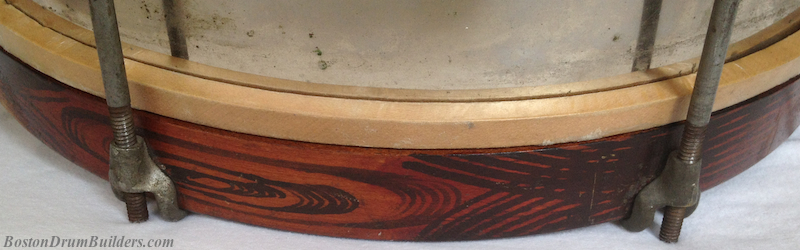
Where were these hoops coming from? They appear on a 1880s Thompson & Odell drum in my collection and several others I have seen. At first glance it appears the hoops are made of rosewood but upon closer inspection they are in fact formed from maple which has been stained a deep reddish color and then hand painted to imitate the woodgrain of rosewood.
Lee'sThompson & Odell Drum, ca. 1880sThompson & Odell Drum, ca. 1880s
Thompson & Odell Drum Label, ca. 1880sThompson & Odell Drum Label

The similarities between the hoops on this Thompson & Odell drum (above) and a similar maple shelled drum by Lyon & Healy of Chicago (below) are uncanny.

Lyon & Healy Drum, ca. 1880sLate 1800s Lyon & Healy Drum        photo: eBay
Lyon & Healy Drum Label, ca. 1880sLyon & Healy Drum Label        photo: eBay

The hardware on the two drums pictured above is also very similar albeit somewhat generic. Furthermore, the wording on the Thompson & Odell label describes the company as "Importers and Wholesale and Retail Dealers in General Musical Merchandise". This all leads me to believe that Lyon & Healy of Chicago was behind the manufacture of this particular Thompson & Odell drum.

Thompson & Odell Drum, ca. 1880s

Late 1800s Lyon & Healy Drum

Lyon & Healy was one of the largest producers of band instruments in the late 1800s, and drums such as these often turn up with labels listing other instrument makers or music stores as is the case here. Lyon & Healy in fact proclaimed themselves to be the "largest general music house in America" and was likely a source of instruments for countless smaller dealers at the time.

This certainly isn't to say that all Thomposon & Odell drums were built by Lyon & Healy because that absolutely is not the case. Drums by J. B. Treat, and Charles A. Stromberg were also dealt by Thompson & Odell prior to the Company's bankruptcy in 1905. Stromberg was in fact employed by the company for a time. But the evidence to suggest some sort of working business agreement between Thompson & Odell and Lyon & Healy is strong as the two drums pictured above demonstrate.

Do you have a Thompson & Odell drum? I want to to hear from you! Send Lee an email at lee@vinson.net.