Sunday, March 6, 2016

William F. McIntosh Snare Drums

William F. McIntosh's most notable contribution to percussion was an early snare throw-off design for which he received a patent on February 9th, 1909. Over the next two decades, his so called "Snare Strainer and Muffler for Drums" would be installed on hundreds if not thousands of snare drums including many by Boston's George B. Stone & Son. According to Christine Merrick Ayars' Contributions to the Art of Music in America by the Music Industries of Boston 1640 - 1936 (New York: H.W. Wilson, 1937), McIntosh had by the 1930s taken up other interests and was dealer in radios and radio equipment.

As discussed in a previous post about a William F. McIntosh rope drum, McIntosh had only a very small industry presence as a drum builder and it is unclear exactly to what degree he was capable of manufacturing for himself the various components needed to produce drums. He did however assemble a small number of snare drums over his life span, three of which are featured here.

First comes a pair of drums now in the possession of the Italian American Citizens Club in Malden, Massachusetts stamped "Wm McIntosh Drum Maker Charlestown, Ma" inside the shells. The drums were apparently owned by the Colonial G. Verdi Musical Club of Malden and reportedly were used for the annual Saint Rocco Processions for many years before being stored away in a basement. No other information or photographs were provided but it is interesting to note that the snare drum employs twelve Stromberg-like separate tension lugs and McIntosh's patented strainer and muffler. Also noteworthy are the collar hooks similar to those used by Stone & Son on their Separate Tension Drums.

William F. McIntosh Snare DrumWilliam F. McIntosh Bass Drum

Secondly, a reader sends along a few (rough) photographs of an early McIntosh orchestra drum with a handwritten label reading "July 03, Made by William F. McIntosh, 6 Elwood Street, Charlestown / Mass." The snare strainer present on the drum is a patented Stromberg design and is stamped 'patent pending'. This would suggest that the strainer was produced after the patent was applied for, but before the patent was granted on April 5th, 1904. This corroborates the date of July 1903 date written on the makers label.

1903 William F. McIntosh Snare Drum1903 William F. McIntosh Snare Drum Label

Do you have a drum by William F. McIntosh? I would love to hear about it! Feel free to send Lee and email anytime at lee@vinson.net.


Sunday, February 7, 2016

A Word About Separate Tension, by George Burt Stone

One hundred years ago, separate tension drums were still something of a new thing. Single tension drums were perhaps slow to fall out of vogue because they had more in common with the traditional rope tension instruments used by drummers for the past century or two. In the case of rope tension drums, the simple pull of a leather tug tightened both heads simultaneously. The same principle was true of early rod tensioned drums, the only difference being the use of metal rods and claws rather than rope and leather to tighten or loosen the heads.

Geo. B. Stone & Son Thumbscrew DrumGeorge B. Stone & Son - Catalog H, ca. 1915Geo. B. Stone & Son Separate Tension DrumGeorge B. Stone & Son - Catalog H, ca. 1915

Catalogs of the 1910s often listed single tension drums and separate tension drums side by side making little suggestion as to which was preferable for any particular reason. A query posed to George Burt Stone in a 1915 magazine column then doesn't seem quite so uninformed. In response to a reader's question published in Volume 6, Number 1 of Jacobs' Orchestra Monthly, Stone chose to reprise his own article from the same publication in August of 1913. This topic was evidently so timely that he also reprinted the article in George B. Stone & Son "Catalog H". The 1915 question and answer are transcribed here.


Q. What is your opinion regarding single and duplex strain on drum heads? I notice that many of the late drum makers are straining with a single rod from rim to rim instead of each head separately. This is, of course, in keeping with the old principle of rope strain but I have had much better results from duplex strain because you can use a heavy batter and a thin snare head.

A. In answer to your question, and to many other questions which I have received within the past month or so concerning the relative merits of separate and double tension, I will reprint below an article, entitled "A Word About Separate Tension." This article appeared in the August, 1913, issue of J. O. M. in the Drummer department.


     "There is at the present time considerable discussion among professional and amateur drummers as to the relative merits of separate and of double tension for tightening snare drum heads.

     "Personally, I think that separate tension is much the better for the following reasons: In a snare drum, the snare head should be comparatively thin, the tension being loose enough for it to vibrate freely against the snares. The batter head should be a certain degree thicker, for this head must receive the beating of the sticks and must necessarily be strong in order to stand it. The batter head should be considerably tighter than the snare head in order to properly transmit the concussion of the sticks to the snare head, also to properly rebound the sticks.

     "With ordinary rods (straining both heads at once), the snare head, being thinner and weaker, is strained much tighter than the batter head, which is the reverse of the correct adjustment.

     "In rainy weather or in a damp theatre pit where heads are bound to slacken, ordinary rods cannot begin to take all the looseness from the batter head without at the same time pulling the snare head to a high tension. Result - a drum with a "tubby" tone that "plays hard" because the batter head is loose; so loose that it will not rebound the sticks to the player's satisfaction.

     "Another point, suppose one of the heads begins to pull down on one side (this is possible with the most even heads obtainable) an attempt to correct the unevenness by tension with ordinary rods invariably results in the other head being pulled out of shape, which makes retucking necessary.

     "Separate tension rods control each head independently. These rods allow the correct relative adjustment of the batter and snare heads, giving the user the exact combination of head tension that he has found in practice to be the most satisfactory for tone and playing qualities. In damp weather, provided he is using separate tension rods, Mr. Drummer will find it very easy to strain the batter head up to a sufficient tension to rebound the sticks without even touching the snare head unless he thinks it necessary. If one of the heads starts to pull down on one side more than on the other, it is a simple matter with separate tension rods, to adjust the strain so that one head will be evened out without disturbing the other.

     "And last, but not least, if while playing on a separate tension drum, his stick goes through the batter head, the player simply turns his instrument upside down, and finishes the engagement playing on the snare head. If he has had the forethought to buy an extra head, tucked, stretched and dried on a flesh hoop, it is a matter of but a few moments to put the drum into first-class playing condition once more."

Sunday, January 3, 2016

The Stone Black Beauty Separate Tension Snare Drum

Boston's George B. Stone & Son produced a great of drums in black lacquer finishes during the 1920s and into the 1930s. Most were either Master-Model snare drums or bass drums from matching drumsets. Much less common are black lacquered examples of the Separate Tension Orchestra Drum.

1925 Geo. B. Stone & Son Black Beauty Separate Tension Snare Drum

This model was in fact listed in Stone's Catalog K (1925) as the "Black Beauty Separate Tension Snare Drum". It is significant to note that Stone's use of the moniker 'black beauty' predates that of Slingerland by three full years. And this was SEVEN years prior to Ludwig using the term in their advertising.

Stone Catalog K - Inside Front Cover
George B. Stone & Son Catalog K - Inside Cover
Stone Catalog K - Page 27
George B. Stone & Son Catalog K - Page 27

While Stone's Black Beauty was not an engraved metal shell drum like those of Slingerland and Ludwig, it was a high end model in its own right. As was the case with all of Stone's Separate Tension Orchestra Drums after 1923, this drum was constructed around a 5/8" thick, three-ply maple shell with no reinforcing rings. This was the same shell used for Stone's flagship snare drum, the highly recognizable Master-Model Drum after its introduction in 1922. It is quite possible that using the same shells for both the Separate Tension Orchestra Drums and the Master-models was a way to streamline production. Earlier Separate Tension Orchestra Drums, before the introduction of the Master-Model, featured thin one-ply shells with a trio of re-enforcing rings. This earlier shell design would remain in use through the 1920s on the larger dimension Separate Tension Band Drums.

This particular example dates from January of 1925, as is indicated by the faintly legible date stamp on the interior shell label, and was one of the first to be adorned with Stone's bakelite grommet. Earlier Stone drums were installed with rosewood grommets. The transition from wooden grommets to plastic occurred somewhere between late November of 1924, and January of 1925 when this drum was manufactured.

Stone Drum Shell Interior Label
Geo. B. Stone & Son Drum Shell Label
Geo. B. Stone & Son Drum Badge

The badge seen here is that commonly installed on the top hoop of Stone snare drums. A very similar badge which lacked the "INC." lettering was in use until 1923. This drum is equipped with the Stone Patent Snare Strainer and Muffler as was typical on Stone's Separate Tension Orchestra Drums. Note that the strainer present on this drum lacks its original lever used to engage or disengage the snares.

Geo. B. Stone & Son Black Beauty Separate Tension Snare Drum
Geo. B. Stone & Son Badge and Grommet
Stone / McIntosh Snare Strainer
Stone Patent Snare Strainer and Muffler

The drum is tensioned using twelve single post tube lugs which attach to the single ply maple counterhoops via slotted tension rods which pass through cast brass hooks. Stone's tube lugs, while elegant, are prone to cracking and are generally less durable than the double post tube lugs used commonly by Ludwig & Ludwig and others on snare drums of the same era. The shell measures 4 1/4" deep despite being listed in Catalog K at four inches even. Earlier advertising was more specific, listing the exact shell depth.

1920 Geo. B. Stone & Son Advertisement
1920 Stone & Son Advertisement
Before Restoration
before restoration

Despite spending many years in a North Andover, Massachusetts barn this example is in fairly good condition and required no major restoration. The nickel plated hardware is surprisingly clean after a thorough polishing. The black lacquer finish shows its age but also shined up reasonably well. A new pair of calfskin heads and gut snares brought the drum back to period correct condition where it will be preserved for many years to come.

Do you have a drum made by George B. Stone & Son? I'd love to hear from you! Feel free to send Lee an email anytime at lee@vinson.net.


Sunday, December 6, 2015

The Golden Master-Model

Driving every jazz age dance orchestra was an ace drummer. And at the center of every drummers outfit was a snare drum. If the twenties were all for flamboyance, and a drummer was expected to drive the band, then he needed a instrument that looked the part. Perhaps no snare drum produced by any of the early 20th century Boston Drum Builders could better fit the bill than this George B. Stone & Son Master-Model Drum finished in sparkling gold wrap with "nobby gold" hardware.

late '20s - early '30s Geo. B. Stone & Son Master-Model Drum

New England can be old fashioned, stodgy, even demure in some respects. These descriptors could also be applied to Boston's drum makers of the 1920s. Flying in the face of such generalizations is the appearance of this drum. In a cosmetic sense this instrument most definitely appears to be of its time. The sparkling gold wrap and faux gold hardware suggest this was not your average George B. Stone & Son drum. Even the exposed wooden areas of the counterhoops are painted gold lest any part of the drum be left ungilded. The overall impression is nearly garish.

While the entire visual aesthetic of this instrument is straight out of the roaring twenties to be sure, it is not so different from any other Master-Model produced by Stone in regards to construction and design. The old fashioned wooden hoops remain, as does the unorthodox method used to tension the heads which was conclusively obsolete by the late 1920s. The throw-off and butt plate are somewhat primitive too as was the case with all of Stone's hardware by the late 1920s and early 1930s.


What sets this drum apart of course is the brilliantly well preserved sparkling gold wrap. The wrap color is quite rich on this example showing very little visible signs of wear and fading. The sparkle pattern itself is very fine grained, closely resembling the wrapped finishes used by Leedy during the same time period. So as to pair with the shell, the hoops are also wrapped in matching strips with the remaining exposed wooden surfaces painted a similar hue of gold.

It is worth noting that George B. Stone & Son Catalog K (1925) makes no mention of wrapped finishes, only "Black De Luxe", "White De Luxe", and natural maple. Stone did however produce a small number of drums finished in pearl and sparkle wraps during the late 1920s and into the 1930s. Examples are known to exist in silver sparkle, red sparkle, white marine pearl, and black diamond pearl. By 1928 wrapped Master-Models are included on Stone price lists, and by 1932 price lists include a "Pyralin" Master-Model for $50.00, a significant increase over the white or black lacquer options priced at $40.00 and the natural finish at $35.00.

The hardware seen here is finished in what Stone cataloged as "Nobby Gold", a faux gold finish accomplished by plating the metal parts in brass before applying a final coat of clear lacquer to prevent tarnishing. The claws, nuts, and washers, which are steel, were first plated in nickel before receiving the brass plating. The lug posts are made from brass and did not need to be nickel plated prior to the brass plating and final lacquering. Catalog K describes Nobby Gold as being available "at small additional cost". Stone also claims that the finish "wears better than real gold and costs less". The former claim may be a case of advertising rhetoric, however, as wear does indeed occur over time and eventually rust begins to creep in.

Labels and marking on this drum are consistent with those on other Master-Models. The badge installed here is a solid brass version of the usual Master-Model badge which commonly has a black enameled background. The four digit Stone serial number is both ink stamped onto the label, and firmly imprinted inside of the wooden shell. Stone discontinued the practice of date stamping sometime in 1925, so a specific date of manufacture can not be determined.

Stone Master-Model Drum LabelStone Master-Model Drum Badge

Interestingly, this drums features conflicting Master-Model numbers. Perhaps this was a special order which was moved along quickly through the factory. That would be one way to explain how numbered hoops could have been installed on a shell bearing a different Master-Model number.

Master-Model Hoop StampMaster-Model pencil markings

Do you have a Stone Master-Model? I would love to hear about it! Feel free to send Lee an email anytime at lee@vinson.net. And a very special thanks to my friend Chris in Washington, DC for allowing his drum to be featured here!

Sunday, November 1, 2015

ca. 1905 Stromberg Artist Drum

Swedish immigrant Charles A. Stromberg came to the United States in 1887 and found work at Boston's Thompson & Odell where he served as the foreman in their banjo, mandolin, and guitar factory. After Thompson & Odell went bankrupt in 1905, Stromberg went into business for himself. The Artist Drum seen here dates from sometime between April of 1904 and March of 1906 just as Stromberg was venturing out on his own.

ca. 1905 Charles A. Stromberg Artist Drum

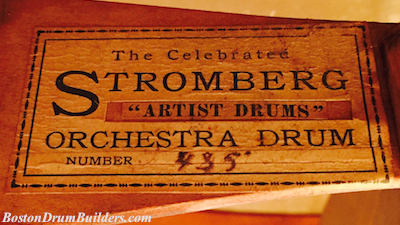
Stromberg was careful to label this instrument as an "Artist" model so that it could not be confused with the higher end Invincible Orchestra Drum which featured patented separate tension lugs. The term "Artist" is a word borrowed from Thompson & Odell's advertising. To that end, Stromberg cut down one of his own paper labels and trimmed out the word "invincible" replacing it quite literally with a snippet from a Thompson & Odell label reading "Artist Drums". Another separate tiny strip of paper inside of the drum simply reads "CHARLES STROMBERG" in block lettering.

More interesting is a unique stamp reading "CHA. STROMBERG / DRUM MANUFACTURER / WASHINGTON STREET". Unfortunately the stamp is too faded to make out the street number, but it is worth noting that Stromberg evidently thought enough of his drum building business at this time to have a stamp identifying himself specifically as a drum manufacturer. Most fascinating is the pencil marking inside of the shell, in Stromberg's own handwriting, indicating that this drum employs his strainer and muffler design patented on April 5, 1904.


The strainer present on this drum is a very close match to Stromberg's original design. It very effectively tightens and loosens the snares though it lacks the ability to quickly engage or disengage the snares from the bottom head. Later versions, or possibly even concurrent ones, were equipped with a throw-off lever which could immediately switch the snares on or off. The strainer and butt seen here are both stamped "PAT. P'D'G", for patent pending, presumably indicating that the hardware was produced no earlier than July 20th, 1903, the date for which the patent was applied.

ca. 1905 Stromberg Artist Drum Snare Strainerca. 1905 Stromberg Artist Drum Snare Butt

Though this was not Stromberg's top of the line snare drum, it still bears his trademark crafstmanship from the beautifully figured maple shell, to the polished rosewood grommet lining the air vent, to the streamlined hoop clips which were more refined version of those used on earlier "Prussian" style drums. Another unique touch is a small brass plate reinforcing the snare side wooden hoop. Barely noticeable when the drum is assembled, this shows not only Stromberg's attention to detail, but his knowledge of the instrument in that this is typically a weak point where the hoop can easily crack.

ca. 1905 Stromberg Artist Drum Hoopca. 1905 Stromberg Artist Drum Grommet

The shell is one ply maple with narrow maple reinforcing rings which is typical for a Boston-made drum of this period. Most unusual is a fixed pinwheel-like wooden structure loosely suspended inside of the shell. The four 'paddles' are joined in the center while only two are attached to the shell. This very strange element seems to have no structural or functional purpose as it does not reinforce the shell and has nothing to do with how the snare strainer operates.

1905 Stromberg Artist Drum

In comparing this drum to nearly two dozen other known examples, nothing like this appears inside of any other Stromberg drum. Furthermore, neither of Stromberg's patents, both of which date from the same period during which this drum was built, mention or illustrate anything of this nature. So what was the purpose of this mysterious wooden pinwheel? Was this somehow intended to affect the sonic qualities of the drum? Was this a one-off experimental prototype or a standard production model? Is this possibly a feature borrowed from banjo construction that Stromberg was attempting to implement on drums? It is, in the end, a drum which presents more questions than answers.

Do you have a drum made by Charles A. Stromberg? I want to hear from you! Feel free to drop Lee an email anytime at lee@vinson.net. And for more on the early 20th century snare drum makers of Boston, Massachusetts, please visit BostonDrumBuilders.com.