Sunday, August 4, 2013

Stone's Market Position in 1932

There is an interesting snippet of information included in Rob Cook's "The Slingerland Book" regarding the market position of George. B. Stone & Son as of 1932.

George Way, one of the driving forces of innovation in the drum making business across many decades was at this time a Sales Manager for the Conn owned Leedy Company of Elkhart, Indiana. Many years earlier, Way had in fact worked for the Stone Company in Boston. For that reason his remarks on Stone hold even more weight as Way would have had some first hand insights to how Stone's business functioned.

In 1932 George Way was searching for financial backing to start his own company. Way's business proposal sized up the competition by including a brief description of each of the major players in the marketplace at that time. His write up of Stone is excerpted below. Remember, this was well after Geo. B. Stone & Son's prime when they're manufacturing ambitions and capabilities were much greater.
"This firm is about 35 years old. They manufacture old style snare and bass drums in limited sizes and finishes. They also make eight or ten accessories. The main activity of the firm is the operation of a large drum school. It is doubtful if their manufacturing activities exceed $25,000.00 a year."
This quote is interesting for several reasons. For one, Way considers Stone's product line to be "old style" by 1932. This isn't altogether surprising as the Stone Company's golden age of the early - mid 1920s had now passed. It also fills us in that by this time the drum school side of the Stone business had surpassed manufacturing as the firm's primary activity.

Further information from Way included in Cook's book gives us some idea of how small George B. Stone & Son really was in comparison to other companies in the industry. Way states that in 1929 just as the Great Depression was setting in that Leedy's sales were down by $80,000 to $449,000 for the year. Slingerland was still very much a newcomer to the percussion business in 1929, but Way estimates that Singlerland's drum division sales rose to about $100,000 that year. Compare this to Ludwig & Ludwig who had grown to surpass Leedy as the largest percussion company in the country by 1927 totaling approximately $800,000 in sales that year. Way's 1932 sales estimates of several other drum makers are telling as well: Novak Drum Supply Co. of Chicago, IL - $50,000 per year; Wilson Drum Company of Chicago, IL - $50,000 to $60,000 per year before going out of business in 1928; Walberg & Auge of Worcestor, MA - $60,000 per year; Duplex Manufacturing Company of St. Louis, MO - around $20,000 per year at their height.

It is difficult to compare all the numbers accurately as Way jumps around a bit on the dates used. Percussion companies in the late 1920s and early 1930s were grappling with the loss of the theater drummer business due to the advent of talking movies, and the Great Depression was crippling the entire economy to the point where nearly everyone's sales figures fell off somewhat. But at the very least, Way's presumptions shed some light on the size of George B. Stone & Son relative to the other major players in the industry during that era.

Do you have a drum made by Geo. B. Stone & Son? I want to hear from you! Send Lee an email at lee@vinson.net.

Sunday, July 21, 2013

William F. McIntosh Rope Drum

From reader Joe Zajack come pictures of an early 20th century rope tension field drum by William F. McIntosh. The drum is fairly simple in design and construction but is notable because very few examples of instruments built by McIntosh are known to exist. McIntosh was mostly a tangential figure in the percussion industry and is best known, so far as the Boston Drum Builders are concerned, for having designed and patented a snare strainer and muffler in 1909 which was used extensively by several manufacturers, most notably Boston's own George B. Stone & Son.


But McIntosh apparently did some manufacturing, or at least assembly, of his own. Clearly he wanted credit for putting this drum together as he marked nearly every component with his name including the shell, leather tugs, and even the drumheads!


Everything about the drum is typical of other Boston makers of the era so it is entirely possible that McIntosh sourced some of the parts, especially the shell and hoops, from his friends at Stone or Stromberg. Given McIntosh's extremely low output of drums, it is unlikely that he had the ability to produce steam bent maple shells and hoops himself.
William F. McIntosh Rope Drum
William F. McIntosh drum, ca. 1926
McIntosh is listed briefly in Christine Merrick Ayars' Contributions to the art of music in America by the music industries of Boston, 1640 to 1936 as having been a "Drummer, drum maker, radio expert and now mostly a dealer in radios and equipment" from about 1900 through 1936. According to the author's footnotes, this information was provided by none other than Enes J. Nokes of Nokes & Nicolai. Inside of the shell of this McIntosh drum is a marking reading "5/26" which may well stand for May of 1926 placing it comfortably within the timeline provided by Nokes to Ayars.
William F. McIntosh Field Drum Detail
William F. McIntosh Rope Drum Shell Stamp
William F. McIntosh Field Drum Head Marking
Do you have a drum by William F. McIntosh? I want to hear from you! Send Lee and email at lee@vinson.net.


Sunday, July 7, 2013

Preservation vs. Restoration

My goal is always first and foremost to preserve an antique drum in as close to original condition as possible. The more aggressive one's approach to 'restoring' a drum, the less of the original is left for future generations to discover. One hundred years from now, a drum's owner should not have to decipher what is factory original and what is a misguided attempt at restoration. That being said, a variety of different approaches may be appropriate when addressing the condition of an old drum. Nothing is cut and dry here, but these are the three basic options with a bit of room for interpretation within each.

1.) Strict Preservation. Leave the drum virtually untouched. Rust, corrosion, and broken heads remain. Only the lightest, most gentle cleaning is done. This approach is recommended for very antique instruments where any tampering could potentially devalue the drum. Patina can be a good thing after all! Once the age is wiped away, it can take decades to return so think twice about cleaning a centuries-old antique. A good candidate for this kind of hands off approach would be an original 18th or 19th century rope drum which still has period heads, rope, and leather ears intact.
 
Lee's 1880s George W. Bemis Drum
1880s George W. Bemis Rope Drum in 'as found' condition.
Unless the drum is incomplete or badly damaged on arrival, only the least invasive cleaning techniques should be used. And unless it has already been converted into a player drum as is sometimes the case, resale value and collectibility in general tend to be adversely affected by any significant alteration to the instrument. Just leave the drum alone and appreciate it for what is is!

2.) Soft Restoration. Gently clean what is left of the original finishes without modifying anything. This to me is still preservation over restoration. It maintains a drum's character and leaves it with a somewhat aged look but helps preserve the instrument and protect it from any further decay. It is important to still keep the instrument in as close to original condition as possible. This is my default approach to cleaning most drums, especially the early 20th century Boston-made drums which I collect.

The level of cleaning and polishing used can be catered to each case but care should be taken not to over clean an antique instrument which can leave it looking over-restored. I typically like to replace broken heads with new calfskin, and gently polish the hardware and shell with products which are non-abrasive and safe for the particular finishes. Abrasive cleaning products should be avoided as antique nickel plating and shellac finishes are especially delicate and can be irreparably damaged with very little effort. Several cleaning products with which I have had success are detailed in a previous post.

Ideal candidates for this type of treatment would be instruments which arrive in fair to good condition and need no significant structural repairs or replacement hardware. So long as the original plating and finishes are in decent condition, shine up what is left and let the drum show its age! The two drums pictured below are examples of 'soft restoration'.
Lee's George B. Stone & Son All-Metal Master-Model Drum - Before Cleaning
Mid 1920s George B. Stone & Son All-Metal Master-Model Drum - Before
Lee's George B. Stone & Son All-Metal Master-Model Drum - After Cleaning
Mid 1920s George B. Stone & Son All-Metal Master-Model Drum - After

1910s Oliver Ditson Orchestra Drum - Before

1910s Oliver Ditson Orchestra Drum - After

3.) Full restoration. This may include the refinishing of wooden shells and hoops, re-plating of metal hardware, replacement of missing parts, and repairs to damaged shells and hardware. This approach is only advisable in extreme cases where the original finishes are already completely destroyed and no real value, financial or otherwise, is being lost. When work is done, care should be taken to use period correct materials and techniques when at all possible. Value is rarely added to antique drums by completely restoring them. Most collectors would much prefer to bring in drums in original condition, flaws in all, than instruments which have already been completely overhauled.

The two drums pictured bellow have undergone significant restoration. Both drums were in poor structural condition, had been previously refinished, and were missing hardware on arrival.
Charles A. Stromberg Orchestra Drum - Before Full Restoration
Charles A. Stromberg Orchestra Drum - After Full Restoration
George B. Stone & Son Separate Tension Band Drum - Before Restoration
George B. Stone & Son Separate Tension Band Drum - Before
George B. Stone & Son Separate Tension Band Drum - After Restoration
George B. Stone & Son Separate Tension Band Drum - After

Sunday, June 16, 2013

Blair & Baldwin, Practical Drum Makers

Amongst the more obscure of the early 20th century Boston Drum Builders is a firm by the name of Blair & Baldwin. They do deserve to be recognized, however, as forefathers to several other Boston makers of the early 1900s.

Blair & Baldwin Drum Makers

Blair & Baldwin was founded in 1892 by William J. Blair and James G. Baldwin. Blair soon took lead of the company and by the mid 1890s the firm claimed to be the largest drum manufacturer in New England. The partnership initially was located in the Brighton District's Abattoir Grounds as is confirmed in the 1893 Boston Almanac and Business Directory. In 1894 the young company moved into Boston proper setting up shop at 379 Albany Street and around 1897 relocated to 169 Dudley Street. The 1902 New England Business Directory and Gazetteer again lists Blair & Baldwin at 169 Dudley Street in Boston. The last inclusion of Blair & Baldwin in Boston City Directories is 1902 at the Dudley Street address.

The information below is reported by Christine Merrick Ayars in Contributions to the Art of Music in America by the Music Industries of Boston 1640 - 1936 (New York: H.W. Wilson, 1937). The author is mistaken however in that Nahum "Grandsire" Baldwin of the J. C. Haynes Company died in 1896. James G. Baldwin, not Nahum J. Baldwin, was in fact a founding partner of Blair & Baldwin. The 1892, 1893, and 1894 Boston Directories list James G. Baldwin as working for Blair & Baldwin. During the very same time period, Nahum J. Baldwin is listed at the same address as the J. C. Haynes Company.

"William J. Blair was a drummer in the Civil War and a maker of good drums. Baldwin was a fine workman also. He resigned to manufacture bicycle wood rims and wheels. Later he worked for John C. Haynes & Co. where he was known as "Grandsire Baldwin". When Mr. Baldwin resigned about 1905, F. E. Dodge bought out Mr. Blair who worked first for Mr. Dodge and then for Nokes & Nicolai until his death."

For more on the origins of Blair & Baldwin, please visit: http://blog.bostondrumbuilders.com/2017/04/blair-baldwin-practical-drum-makers.html

Do you have a drum made by Blair & Baldwin? I want to hear from you! Send Lee an email at lee@vinson.net.

Saturday, June 1, 2013

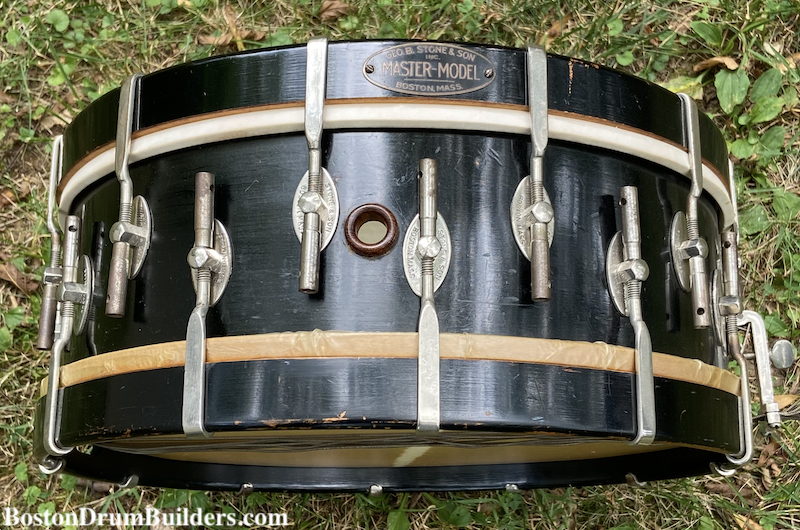
1923 George B. Stone & Son Master-Model Drum

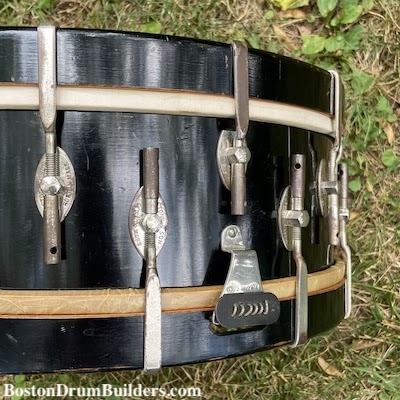
The latest arrival into the collection is another early Master-Model Drum by Boston's George B. Stone & Son This one is finished in the commonly seen black lacquer with nickel plated hardware. As is consistent with other Master-Models from the first two years of production, the drum features a rosewood grommet, Stromberg butt plate and cylindrical tensioning nuts.
1923 George B. Stone & Son Master-Model Drum

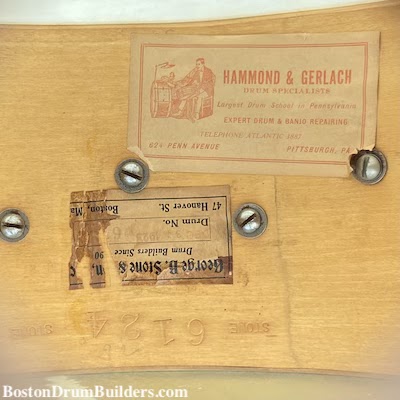
Inside the drum is a Stone & Son label dated December 31, 1923 as well as a second label reading "Hammond & Gerlach / Drum Specialists / Largest Drum School in Pennsylvania / Expert Drum and Banjo Repairing / Telephone Atlantic 3887 / 624 Penn Avenue, Pittsburgh, PA."
W. F. "Bill" Hammond was a renowned performer and teacher in his day. Malcolm M. "Heine" Gerlach was a four time National Champion Drummer of the American Legion Contest, a former member of Pittsburgh's Grand Theater orchestra, and a member of the Pittsburgh Symphony Orchestra. Both Hammond and Gerlach came to know George Lawrence Stone through their involvement in the American Legion competition circuit. The three men were among the thirteen charter members of the National Association of Rudimental Drummers founded at the 1933 American Legion National Convention in Chicago. This personal connection between Stone, Gerlach and Hammond helps explain how a drum shop in Pittsburgh became a dealer for Geo. B. Stone & Son whose sales were mostly localized to New England.
1923 George B. Stone & Son Master-Model Drum
Do you have a George B. Stone & Son Master-Model drum? I would love to hear about it! Drop me a note at lee@vinson.net. And for more on Boston's early 20th century drum makers, please visit BostonDrumBuilders.com.