Sunday, August 2, 2015

The Story of A. A. Young

As Vaudeville was meeting a rapid demise towards the end of the 1920s at the hands of talking cinema and broadcast radio, so too were the dreams of aspiring drummers and drum makers alike. Just as the curtain was coming down for good on Vaudeville, the Great Depression landed and a manufacturing startup of any sort was all but impossible for a one man operation such as that of A. A. Young. But a decade earlier, the twenties were just beginning to roar and to an aspiring drummer and drum maker from Lewiston, Maine the lights of Lynn, Massachusetts must have shined brightly.

Central Square in Lynn, Massachusetts circa 1910
Central Square - Lynn, Massachusetts ca. 1910

Lynn, Massachusetts was long known as an industrial hotbed along the Massachusetts North Shore and more specifically as the center of shoe production in America. By the early 1900s, it is said to have been the largest shoe manufacturing city in the world. This reputation as a cobblers haven may have helped draw A. A. Young to Lynn. Government records from his marriage to Edith M. Sampson in 1894 list Young's occupation as that of Shoemaker.

Known more for industry than for culture, Lynn had a thriving theater scene nonetheless. Venues included the Olympia, B. F. Kieth's Theatre, the Mark Comique, and Katz's Auditorium Theatre. In 1915, the new 2000 plus seat Strand Theater opened on Union Street and it was here that Young would soon find regular work as a musician.

The Strand Theatre in Lynn, MA between 1915 and 1930
Union Street - Lynn, Massachusetts between 1915 - 1930

Arthur Amos Young (1875 - 1957) was born and raised in Lewiston, Maine. The youngest of four children, Arthur attended school and was a laborer as a young man. His father Ezekiel was an engineer and a Free Mason who retired to Harpswell, Maine as a farmer late in his life. Arthur would live with his aging father in Maine until at least 1900.

By 1909 Arthur had moved south to Lynn, Massachusetts with his wife and son. A drum teacher by day and a theater musician by night, Young also had a strong interest in building and selling drums and percussion accessories. City directories throughout the 1910s list Arthur A. Young as a drum manufacturer at 113 Munroe Street just off Central Square. In 1920 his studio moved to 341 Union Street where he would remain for more than a decade teaching students and selling drums in the heart of downtown Lynn.

Not unlike modern times there were tiers amongst drum builders of the 1920s. There were the well established companies of varying sizes, then there were the smaller artisan makers who hand crafted only a select number of instruments, and then there were the A. A. Youngs of the world. Young maintained only a minuscule industry presence and was more of an assembler and a dealer rather than a manufacturer of significance.1922 A. A. Young Drum Advertisement
The International Musician, June 1922

For such a small timer who peaked in the early 1920s, it's a wonder that anything at all can be uncovered on Young. As nearly 100 years have disappeared since, so have most of the A. A. Young drums and sticks used to keep the beat in the theater orchestras of Lynn. Of the few surviving examples left to tell the story, most are dusty, dying, or incomplete.

A. A. Young Orchestra Drum
A. A. Young Orchestra Drum ca. 1910s - 1920s
A. A. Young Drum Butt
A. A. Young Drum Snare Butt
A. A. Young Timpani Mallet
 
A. A. Young Timpani Mallet
A. A. Young Timpani Mallet                         photo courtesy of Danielle Squyres

Young's own advertising would suggest that his "Special Orchestra Drum" was more of a budget level instrument than a professional model. It's likely that the shells and hardware were sourced from other more prominent companies in New England and assembled by Young. Going by the few examples of his work to surface, there are few distinguishing features unique to Young as a maker. Later instruments sometimes appear as a curious hodgepodge of parts taken from different companies and different eras.

Perhaps A. A. Young's most notable contribution to percussion manufacturing was a bass drum pedal design for which he was granted a Canadian patent on November 21st, 1922. It appears that while he applied for an American patent as well, only the Canadian patent was granted, maybe because Young's design was not so different the from other piano-action pedals available at the time.

In the end, Arthur Young was like so many others in his day. He played drums and he built drums. Most early 20th century drum companies were started by drummers after all. Only the biggest and most influential makers left their mark and only the strongest would weather the economic climate of the 1930s. Young's manufacturing prowess never grew that large or powerful and ultimately he has faded into obscurity.

Young lived out his later years, at least through 1940, in Lynn, Massachusetts just as he had in previous decades working as a theater musician and a drum teacher. There couldn't have been much theater work left in those days. The Strand had long since been purchased by Warner Brothers and converted into a movie house. Arthur Amos Young died on May 7, 1957 and was laid to rest at Riverside Cemetery in his native Lewiston, Maine.
A. A. Young Bass Drum Pedal Advertisement
The International Musician, August 1921


Do you have a drum made made by A. A. Young? I'd love to hear from you! Feel free to send Lee an email anytime at lee@vinson.net. And for more on the early 20th century snare drum makers of Boston, Massachusetts, please visit BostonDrumBuilders.com.

Sunday, July 5, 2015

Stone Master-Model Dating Guide - Part II

Historical Overview | Dating Guide Part I | Dating Guide Part II

After discussing tension nuts, snare strainers, butt plates, and grommets in Part I, this second installment will detail additional characteristics by which to more accurately identify and date George. B. Stone & Son Master-Model drums.

Badges

George B. Stone & Son Master-Model snare drums normally have a Master-Model badge mounted to the top counterhoop, positioned above the air vent. Badges appear in several styles but they do not tend to be an accurate guideline for specifically dating a drum. The most commonly seen badge reads " GEO. B. STONE & SON INC. / MASTER-MODEL / BOSTON, MASS." This badge is found on the vast majority of the more than 700 Master-Model snare drums to be produced. A few exceptions include the very earliest drums which sometimes bear the typical GEO. B. STONE & SON or GEO. B. STONE & SON INC. badge lacking the "Master-Model" wording. Other variations include plain brass or silver versions of all three of these badges. George B. Stone & Son Master-Model Drum Badge
Geo. B. Stone & Son Master-Model Drum Badge, ca. 1920s - 1930s

Plain brass or silver badges were generally reserved for more special drums such as those wrapped in Pyralin finishes, or the all-metal Master-Model drums built around solid aluminum shells. On all-metal Master-Model drums, the badge is usually affixed directly onto the shell rather than the top counterhoop.

George B. Stone & Son Master-Model Drum Badge
early Master-Model Drum Badge, ca. 1922
George B. Stone & Son Master-Model Drum Badge
early Master-Model Drum Badge, ca. 1923

George B. Stone & Son Master-Model Drum Badge
All-Metal Master-Model Drum Badge, ca. 1925
George B. Stone & Son Master-Model Drum Badge
Pearl Wrapped Master-Model Drum Badge, ca. 1930s

Late in Stone's manufacturing days of the 1930s, a significant number of common single tension field drums were assembled with Master-Model badges installed. While it is possible that Stone cataloged a Master-Model field drum in the late 1930s, it is more likely that the factory was merely using up their leftover stock of Master-Model badges. A decade earlier, these instruments never would have been considered by Stone to be true "Master-Model" drums as none of the other characteristic elements of the Master-Model drums are to be found in these instruments.

Labels and Date Stamps

Makers labels were typically applied to the inside of Stone Master-Model shells across from the air vent so that they could be viewed by peering through the grommet. Sometimes labels were placed right side up, and sometimes they were placed upside down. There does not appear to be a specific pattern to or method by which the labels were applied.

Date stamps were commonly applied to Stone Master-Model labels up through mid 1925 by which time the serial numbers had reached the low 7000 range. After 1925, the practice of date stamping ceased while the use of serial numbers continued as the four digit numbers would ultimately climb into the high 9000 range. It should be noted that these four digit serial numbers were applied to all Stone shells, not just the Master-Models. The same is true of date stamps from the same time period of 1922 - 1925.

George B. Stone & Son Master-Model Drum Label
Master-Model Label, 1923
George B. Stone & Son Master-Model Drum Label
Master-Model Label, ca. 1926

George B. Stone & Son Master-Model Drum Label
Master-Model Label, late 1920s - early 1930s
George B. Stone & Son Master-Model Drum Label
Master-Model Label, mid 1930s

Master-Model Numbers and Pencil Markings

Geo. B. Stone & Son kept a running count of exactly how many Master-Model drums were being produced. Most Master-Models have a two or three digit number marked somewhere inside of the shell. This is the Master-Model number. The method by which the Master-Model numbers were marked inside of the drums is inconsistent. The most commonly seen marking is a small three digit number hand written in pencil at the bottom of each drum label.

George B. Stone & Son Master-Model Drum NumberingsGeorge B. Stone & Son Master-Model Drum Numberings

Sometimes the Master-Model number was also handwritten in pencil near one or both bearing edges inside the drum. At other times the number is stamped into the wood in a similar fashion to how the serial numbers were imprinted only with much smaller numerals. Sometimes both of the markings are present simultaneously. (Example 1)

Often times, the shell and the wooden counterhoops were marked with the same number telling us that the Stone factory workers matched the hoops specifically to each individual drum. (Examples 2a and 2b)

Complicating this numbering system is the way that the factory kept track of matched pairs of hoops with very similar pencil markings. Sometimes these numbers match the drum but many times they do not. Sometimes the two hoop numbers match each other, but other times they correspond only to a specific side of a particular drum and do not correlate with the Master-Model numbering system. (Example 3)

George B. Stone & Son Master-Model Drum Numberings
Example 1
George B. Stone & Son Master-Model Drum Numberings
Example 2a

George B. Stone & Son Master-Model Drum Numberings
Example 2b
George B. Stone & Son Master-Model Drum Numberings
Example 3

It can be difficult to discern the difference between Stone's hoop numbers and the Master-Model numbers. The hoop numbers are typically one or two digits, marked only in pencil. Master-Model numbers are usually two or three digit numbers and are marked elsewhere in the shell and hoops. Thus confusing the hoop numbers with the Master-Model number is really only an issue with the first one hundred drums where a two digit hoop number could be mistaken for a two digit Master-Model number, or in cases where a Master-Model number can not be found.

Preservation and Provenance

Care should be taken when disassembling a Stone Master-Model drum so as not to accidentally obscure or remove any of the original pencil markings inside of the drum and on the underside of the wooden counterhoops. Removing these small pieces of evidence left behind by a factory worker nearly a century ago takes away from the story of each individual drum and its unique provenance.

If you are the owner of a Stone Master-Model Drum, please write to me! For several years now I have been compiling a listing of Master-Models which currently includes more than three dozen instruments. With each drum documented, more is learned about George B. Stone & Son as a manufacturer, and about the evolution of the company's production capabilities. This is especially important seeing as no original Stone serial number listing exists. Any records kept by the company have long since been lost or destroyed. This is why, by recording information about each drum as it is discovered, we can paint an ever clearer picture of the full history of these wonderful drums and the company that produced them.

Lee can be contacted any time by email at lee@vinson.net.

And for more on the Boston Drum Builders of the early 20th century, please visit BostonDrumBuilders.com.

Sunday, June 7, 2015

Stone Master-Model Dating Guide - Part I

Historical Overview | Dating Guide Part I | Dating Guide Part II

More than 800 George B. Stone & Son Master-Model Drums were produced from the early 1920s through the late 1930s. Many defining characteristics of the Master-Model Drums evolved over time allowing for one to date a particular instrument with some degree of accuracy. Several of these characteristics are detailed here with additional features to be discussed later in Part II of the Stone Master-Model Dating Guide.

TENSION NUTS

When the first Master-Models were introduced in 1922, the drums were tensioned using cylindrical tension nuts. A second style of nut which was partially hexagonal and partly cylindrical appears on drums dating roughly from 1924 through 1926. The most commonly seen tension nuts were completely hexagonal and could easily be tuned with a typical wrench. Master-Models sometimes appear with a mix of second and third generation tension nuts, but the third style of nut was used exclusively from about 1926 onward.


ca. 1922 - 1924

ca. 1924 - 1926

ca. 1925 - 1930s


SNARE STRAINERS

The Master-Model snare throw-off is basically an elongated, inverted version of the Stone Patent Snare Strainer and Muffler designed by William F. McIntosh. While there were several slight variations of this design used on the Master-Model drums, it is generally not a reliable distinguishing feature by which to date an instrument. To further complicate matters, Stone was willing to sell this part separately thus some instruments not produced by Stone may surface bearing a version of the McIntosh strainer.

The most noticeable adaptation to the Master-Model strainer over time is the crossover from a somewhat primitive thumb screw on earlier examples to a more finished looking knurled metal knob on later ones. Also, earlier strainers typically had straight lever arms while angled arms are more common on later examples. Later strainers commonly are installed with a thin metal tab which helps maintain snare tension.

1922 - ca. 1925 (pictured without snare wires)1922 - ca. 1925 (pictured with snare wires)

ca. 1925 - 1930s (pictured without snare wires) ca. 1925 - 1930s (pictured with snare wires)


BUTT PLATES

Early Stone Master-Model drums, circa 1922 - 1924, used a butt plate designed and patented by Charles A. Stromberg. This piece strongly resembles a banjo tailpiece, something Stromberg would have been very familiar with as a string instrument maker. By late 1924, Stone began installing a more stable, two point butt plate which could accept wire, gut, or wire wound silk snares. This later style of butt plate also appears on some early Walberg & Auge drums.

1922 - ca. 1924 (pictured without snare wires)1922 - ca. 1924 (pictured with snare wires)

ca. 1925 - 1930s (pictured without snare wires) ca. 1925 - 1930s (pictured with snare wires)


GROMMETS

The earliest generation of Master-Models featured highly polished rosewood grommets as did most other drums made by Stone & Son during that era. Around the end of 1924 the company began using threaded black synthetic grommets which screwed directly into a threaded vent hole in the shell.


1922 - late 1924

early 1925 - 1930s


In the next post we'll have Part II of the Stone Master-Model Dating Guide.

Do you have a Stone Master-Model? I would love to hear about it! Feel free to send Lee an email anytime at lee@vinson.net. And for more on the other turn of the century Boston-based drum makers, please visit BostonDrumBuilders.com.

Thursday, May 28, 2015

The George B. Stone & Son Master-Model Drum

Historical Overview | Dating Guide Part I | Dating Guide Part II

First introduced in 1922, the Master-Model Drum was George B. Stone & Son's premier snare drum offering and remains the most recognizable and iconic instrument produced by the company. Originally marketed as the "All-Weather Drum", the name "Master-Model" was adopted by late 1922.

Geo. B. Stone Advertisement, September 1922
Geo. B. Stone & Son Advertisement, September 1922
Geo. B. Stone Advertisement, December 1922
Geo. B. Stone & Son Advertisement, December 1922

The Stone Master-Model snare drums were built from staggered three-ply all maple shells, not single-ply maple as is sometimes reported. Counterhoops were constructed from a single ply of maple and were matched specifically to each drum. The Master-Model was cataloged in only one size, initially 5 1/4" x 14" and later 5" x 14". Deeper sizes including 6.5" and 7" were produced on a limited basis with most such examples dating to the mid 1930s.

Geo B. Stone & Son Master-Model Drum, Catalog K - 1925
Geo. B. Stone & Son Catalog K, 1925
Geo B. Stone & Son Master-Model Drum, Catalog K - 1925
Geo. B. Stone & Son Catalog K, 1925

Master-Model snare drums were offered in a variety of finishes but the most common by far was what Stone described as "Black De Luxe Finish" with "Nickel Trimmings". Hardware was also available in "Nobby Gold finish", and later chromium, for an additional charge. Natural maple is the second most commonly seen finish on Master-Model snare drums with "White De Luxe Finish" being less common.

1922 George B. Stone % Son Master-Model snare drum1923 Geo B. Stone % Son Master-Model snare drum
Antique George B. Stone % Son Master-Model DrumVintage Geo B. Stone % Son Master-Model Snare Drum ca. mid - late 1920s

Examples in wrapped finishes including white marine pearl, black diamond pearl, silver sparkle, gold sparkle, and red sparkle were produced beginning around 1928. An all-metal Master-Model built around a solid aluminum shell with polished aluminum hoops was first introduced in 1925 but was produced only in small quantities. The Stone Master-Models were sold in dwindling numbers into the late 1930s with more than 800 drums ultimately being built.

ca. mid 1930s George B. Stone % Son Master-Model Drum in White Marine Pearlca. late 1920s - early 1930s Stone Master-Model Drum in Sparkling Silver Pyralin

In the next post we'll have Part I of the Stone Master-Model Dating Guide.

Do you have a Stone Master-Model? I would love to hear about it! Feel free to send Lee an email anytime at lee@vinson.net. And for more on the other turn of the century Boston-based drum makers, please visit BostonDrumBuilders.com.

Wednesday, April 15, 2015

The Celebrated Stromberg Invincible Orchestra Drum

Swedish immigrant Charles A. Stromberg was a cabinet maker turned musical instrument craftsman who came to America in 1887 and soon after began working for Thompson & Odell in Boston. In 1905, upon the bankruptcy of Thompson & Odell, Stromberg went out on his own manufacturing and repairing a wide assortment of musical instruments including banjos, mandolins, guitars, harps, and drums. According to Christine Merrick Ayars' Contributions to the Art of Music in America by the Music Industries of Boston 1640 - 1936 (New York: H.W. Wilson, 1937) Stromberg had by the mid 1930s produced "about 1000 banjos, 200 mandolins, 100 guitars all custom made and 400 drums."

Long before Charles and his youngest son Elmer would become famous for their big-body archtop guitars of the 1940s and 1950s, the elder Stromberg was catering to the needs of theater drummers in Boston's thriving Vaudeville scene. Today we take a look at a magnificent example of some of his very earliest independent work, a beautifully well preserved "Celebrated Stromberg Invincible Orchestra Drum" dated March, 30 1906.

Lee's Celebrated Stromberg Invincible Orchestra Drum1906 Charles A. Stromberg Invincible Orchestra Drum1903 Music Trade ReviewThe Music Trade Review - December, 1903

This drum was in many ways a decade or two ahead of its time and at least lap ahead of the local field as no maker in New England was making anything like this at the turn of the 20th century. Emile Boulanger's Duplex Manufacturing Company of St. Louis had patented a separate tension lug in 1883, but drummers and other drum makers were slow to embrace the concept. In 1906, the lowly snare drum was still more than a decade from being fully modernized at the hands of companies such as Ludwig & Ludwig and Leedy during the 1920s. At the time when Stromberg built this drum, Ludwig & Ludwig had not even been founded yet.

Stromberg applied for a two patents pertaining to snare drum construction, both of which were applied to his Invincible Orchestra Drum. The first patent, applied for on July 20, 1903 and granted on March 8, 1904, involved the method by which the drum is tensioned using claws, tension rods, and separate tension lugs. The second patent, also applied for on July 20, 1903 and then granted on April 5, 1904, related to the snare throw-off and snare butt. A somewhat updated version of this design is present on this drum though the patent date is still stamped into both the snare butt and the bracket which clamps the snares into the throw-off. Presumably, Stromberg continued to evolve his design after submitting it to the patent office almost three years earlier.
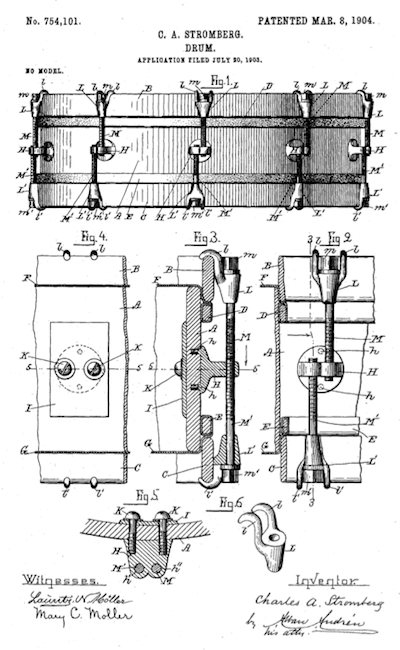
Stromberg Drum PatentStromberg Drum Patent

The significance of these patented designs cannot be understressed. The concept of separate tension, where either head can be tensioned independently of the other, was still a relatively new one at the turn of the 20th century and this drum was likely the first of its kind in Boston. And a fully functioning snare throw-off capable of not only tightening and loosening the snares, but fully engaging them with or releasing them completely from the bottom head with the turn of a single lever was almost unheard of at the time.

Stromberg's background as a cabinet maker is clearly on full display here. A beautiful outer ply of birds-eye maple, a perfectly turned ebony grommet, and engraved, faux rosewood counter hoops are all examples of his impressive craftsmanship. Such touches were not uncommon in the early decades of the 1900s, but Stromberg's work is of exceptionally high quality. The counterhoops for example have been painted to resemble rosewood veneer and have then been scored or engraved with a series of lines as ornamentation. This also gives the drum a more high end look and even a certain lightness in appearance considering the height of the wooden hoops necessary to maintain tension on the heads. Stromberg drums in general have a certain elegance about them and that characteristic is certainly apparent here.

Maybe the most astonishing feature of this drum is its staggered, THREE PLY maple shell with no reinforcing rings. Gretsch often claims that this is an innovation of their own dating from sometime in the 1920s and later popularized in the 1940s, but this drum provides us with hard evidence that Stromberg was forming such shells in his Boston workshop several decades earlier.
Lee's 1906 Charles A. Stromberg Invincible Orchestra Drum

Despite the rather rudimentary design of the separate tension lugs, they still have a certain low mass quality about them so as not to give the drum a bulky or heavy appearance. And the quality of construction in general is of the highest level. The three ply shell is as sturdy as the day it was built and the solid brass lugs, which maintain their bright nickel plating, function just as they should after 109 years.

The makers label present inside of the drum shell is significant in its own right. It is in fact a Thompson & Odell label that has been modified with what was apparently Stromberg's own address at the time, 767 Washington St., Boston, Mass., U.S.A. The handwritten date, March 30, 1906, positions this as one of the first drums made by Stromberg after his departure from Thompson & Odell upon their bankruptcy in 1905.

1906 Stromberg Drum LabelStromberg Snare Throw-off
Stromberg Snare ButtStromberg Snare Drum Lug

The drum is outfitted with period correct calfskin heads and what looks to be the original gut snares which are quite thin and of high quality. This instrument won't receive any playing time as it will be preserved purely as a historical collectible, but a few light taps on the head produce a surprisingly bright sound due to the shallow three inch shell depth and firm head tensioning provided by the design of the drum.

Do you have a drum made by Charles A. Stromberg? I want to hear from you! Feel free to drop Lee an email anytime at lee@vinson.net. And for more on the early 20th century snare drum makers of Boston, Massachusetts, please visit BostonDrumBuilders.com.
