Sunday, July 7, 2013

Preservation vs. Restoration

My goal is always first and foremost to preserve an antique drum in as close to original condition as possible. The more aggressive one's approach to 'restoring' a drum, the less of the original is left for future generations to discover. One hundred years from now, a drum's owner should not have to decipher what is factory original and what is a misguided attempt at restoration. That being said, a variety of different approaches may be appropriate when addressing the condition of an old drum. Nothing is cut and dry here, but these are the three basic options with a bit of room for interpretation within each.

1.) Strict Preservation. Leave the drum virtually untouched. Rust, corrosion, and broken heads remain. Only the lightest, most gentle cleaning is done. This approach is recommended for very antique instruments where any tampering could potentially devalue the drum. Patina can be a good thing after all! Once the age is wiped away, it can take decades to return so think twice about cleaning a centuries-old antique. A good candidate for this kind of hands off approach would be an original 18th or 19th century rope drum which still has period heads, rope, and leather ears intact.
 
Lee's 1880s George W. Bemis Drum
1880s George W. Bemis Rope Drum in 'as found' condition.
Unless the drum is incomplete or badly damaged on arrival, only the least invasive cleaning techniques should be used. And unless it has already been converted into a player drum as is sometimes the case, resale value and collectibility in general tend to be adversely affected by any significant alteration to the instrument. Just leave the drum alone and appreciate it for what is is!

2.) Soft Restoration. Gently clean what is left of the original finishes without modifying anything. This to me is still preservation over restoration. It maintains a drum's character and leaves it with a somewhat aged look but helps preserve the instrument and protect it from any further decay. It is important to still keep the instrument in as close to original condition as possible. This is my default approach to cleaning most drums, especially the early 20th century Boston-made drums which I collect.

The level of cleaning and polishing used can be catered to each case but care should be taken not to over clean an antique instrument which can leave it looking over-restored. I typically like to replace broken heads with new calfskin, and gently polish the hardware and shell with products which are non-abrasive and safe for the particular finishes. Abrasive cleaning products should be avoided as antique nickel plating and shellac finishes are especially delicate and can be irreparably damaged with very little effort. Several cleaning products with which I have had success are detailed in a previous post.

Ideal candidates for this type of treatment would be instruments which arrive in fair to good condition and need no significant structural repairs or replacement hardware. So long as the original plating and finishes are in decent condition, shine up what is left and let the drum show its age! The two drums pictured below are examples of 'soft restoration'.
Lee's George B. Stone & Son All-Metal Master-Model Drum - Before Cleaning
Mid 1920s George B. Stone & Son All-Metal Master-Model Drum - Before
Lee's George B. Stone & Son All-Metal Master-Model Drum - After Cleaning
Mid 1920s George B. Stone & Son All-Metal Master-Model Drum - After

1910s Oliver Ditson Orchestra Drum - Before

1910s Oliver Ditson Orchestra Drum - After

3.) Full restoration. This may include the refinishing of wooden shells and hoops, re-plating of metal hardware, replacement of missing parts, and repairs to damaged shells and hardware. This approach is only advisable in extreme cases where the original finishes are already completely destroyed and no real value, financial or otherwise, is being lost. When work is done, care should be taken to use period correct materials and techniques when at all possible. Value is rarely added to antique drums by completely restoring them. Most collectors would much prefer to bring in drums in original condition, flaws in all, than instruments which have already been completely overhauled.

The two drums pictured bellow have undergone significant restoration. Both drums were in poor structural condition, had been previously refinished, and were missing hardware on arrival.
Charles A. Stromberg Orchestra Drum - Before Full Restoration
Charles A. Stromberg Orchestra Drum - After Full Restoration
George B. Stone & Son Separate Tension Band Drum - Before Restoration
George B. Stone & Son Separate Tension Band Drum - Before
George B. Stone & Son Separate Tension Band Drum - After Restoration
George B. Stone & Son Separate Tension Band Drum - After

Sunday, June 16, 2013

Blair & Baldwin, Practical Drum Makers

Amongst the more obscure of the early 20th century Boston Drum Builders is a firm by the name of Blair & Baldwin. They do deserve to be recognized, however, as forefathers to several other Boston makers of the early 1900s.

Blair & Baldwin Drum Makers

Blair & Baldwin was founded in 1892 by William J. Blair and James G. Baldwin. Blair soon took lead of the company and by the mid 1890s the firm claimed to be the largest drum manufacturer in New England. The partnership initially was located in the Brighton District's Abattoir Grounds as is confirmed in the 1893 Boston Almanac and Business Directory. In 1894 the young company moved into Boston proper setting up shop at 379 Albany Street and around 1897 relocated to 169 Dudley Street. The 1902 New England Business Directory and Gazetteer again lists Blair & Baldwin at 169 Dudley Street in Boston. The last inclusion of Blair & Baldwin in Boston City Directories is 1902 at the Dudley Street address.

The information below is reported by Christine Merrick Ayars in Contributions to the Art of Music in America by the Music Industries of Boston 1640 - 1936 (New York: H.W. Wilson, 1937). The author is mistaken however in that Nahum "Grandsire" Baldwin of the J. C. Haynes Company died in 1896. James G. Baldwin, not Nahum J. Baldwin, was in fact a founding partner of Blair & Baldwin. The 1892, 1893, and 1894 Boston Directories list James G. Baldwin as working for Blair & Baldwin. During the very same time period, Nahum J. Baldwin is listed at the same address as the J. C. Haynes Company.

"William J. Blair was a drummer in the Civil War and a maker of good drums. Baldwin was a fine workman also. He resigned to manufacture bicycle wood rims and wheels. Later he worked for John C. Haynes & Co. where he was known as "Grandsire Baldwin". When Mr. Baldwin resigned about 1905, F. E. Dodge bought out Mr. Blair who worked first for Mr. Dodge and then for Nokes & Nicolai until his death."

For more on the origins of Blair & Baldwin, please visit: http://blog.bostondrumbuilders.com/2017/04/blair-baldwin-practical-drum-makers.html

Do you have a drum made by Blair & Baldwin? I want to hear from you! Send Lee an email at lee@vinson.net.

Saturday, June 1, 2013

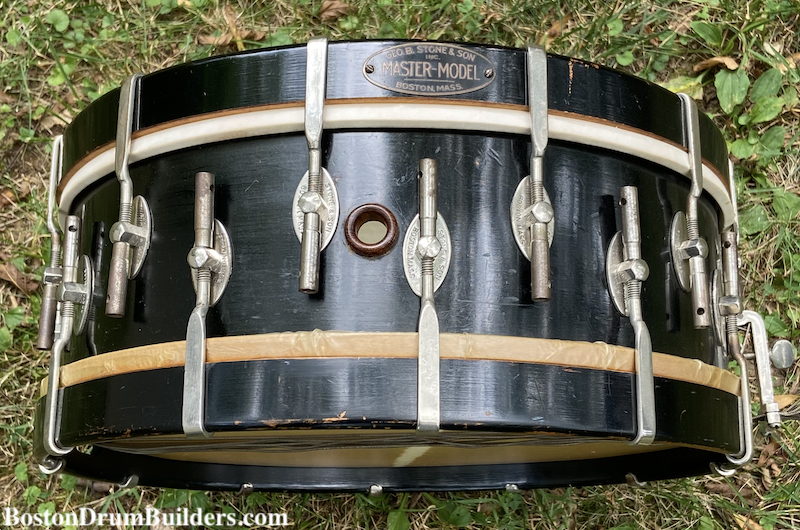
1923 George B. Stone & Son Master-Model Drum

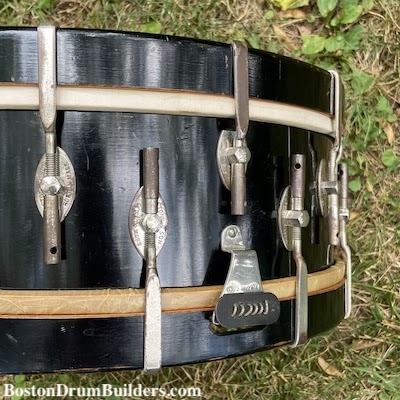
The latest arrival into the collection is another early Master-Model Drum by Boston's George B. Stone & Son This one is finished in the commonly seen black lacquer with nickel plated hardware. As is consistent with other Master-Models from the first two years of production, the drum features a rosewood grommet, Stromberg butt plate and cylindrical tensioning nuts.
1923 George B. Stone & Son Master-Model Drum

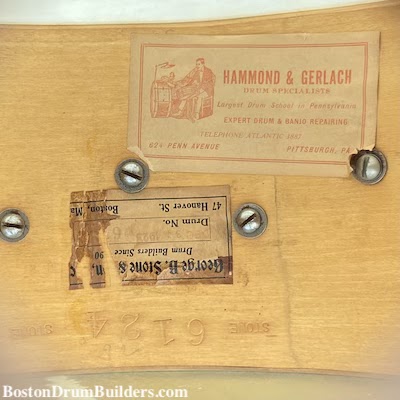
Inside the drum is a Stone & Son label dated December 31, 1923 as well as a second label reading "Hammond & Gerlach / Drum Specialists / Largest Drum School in Pennsylvania / Expert Drum and Banjo Repairing / Telephone Atlantic 3887 / 624 Penn Avenue, Pittsburgh, PA."
W. F. "Bill" Hammond was a renowned performer and teacher in his day. Malcolm M. "Heine" Gerlach was a four time National Champion Drummer of the American Legion Contest, a former member of Pittsburgh's Grand Theater orchestra, and a member of the Pittsburgh Symphony Orchestra. Both Hammond and Gerlach came to know George Lawrence Stone through their involvement in the American Legion competition circuit. The three men were among the thirteen charter members of the National Association of Rudimental Drummers founded at the 1933 American Legion National Convention in Chicago. This personal connection between Stone, Gerlach and Hammond helps explain how a drum shop in Pittsburgh became a dealer for Geo. B. Stone & Son whose sales were mostly localized to New England.
1923 George B. Stone & Son Master-Model Drum
Do you have a George B. Stone & Son Master-Model drum? I would love to hear about it! Drop me a note at lee@vinson.net. And for more on Boston's early 20th century drum makers, please visit BostonDrumBuilders.com.

Sunday, May 26, 2013

F. E. Dodge Timpani

From Jim Davey in Norfolk, Massachusetts come photos of a turn of the century timpano by the F. E. Dodge Company. The pair of drums, one of which is shown here, was acquired several years ago at a large outdoor antique show in New England and now sees regular use with Southeastern Massachusetts Community Concert Band.

Of note is that the drums are constructed around "Silver-Aluminum Bell-Metal Seamless Kettles". This is unusual in that timpani are traditionally built around copper bowls. The tuning system on these Dodge drums is also somewhat unusual as the handles used to tension the heads pull against metal bands which stretch fully around the outside of the shell and connect at the bottom of the drum. More conventional designs apply tension to brackets attached to the side of the kettles.

The heads, I am told, originally were tucked directly onto the counterhoops as is the case with many antique timpani. However, to more easily facilitate modern performance applications, plastic heads have now been fitted onto the drum.

The badge affixed to the drum is not one I have come across before. Perhaps it is of an earlier design and or a badge used exclusively for large instruments such as timpani.

The drums rest on a simple three legged cradle and would have been suitable for use with theater orchestras or larger performing ensembles of the day.

The drums were modeled around a patented design by Harry A. Bower. Timpani illustrated in the 1907 Dodge Catalog are of a more common design. The catalog page seen at right is taken from Nokes & Nicolai American Drummer no. 5, circa 1914. Nokes & Nicolai succeeded the Dodge Company in 1912 and continued to produce and market many of Dodge's products under their original names.

Bower's design included both an external and internal tuning mechanism. The production model appears to use only the external system while the internal mechanism is absent from both the cataloged drum and the surviving example seen here.
Nokes & Nicolai American Drummer No. 5, ca. 1914
Photo Courtesy of Jim Davey

1907 Harry A. Bower Patent Drawings

Do you have a percussion instrument made by the F. E. Dodge Company? I want to hear from you! Send Lee an email at lee@vinson.net.

Sunday, April 21, 2013

Single Head Snare Drums

The early 1900s saw a great deal of experimentation in drum design and construction. One model which caught on for a brief time but has long since gone nearly extinct is that of the single head snare drum.

Single head snare drums served several purposes. For one, they were compact in size and were highly portable. A small drum with only one head could easily nest with other smaller drums or be filled with traps and sound effects to be packed and transported to the next gig. Also, single head drums were by their very nature economical since they didn't require as much material to assemble. In some instances, these drums were constructed with less than high end shells and hoops which further reduced production costs.
It should be noted that companies were not promoting single head drums as being top of the line. Instead, these drums were targeted towards working drummers who were on the move and those buyers who were looking for cheaper options than the high end models. This isn't to say, however, that single head drums were poorly built.

In terms of construction, most of these drums are fairly straight ahead. The three examples pictured here, as well as all of those depicted in catalog artwork below, utilize a single wooden counterhoop. Some use conventional tension rods and some use thumbscrew rods. Many but not all had some sort of posts affixed to the shell to facilitate the positioning of the tension rods. The style of hooks used to pull tension down on the hoop vary by maker. Some designs tension from the top but most tune from the bottom where the tensioning hardware would remain completely out of the way of the player.

Perhaps the most unique aspect of these drums is how the snares are mounted inside of the drum against the bottom of the head. Some models had only a simple strainer with which to adjust the snare tension. Other examples, such as the one pictured at top, had a true throw-off capable of engaging or fully disengaging the snares from the head.

The three drums pictured at right are all of unknown make. No badge or label is present on any of the three nor do they match up definitively with any of the catalog pages below. This speaks to a couple of point including the inherent generic nature of these drums, and the fact that these were generally considered lower level instruments even in their day. It would appear that many companies were less likely to herald or even label these instruments as they left the factory.
Lee's Early 1900s Single Head Drum


Danielle's Early 1900s Single Head Drum
Photo Courtesy of Danielle Squires


Early 1900s Single Head Drum
Photo: ebay
In the catalog pages below, most of which date from the 1910s, you will notice some shared artwork. Where these instruments were being manufactured is unknown. Note how adamantly the second Stone & Son catalog states that their single head drums are bought from another manufacturer! Again, this all speaks to the fact that these instruments were popular economical offerings available through a great number of companies during the early 1900s.


Oliver Ditson Wonderbook Number Four - 1910


Excelsior Drum Works - 1911          Photo: VintageDrumGuide.com


Geo. B. Stone & Son Catalog G - ca. 1912


Geo. B. Stone & Son Catalog H - ca. 1915


F. E. Dodge Company - 1907          Photo: VintageDrumGuide.com


Carl Fischer Musical Instrument Co.          Photo: eBay


Acme / Sears, Roebuck, and Co. - 1908          Photo: eBay


Nokes & Nicolai American Drummer No. 6 - ca. 1918


Do you have a single head snare drum? I want to to hear from you! Send Lee an email at lee@vinson.net.