Wednesday, January 1, 2025

1908 Stromberg Invincible Orchestra Drum

A cabinet maker by trade, Charles A. Stromberg immigrated in 1886 to the United States from Sweden. By 1891 he came to be employed at Boston's Thompson & Odell where he would eventually serve as foreman in their banjo, mandolin and guitar factory. Following the 1905 bankruptcy of Thompson & Odell, Stromberg briefly partnered with William Parker Ware at 767 Washington Street before setting up his own shop at 61 Hanover Street where he would remain until 1912. The example seen here dates from February 15, 1908.
1908 Stromberg Invincible Orchestra Drum
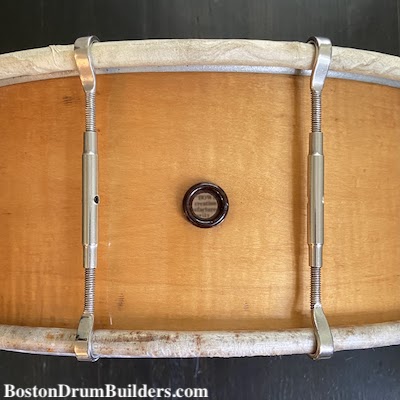
Weathered but completely intact, the drum features a well-preserved makers label with a handwritten number and date. The drum has no badge as the practice was not adopted by Stromberg until the mid 1910s.
1908 Stromberg Invincible Orchestra Drum Grommet
1908 Stromberg Invincible Orchestra Drum Makers Label
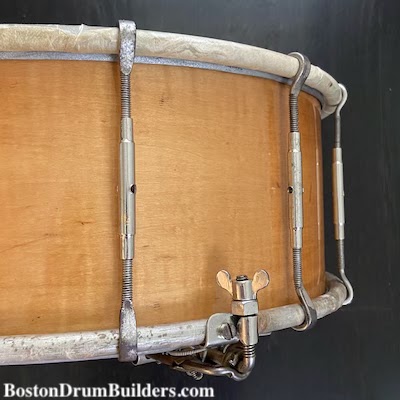
Stromberg filed for and was granted two patents pertaining to snare drum construction: (Snare-tightening device for drums. US Patent 756,730 filed for July 20, 1903, and issued April 5, 1904, and Drum. US Patent 754,101 filed for July 20, 1903, and issued March 8, 1904.) The snare mechanism present on this example is a slightly evolved version of Stormberg's patented design.
1908 Stromberg Invincible Orchestra Drum Snare Mechanism
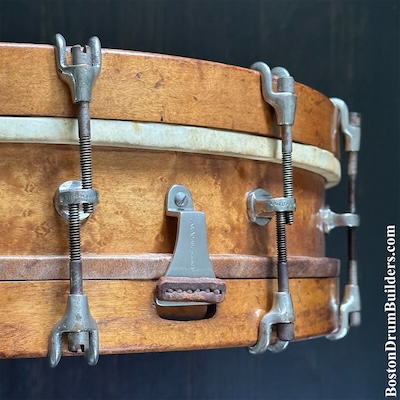
1908 Stromberg Invincible Orchestra Drum Snare Butt
Do you have a drum made by Charles A. Stromberg? I would love to hear about it! Feel free to drop Lee an email at lee@vinson.net. And for more on the early 20th century snare drum makers of Boston, Massachusetts please visit BostonDrumBuilders.com or follow @old_boston_drums on instagram.

Tuesday, October 1, 2024

Stone Separate Tension Orchestra Drum, ca. mid 1910s

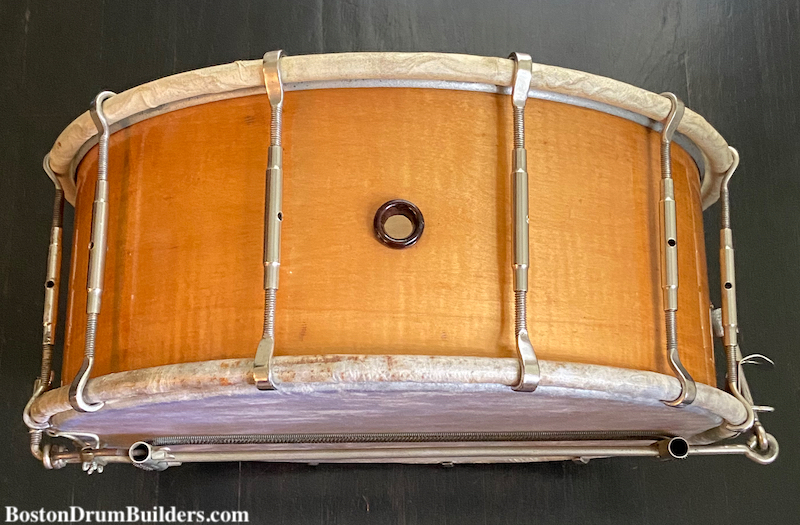
The Separate Tension Orchestra Model was George B. Stone & Son's premier snare drum offering through the 1910s and into the early 1920s. The example featured here, dating from the early to mid 1910s, is typical in many ways but quite uncommon in others. Immediately noticeable is something not often seen from Stone & Son - a mahogany shell.
mid 1910s George B Stone and Son Separate Tension Snare Drum
The overwhelming majority of Stone drums feature maple shells. Mahogany, however, as well as oak and walnut were offered in early Stone catalogs including Catalog H, circa 1915. By the time Catalog I was published in 1919, only maple was listed.

Also in contrast with later Stone drums is the recessed rosewood grommet intended to prevent obstructing the flesh hoops as the heads are tightened. Lastly, the single-ply maple counterhoops are stained around the outer face to approximate the color of mahogany.

Stone Catalog H circa 1915
mid 1910s George B Stone and Son Separate Tension Snare Drum
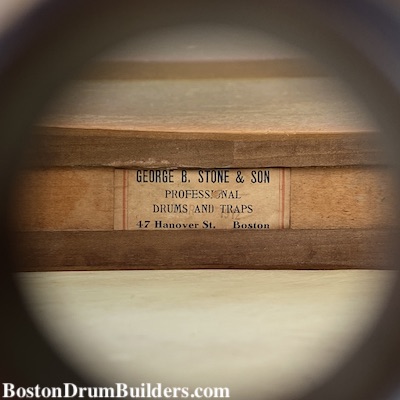
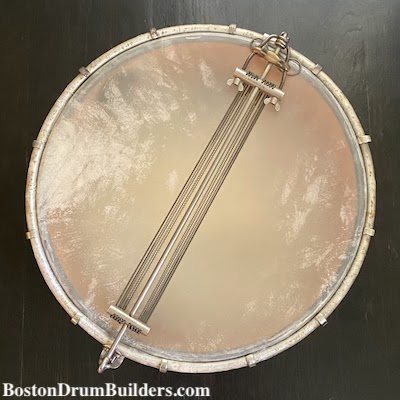
Though badly torn, an original Stone "SPECIAL TRANSPARENT" snare side head remains intact. A well-preserved makers label inside the drum is consistent with other Stone drums from the early to mid 1910s. The drum has no metal badge as the practice had not yet been adopted by Stone & Son.
George Stone drumhead stamp
mid 1910s George Stone drum makers label
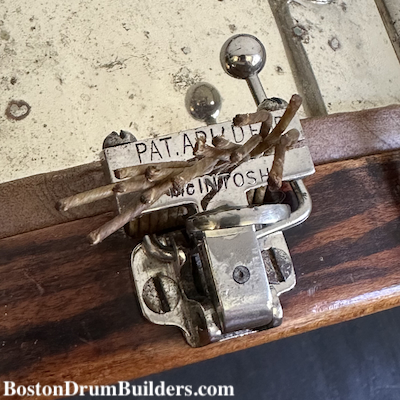
The snare mechanism is William F. McIntosh's 1909 patent snare strainer and muffler and the original "Wire Wound Waterproof Snares" are held in place on the opposite side by a simple leather anchor.
mid 1910s George B Stone and Son Separate Tension Snare Drum
Do you have a Geo. B. Stone & Son drum? I would love to hear from you! Feel free to email Lee at lee@vinson.net. And for more on Stone and the other turn of the century Boston-based drum makers, please visit BostonDrumBuilders.com or follow @old_boston_drums on Instagram.

Wednesday, July 10, 2024

William F. McIntosh Snare Drum, ca. 1908

William F. McIntosh (1876 - 1950) lead a varied professional life working as a machinist, drum maker, musician, radio repairman, and electrician. He is perhaps best known for his snare strainer and muffler patented in 1909 and used extensively by Boston's George B. Stone & Son through the 1910s and 1920s. McIntosh's output as a maker was small but ranged across the first several decades of the 1900s and is known to include snare drums, bass drums, xylophones and traps such as whistles and ratchets. The separate tension snare drum featured here was likely produced around 1908 or 1909.
circa 1908 William F McIntosh Snare Drum
Lettering stamped into the snare mechanism indicates that a patent has been applied for but has not yet been granted. This helps pinpoint the likely date of manufacture to a narrow window of time between October of 1908 and February of 1909. Of course the drum could have been assembled later using earlier components, but the snare machanism at least dates to this very speicific timeframe. A superbly well preserved makers label inside the drum reads "Wm. F. McIntosh / MANUFACTURING DRUMMER, / HIGH GRADE / Drums, Traps and Drum Findings / Professional Xylophones & Orchestra Bells / a specialty, 6 ELWOOD STREET / CHARLESTOWN, MASS."

William F McIntosh Snare Strainer and Muffler
circa 1908 William F McIntosh Makers Label

The drum is outfitted with twelve single-post tube lugs, slotted tension rods, and cast brass hooks all of which have been nickel plated. Of note is the somewhat crudely formed metal shell with rolled over bearing edges and a soldered seam. A wooden band mounted inside the shell offers additional reinforcement while providing a sturdy backing for the mounting hardware. The counterhoops are single-ply maple with the exterior painted to emulate the look of a more exotic wood.

William F McIntosh Snare Drum Shell
circa 1908 William F McIntosh Snare Drum

Do you have a drum made by William F. McIntosh? I would love to hear about it! Feel free to send Lee and email at lee@vinson.net. And for more on the early 20th century snare drum makers of Boston, Massachusetts please visit BostonDrumBuilders.com and follow @old_boston_drums on instagram.

Thursday, June 1, 2023

ca. 1862 John C . Haynes Drum with Provenance

Boston's John C. Haynes & Company dealt a wide variety of musical instruments including many that were imported or sourced from other makers. Drum building, however, was a central element of their business from the outset. Haynes advertising from the early 1860s commonly promotes their "Massachusetts Drum Manufactory". Makers labels found inside early Haynes drums mirror this wording.

Haynes produced a huge quantity of drums during the second half of the 19th century, a majority of which were rope tension drums built around natural colored maple shells with black painted wooden counterhoops - a motif favored by band instrument makers in and around Boston during the later decades of the 1800s. By contrast, drums from the earliest days of Haynes production are typically stained a dark brown color with matching counterhoops. Less common are drums with ornately painted eagle motifs or artwork denoting a particular regiment.

It is a common misconception that any Haynes drum with a label bearing the address of 33 Court Street dates from the Civil War. While the company was indeed located at this address during the Civil War era, Haynes continued to do business at 33 Court Street until the early 1890s. The drum featured here is presumed to have been produced in 1862 and is typical of Haynes' early period.

Acquired from a great, great grandson of the original owner, the drum remained in the family for more than 150 years, its provenance having mostly been lost. No signature or name is anywhere to be found. Aside from a well-preserved makers label, the sole visible markings are the letter "e" and a number "5" written boldly in black ink inside the shell. Only after a good amount of research into military records and family genealogy would the drum begin to reveal its backstory reconnecting it with very specific time and place, and to the soldier who once carried it.

Ezra Morse was born January 3rd, 1835 in Ashland, Massachusetts where he would spend most of his adult life. On September 27, 1855, he was married to Ellen Lucinda Dadmun, a native of Framingham. Marriage records list Morse's occupation as "farmer". 1860 Census records show Ezra and Ellen with two young children living in the Dadmun household while Ezra worked as a carpenter. The couple would eventually bear six children. On August 28, 1862 Morse enlisted in the Fifth Regiment of the Massachusetts Volunteer Infantry mustering into service on September 16th. He was discharged at Boston on July 2nd, 1863.

Copious documentation exists on the Fifth Regiment's movements and activities during the Civil War thanks in part to a 1911 publication by the Fifth Regiment Veteran Association. "THE FIFTH REGIMENT MASSACHUSETTS VOLUNTEER INFANTRY IN ITS THREE TOURS OF DUTY 1861, 1862-'63, 1864" by Alfred S. Roe offers several mentions of Morse including a first-hand account of him having been part of the regimental band. This along with other military records identifies Morse as a member of Company E from the Fifth Regiment. This explains the "5" and "e" marked inside of the shell and presumably dates Morse's drum as having been manufactured no later than 1863.

Following the War, Ezra Morse had a long and successful career as an auctioneer and trader dealing in commodities such as coal, lumber, and wool. He also maintained an active involvement in the Grand Army of the Republic, a fraternal organization formed by veterans of the Union forces. Morse was among the forty charter members of Massachusetts' Colonel Prescott Post 18 upon its founding in August of 1867 and later served as Commander (1882) and Adjutant (1910).

The Ashland Historical Society has extensive records pertaining to the history of GAR Post 18 including a "Personal War Sketch" signed by Morse. This document brings to light many fascinating details including the names of Morse's "most intimate comrades" during his time in service and chronicles his participation in the march from New Bern to Goldsboro, and battles at Kinston and Whitehall, North Carolina.

Also in the holdings of the Society is a brass horn attributed to Morse which raises the intriguing possibility that he played multiple instruments or perhaps was not a drummer at all. It could be that one instrument, either the drum or the horn, was his own while the other was kept as a relic. The Ashland Band, which appears to have been closely aligned with Post 18, likely made use of whatever instruments they could find including those leftover from the War. And considering Morse's involvement in the Fifth Regiment, the GAR, and the Ashland Band, instrument sharing seems highly plausible.

Around the late 1870s, Ezra Morse served for three years as Deputy Sheriff - one of the few tangible pieces of information which had remained with the drum. Morse passed away on November 21st, 1919, outliving his wife by nearly two decades. Following his death, the Morse drum ended up in the possession of Ezra's eldest son, Charles E. Morse (b. 1870 - d. 1941). The drum was acquired from his descendants in the Spring 2022.


W. Lee Vinson is a classical percussionist, music educator, and snare drum historian. He is the author of BostonDrumBuilders.com, a website devoted to the late 19th and early 20th century drum makers of Boston, Massachusetts.


Tuesday, November 1, 2022

The Last of the Master-Models

Boston's George B. Stone & Son manufactured more than 800 Master-Model Drums between the early 1920s and late 1930s. Over nearly two decades of production, many aspects of these instruments evolved making it possible to date most examples with some degree of accuracy. The final generation of Master-Models, those which date from the mid to late 1930s, displays several distinguishing characteristics.

Serial Numbers and Makers Labels

Master-Model drums dating from the mid to late 1930s have serial numbers in the mid 9000 range. Around serial number 9000, with nearly 700 Master-Models having already been manufactured, Stone ran out of makers labels the style of which had been in use since January of 1922. Rather than having new labels printed, the factory began using up old stock inclduing repair labels. For this reason, drums produced in the 1930s sometimes have labels matching pre-serial number drums from the late 1910s. In cases where repair labels are used in place of makers labels, the wording is often altered using ink stamps or pencil markings.

late 1910s Geo. B. Stone & Son Label
Geo. B. Stone & Son Label with 1930s Serial Number
Edited Stone & Son Repair Label          image source: Reverb
Edited Stone & Son Repair Label

Washers

Another telltale sign of late production Master-Models is the use of blank oval washers instead of those stamped "STONE & SON / BOSTON MASS". Unstamped washers began appearing on drums with serial numbers in the mid 9500 range.

early 1920s - mid 1930s
mid to late 1930s

Leedy Tone Controls

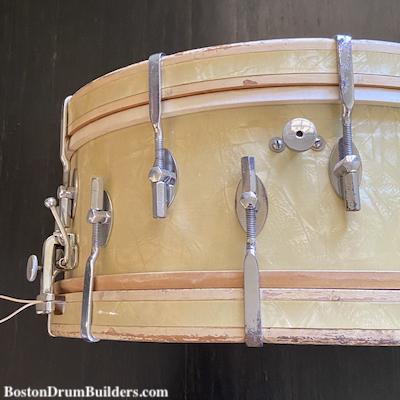
Often mistaken for an aftermarket addition, factory installed Leedy tone controls are common on Master-Model drums of the mid to late 1930s. Stone's use of tone controls roughly coincides with the introduction of blank washers on drums with serial numbers in the mid 9500 range.

Ten Lug Configurations

The use of ten tenioners per head, as opposed to twelve, becomes common on extremely late production Master-Models with serial numbers in the 9600 range. Ten lug models account for only the last few dozen drums manufactured around the late 1930s.
Other Characteristics

Though not exclusive to the final generation of Master-Models, later examples are more likely to feature pyralin wrapped finishes, deeper shell sizes and chrome plated hardware. Wrapped finishes are included in Stone & Son pricelists as early as 1928 and begin appearing on drums with serial numbers in the low 8000s. Chrome plating, which is not mentioned in Stone & Son's 1932 pricelist, does appear as an option in Booklet "L" published around 1935 suggesting this became an option sometime in the early-mid 1930s. Deeper shell sizes begin appearing on Master-Model drums with serial numbers in the mid 8000 range. Despite being cataloged in only one size (initially 5 1/4" x 14" and later 5"x14") deeper drums account for about 10% of Master-Models produced.

Do you have a Stone & Master-Model? I would love to hear from you! Feel free to drop Lee an email at lee@vinson.net. And for more on the early 20th century snare drum makers of Boston, Massachusetts please visit BostonDrumBuilders.com or follow @old_boston_drums on instagram.

Saturday, October 1, 2022

J. B. Treat Drum, ca. 1879

Joseph B. Treat was a well-known drummer and drum maker in Boston during the mid to late 19th century. A native of Connecticut, Treat arrived in Massachusetts by 1860 and briefly served as a drummer in Boston's Independent Corps of Cadets during the Civil War. A musician by vocation, he worked extensively in the musical instrument trade as well. Treat's most recognizable work as a maker was for Thompson & Odell during the 1880s and early 1890s.

Through much of the 1860s and 1870s, directory listings place Treat at addresses corresponding to the workplace of Asa Warren White suggesting that Treat worked alongside or was employed by White during these years. Signed makers labels offer further evidence that the two men were affiliated in some capacity well into the 1870s though they diverged shortly thereafter. Directories list Treat independently under 'Musical Instrument Makers' in 1879, and both Treat and White are absent from the Boston Business Directory in 1880 before reappearing at separate addresses the following year. Beginning in 1881 Treat's place work was 177 Washington Street confirming that he was by then employed by Thompson & Odell.

Treat likely produced the drum seen here during the narrow window of time after leaving White's shop, before landing at Thompson & Odell.

ca. 1879 J. B. Treat Drum
ca. 1879 J. B. Treat Drum Label
A large makers label inside the drum reads: "CIRCULAR / Having located at 50 Bromfield Street, Room 24, I am prepared to furnish Drums of any, and all descriptions, of the best materials throughout, also Rodger's Drum Heads, and Drum Findings of all descriptions, at the lowest possible prices. / Uniform sets of Drums, for Corps, made at the shortest notice. Old Drums remodelled and repaired in the best manner. / J. B. TREAT, / 50 BROMFIELD ST., ROOM 24 / I invite my old friends and customers to / "CALL ROUND." / Pin this up in the Band Room."
ca. 1879 J. B. Treat Drum
The drum is straightforward in construction, typical of military style drums manufactured in Boston during the decades following the Civil War. Formed from a single ply of maple, the shell is held at the seam by a line of small brass tacks. Slightly unusual is the orientation of the air vent and snare beds which are often placed further around the shell from the seam.

Do you have a drum made by J. B. Treat? I would love to hear from you! Email Lee anytime at lee@vinson.net. And for more on the early 20th century snare drum makers of Boston, Massachusetts please visit BostonDrumBuilders.com or follow @old_boston_drums on instagram.
Thursday, September 1, 2022

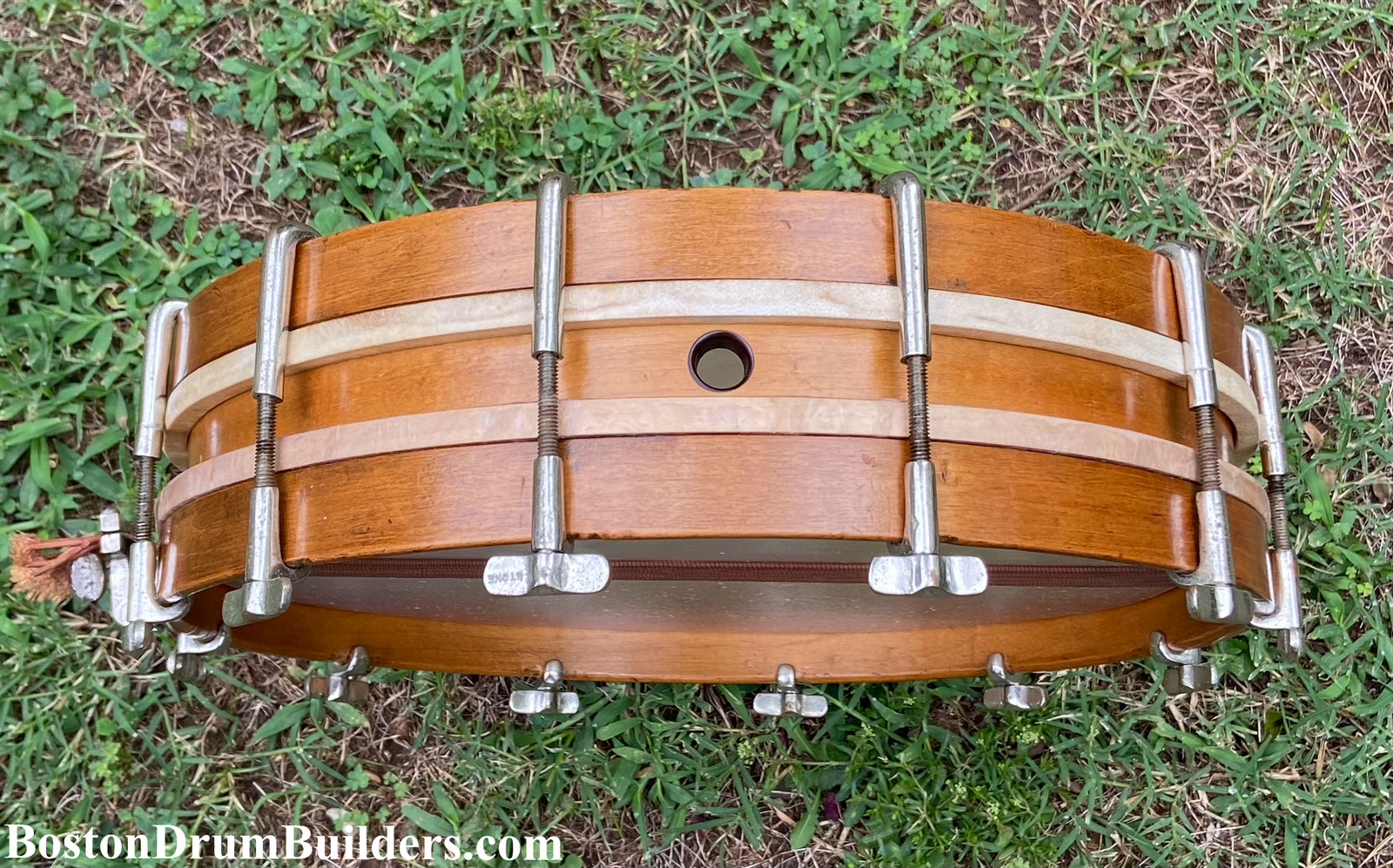
1912 George B. Stone & Son Thumbscrew Rod Orchestra Drum

Boston's George B. Stone & Son manufactured a vast number of single tension, thunmbscrew rod drums during the early decades of the 1900s. The paper label inside of this example is date stamped March 1912, roughly a decade before the company reached its zenith.
1912 George B. Stone & Son Thumbscrew Rod Orchestra Drum
Of special interest here is the extremely shallow shell measuring only two inces in depth. The rosewood grommet is cleverly recessed into the shell to prevent it from obstructing the flesh hoops as the heads are tightened.
1912 George B. Stone & Son Thumbscrew Rod Orchestra Drum
1912 George B. Stone & Son Drum Label
An early version of the Stone Patent Snare Strainer and Muffler is stamped with the inventor's name rather than "Stone" which is common on later examples. As is often the case, the original arm has broken off and gone missing. The original 'flexible waterproof woven' snares, however, remain intact.
McIntosh Snare Mechanism
1912 George B. Stone & Son Thumbscrew Rod Orchestra Drum
Do you have a Stone & Son drum? I would love to hear from you! Feel free to send Lee an email at lee@vinson.net. And for more on George B. Stone & Son and the other turn of the century Boston-based drum makers, please visit BostonDrumBuilders.com or follow us on Instagram: @old_boston_drums.

Monday, August 1, 2022

1921 Harry A. Bower Drum

Harry Augustus Bower (1866 - 1948) was a prolific theater drummer, Vaudeville performer, xylophone soloist, method book author, teacher and inventor with more than a dozen patents to his name. His most prolific period as a maker was during the late 1910s and early 1920s before relocating to Southern California in 1924. The drum featured here is dated February 14, 1921.
1921 Harry A. Bower Snare Drum
Many of Bower's instruments were eccentric even for their time. In particular, the use of a frame mounted snare system and tubular counterhoops which doubled as flesh hoops were unique to Bower drums.
1921 Harry A. Bower Snare Drum
Many variables exist between one Bower drum and the next as the maker was constantly editing and evolving his own inventions. This example is formed around a figured maple shell with metal bands lining the bearing edges. A finely turned rosewood grommet adorns the air vent and an oversized makers label is applied inside of the drum.
1921 Harry A. Bower Snare Drum
Harry A. Bower Drum Label
Most Bower drum shells have no snare beds instead relying on the snare frame to keep the wires in contact with the bottom drum head. In this case, however, the shell has deeply cut beds which dictate that either the strainer or butt must be oriented directly underneath the badge. This must have been intentional on the makers part and probably explains why many Bower drums have conspicuously dented badges where the strainer often rests against the shell when engaged.
1921 Harry A. Bower Snare Drum
Do you have a Bower drum? I'd love to hear from you! Feel free to send Lee an email at lee@vinson.net. And for more on the early 20th century snare drum makers of Boston, Massachusetts please visit BostonDrumBuilders.com or follow @old_boston_drums on instagram.

Wednesday, December 1, 2021

1922 George. B. Stone & Son "All-Weather Drum"

First advertised in 1922 as the "All-Weather Drum", George B. Stone & Son's newly introduced flagship snare drum was renamed the "Master-Model Drum" later that year. Described as a "Combination Dance and Theater Model", the All-Weather Drum was initially offered in only one size, 5 1/4" x 14". The example shown here dating from August of 1922 precedes the adoption of the Master-Model name.
1922 Geo. B. Stone & Son All-Weather Drum
There are several characteristics of the All-Weather Drum which distinguish it from the vast majority of the more than 800 Master-Models produced from the early 1920s through the late 1930s. The earliest shells such as this one are formed from single-ply maple with a series of four reinfircing rings which span the entire depth of the shell. By mid-1923 this design would be supplanted a 3-ply, 5/8" thick maple shell which was used on all Master-Models and Separate Tension Orchestra Drums moving forward.

Geo. B. Stone Advertisement, September 1922
Geo. B. Stone & Son Advertisement, September 1922
Geo. B. Stone Advertisement, December 1922
Geo. B. Stone & Son Advertisement, December 1922

Most Stone drums of this era feature a metal badge affixed to the batter side counterhoop. Interestingly, while this drum has a makers label with a strong date stamp and serial number, it has no badge. This is likely because Stone was in the process of changing over from an older version to a newer badge which included lettering noting their recent incopration. Also, the Master-Model specific badges installed on most examples had not yet been introduced. While there are pencil markings present inside of the shell and underneath the counterhoops, they are not consistent with the numbering system later used by Stone to keep track of the total number of Master-Model drums produced.
Antique George B. Stone & Son All-Weather Drum
1922 Geo. B. Stone & Son Makers Label
The drum features an elongated, inverted version of William F. McIntosh's Patent Snare Strainer and Muffler which was standard on all Master-Model drums. The butt end seen here is patented design by Charles A. Stromberg which was used on Master-Model drums until about 1925.
Stone Patent Snare Strainer and Muffler
Charles A. Stromberg Snare Anchor
Do you have a drum made by Geo. B. Stone & Son? I would love to hear about it! Feel free to drop Lee an email at lee@vinson.net. And for more on the early 20th century snare drum makers of Boston, Massachusetts please visit BostonDrumBuilders.com or follow @old_boston_drums on instagram.