Sunday, April 14, 2013

Faux Rosewood Hoops

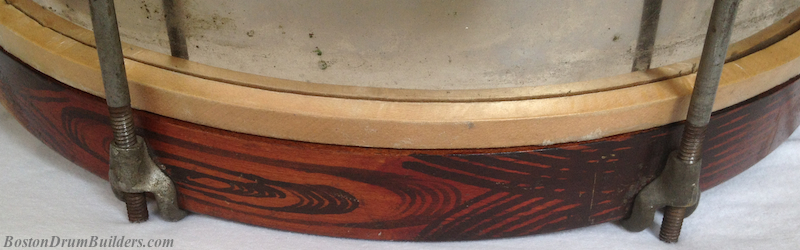
Where were these hoops coming from? They appear on a 1880s Thompson & Odell drum in my collection and several others I have seen. At first glance it appears the hoops are made of rosewood but upon closer inspection they are in fact formed from maple which has been stained a deep reddish color and then hand painted to imitate the woodgrain of rosewood.
Lee'sThompson & Odell Drum, ca. 1880sThompson & Odell Drum, ca. 1880s
Thompson & Odell Drum Label, ca. 1880sThompson & Odell Drum Label

The similarities between the hoops on this Thompson & Odell drum (above) and a similar maple shelled drum by Lyon & Healy of Chicago (below) are uncanny.

Lyon & Healy Drum, ca. 1880sLate 1800s Lyon & Healy Drum        photo: eBay
Lyon & Healy Drum Label, ca. 1880sLyon & Healy Drum Label        photo: eBay

The hardware on the two drums pictured above is also very similar albeit somewhat generic. Furthermore, the wording on the Thompson & Odell label describes the company as "Importers and Wholesale and Retail Dealers in General Musical Merchandise". This all leads me to believe that Lyon & Healy of Chicago was behind the manufacture of this particular Thompson & Odell drum.
Thompson & Odell Drum, ca. 1880s

Late 1800s Lyon & Healy Drum

Lyon & Healy was one of the largest producers of band instruments in the late 1800s, and drums such as these often turn up with labels listing other instrument makers or music stores as is the case here. Lyon & Healy in fact proclaimed themselves to be the "largest general music house in America" and was likely a source of instruments for countless smaller dealers at the time.

This certainly isn't to say that all Thomposon & Odell drums were built by Lyon & Healy because that absolutely is not the case. Drums by J. B. Treat, and Charles A. Stromberg were also dealt by Thompson & Odell prior to the Company's bankruptcy in 1905. Stromberg was in fact employed by the company for a time. But the evidence to suggest some sort of working business agreement between Thompson & Odell and Lyon & Healy is strong as the two drums pictured above demonstrate.

Do you have a Thompson & Odell drum? I want to to hear from you! Send Lee an email at lee@vinson.net.

Sunday, April 7, 2013

Stone Master-Model Prototype Shell

First introduced in 1922, the Master-Model Drum was George B. Stone & Son's premier snare drum offering and remains the most easily recognizable and iconic instrument produced by the company. Originally marketed as the "All-Weather Drum", the name "Master-Model" was adopted by late 1922. The Master-Model snare drums were built around 5" x 14" staggered three-ply all maple shells, not single-ply maple as is sometimes reported.

But with every rule comes an exception as is the case with this early prototype.

All that remains of this drum is the shell and hoops. There is a paper label inside of the drum and a Stone & Son badge mounted on the top hoop which places the drum no later than 1922. (The Master-Model specific badge appears to have begun use around January of 1924.) What is most interesting about this early example is that unlike every other Master-Model shell I've ever handled, this one is formed from a single, thin outer ply with four reinforcing rings which combine to line the entire inside of the drum.

Now compare the prototype shell pictured above with this late 1920s example. This is the typical 3 ply 5/8" thick maple shell employed by Stone on their Master-Model drums through the 1920s and into the 1930s.

1923 George B. Stone & Son Master-Model Snare Drum Shell1923 George B. Stone & Son Master-Model Snare Drum

The odd thing about the prototype is how the entire inner shell is covered by the reinforcing rings. It's an obvious evolution at that point to then make the inner rings into one complete ply which would yield a two ply shell composed of a thin outer ply and a much thicker inner ply. Stone apparently settled on a three ply version by about 1922 which they would use on all of their Master-Model drums going forward. The production of a staggered three ply shell is a milestone often credited to Brooklyn's Gretsch Manufacturing Company but date stamped examples from George B. Stone & Son appear as early as 1922.

Do you have a drum made by Geo. B. Stone & Son? I'd love to hear from you! Send Lee an email at lee@vinson.net.

Sunday, March 31, 2013

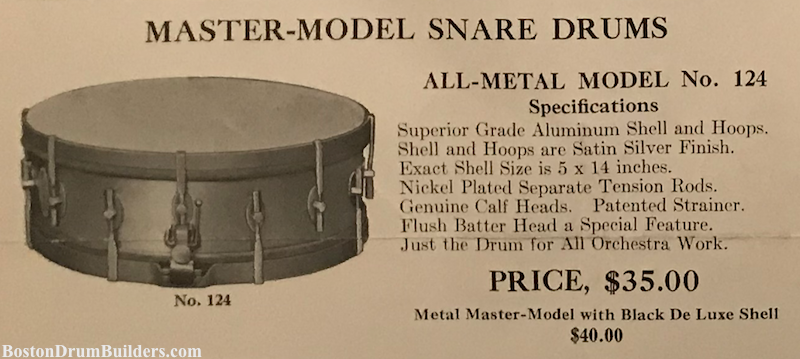
George B. Stone & Son All-Metal Master-Model

The 'R' word is grossly over used in drum collecting, but it probably applies to this one. One guy back in Boston said he had seen one before . . . in the 1970s. Another prominent collector said he laid eyes on one in the early '90s and described this in an email as a "very, very, very rare drum". That's three verys. I have seen pictures of one before, but that would only amount to three sightings in 30+ years between the three of us. So I tend to agree. This is a Rare drum.

Lee's Geo. B. Stone All Metal-Master Model-Drum

It's a mid 1920s George B. Stone & Son All-Metal Master-Model Drum. No such instrument is included in Stone Catalog K which was released around December of 1924. But a press release dated July 25, 1925 published by the Music Trade Review on August 1st of that year described the new drum as follows:

Stone Announces New All-Metal Snare Drum
----
Made With Solid Aluminum Shell With Hoops to Match, This Being Selected After Many Experiments by Firm

----
BOSTON, MASS., July 25. - With the issue of a brank new Summer drum folder in colors, just off the press, containing many new items of interest to all drummers, George B. Stone & Son, Inc., drum makers, have introduced to the trade and profession a most remarkable all-metal snare drum constructed on the same scientific lines as their wood-shell Master-Model which is now so well-known to the trade and which is being used by so many of the better-known professional drummers to day, including Lopez Pennsylvanians, Mal Hallet, U. S. Jazz Band, Pryor's Band and many others of equal prominence.

The new all-metal Master-Model drum is the result of long and careful study of different forms of metal and a solid aluminum shell with hoops to match was finally selected as being the least impervious to dampness and other weather conditions which cause the drummer so much worry.

Many other features have been incorporated into this new drum and the immediate sales have indicated that this drum will soon take a place among the finest all-metal snare drums on the market.


A Stone & Son poster size mailing indeed includes a picture and description of an All-Metal Master Model.
The example featured here fits the description in every way. The shell is made of solid aluminum and is painted silver. The aluminum, unfortunately, is beginning to oxidize giving the shell a less even appearance than when it was new. The hoops are also formed from aluminum but are polished to a shine and are not painted. The top hoop is slightly shorter than the bottom hoop and the bottom hoop has pronounced snare gates one of which is larger than the other. The remaining hardware is nickel plated and is all typical of mid - late 1920s Stone Master-Models. Interestingly, the all-metal version of the Master-Model utilizes only eight claws per head while their wooden shell brethren employ twelve each on top and bottom.

The drum sports a silver Master-Model badge which is tacked into the shell three panels to the left of the throw-off. There is a simple, unadorned metal grommet one more panel to the left. There is no paper label inside of the drum which is unusual for Stone. Instead, the number four is penciled on the shell and is visible through the air vent. This was either the fourth drum in a batch, or quite likely was only the fourth all-metal Master-Model to leave the factory. The workers at Stone & Son kept a running count of how many drums were being produced and while this drum bears no four-digit serial number, the hand written markings inside the shell are in keeping with those used by Stone on other drums.

Both heads were broken when I received the drum so new calfskins from Stern Tanning were tucked on the original flesh hoops. Interestingly, the flesh hoops were painted silver at the factory to match the shell! I know the paint is original because pencil markings over the paint indicated that these were a factory matched pair of flesh hoops. These markings, again, are in keeping with those seen on other Stone drums. The original wire snares were intact so they were cleaned and remounted. The drum is now in as close to original condition as possible and is ready to be proudly displayed.

Geo. B. Stone All Metal-Master Model-Drum snare throw-offGeo. B. Stone All Metal-Master Model-Drum Badge
Geo. B. Stone All Metal-Master Model-Drum shell numberGeo. B. Stone All Metal-Master Model-Drum snare butt
Do you have a antique George B. Stone & Son drum? I'd love to hear from you! Send Lee an email at lee@vinson.net.

Sunday, March 17, 2013

Nokes & Nicolai . . . Hydrocarbon Engines???

Okay here is an odd post relating only tangentially to drums whatsoever . . .

Boston's Nokes & Nicolai enjoyed a what appears to have been a reasonably successful albeit somewhat modest fourteen year existence from 1912, when they took over the operation of F. E. Dodge, until 1926 when they were acquired by the Liberty Musical Instrument Company of Chicago. It is well known that Nokes & Nicolai produced and sold a full line of drums, traps, keyboard percussion instruments, and timpani as well as banjos. But what interest did the company's namesakes Enes J. Nokes and Edward F. Nicolai have in hydrocarbon engines???


Nokes & Nicolai Letterhead
Nokes & Nicolai letterhead dated July 10th, 1915


U. S. Patent 1,523,954, claiming to offer "useful improvements in Gas Savers for Hydrocarbon Engines", was applied for on October 14, 1921 by Walter T. Greene of Roxbury, MA. The patent was granted on January 20th, 1925 and was assigned, curiously enough, to the firm of Nokes & Nicolai. Now, why on earth Nokes & Nicolai had any interest at all in hydrocarbon engines, I have no idea! So I'll offer up a wild guess or two here with absolutely nothing to back them up.

Maybe this device, described as "a gasket adapted to be clamped between the surfaces of the connections of the intake passage, a wire extending on one side of the gasket to the other across the opening therein, and a plurality of absorbent washers loosely mounted on the wire" , was so simple in construction that it could have been an easy item to assemble at the Nokes & Nicolai factory. Or could it be that in the interest of diversification that the company's owners were in some small way hedging their bets by venturing into other areas of manufacturing? This would be the the first and only piece of evidence I've come across that would suggest as much, but maybe it is possible. This seems sort of unlikely, however, seeing as how the musical instrument business was booming in the early 1920s even for a smaller company such as Nokes & Nicolai.

Or was it that by the time Greene's patent was granted in 1925 that the handwriting was on the wall and the end was growing near for Nokes & Nicolai? By the mid 1920s it would appear that, not unlike their Boston drum building counterparts, the company was likely falling behind in terms of modernization and was unable to evolve and grow to the extent needed to compete with the industry titans of the Midwest. Maybe a venture into other areas of manufacturing was a last ditch effort to feed the operation in Boston and prevent selling the company.


All of this is purely speculative on my part. It could just as well be the case that nothing at all ever came of the patent being licensed to Nokes & Nicolai. Or perhaps there was simply a friendly business arrangement between Nokes, Nicolai, and Greene. We may never know. What is for certain however is that Nokes & Nicolai is much better remembered for their drums and percussion instruments than any contributions they made to the automobile industry!

Do you have a percussion instrument manufactured by Nokes & Nicolai? I want to hear from you! Send Lee an email at lee@vinson.net.

Sunday, March 3, 2013

The Haynes Drum Dating Conundrum

Every time a John C. Haynes drum turns up, the obvious question arises as to it's age. And there is a lot of incomplete information floating around to help find incomplete answers to that question.

There seems to be a widespread misconception that any drum with a label listing J. C. Haynes & Company's 33 Court Street address dates from the Civil War. This is simply not true, however, because Haynes continued to operate as the musical instrument manufacturing division of the Oliver Ditson Company at 33 Court Street in Boston for several decades after the end of the war.

An online search of Boston City Directories from 1845 through 1875 yields the following results:


A search of the 1879 Boston Almanac and Business Directory yields this:


And a search of the 1885 Boston Directory via Tufts University's Boston City Directories Search gives us this:


So before any John C. Haynes instrument can be purported as dating from the Civil War, further provenance is needed. A drum labeled with the 33 Court Street address could in fact date from the 1860s, but it could also date from the 1870s, 1880s, or even the 1890s.

Some later labels (see image at left) clearly state the Ditson and Haynes addresses together which somewhat narrows down the date of manufacture for those instruments. But lacking any further information, the 33 Court St. address alone does not mean a drum was produced during the Civil War.

For more historical information on John C. Haynes and the late 19th century drums they built for Boston's Oliver Ditson Company, please visit BostonDrumBuilders.com.

As always, you can contact me about old Boston-made drums at lee@vinson.net.