
Wednesday, April 15, 2015

The Celebrated Stromberg Invincible Orchestra Drum

Swedish immigrant Charles A. Stromberg was a cabinet maker turned musical instrument craftsman who came to America in 1887 and soon after began working for Thompson & Odell in Boston. In 1905, upon the bankruptcy of Thompson & Odell, Stromberg went out on his own manufacturing and repairing a wide assortment of musical instruments including banjos, mandolins, guitars, harps, and drums. According to Christine Merrick Ayars' Contributions to the Art of Music in America by the Music Industries of Boston 1640 - 1936 (New York: H.W. Wilson, 1937) Stromberg had by the mid 1930s produced "about 1000 banjos, 200 mandolins, 100 guitars all custom made and 400 drums."

Long before Charles and his youngest son Elmer would become famous for their big-body archtop guitars of the 1940s and 1950s, the elder Stromberg was catering to the needs of theater drummers in Boston's thriving Vaudeville scene. Today we take a look at a magnificent example of some of his very earliest independent work, a beautifully well preserved "Celebrated Stromberg Invincible Orchestra Drum" dated March, 30 1906.

Lee's Celebrated Stromberg Invincible Orchestra Drum1906 Charles A. Stromberg Invincible Orchestra Drum1903 Music Trade ReviewThe Music Trade Review - December, 1903

This drum was in many ways a decade or two ahead of its time and at least lap ahead of the local field as no maker in New England was making anything like this at the turn of the 20th century. Emile Boulanger's Duplex Manufacturing Company of St. Louis had patented a separate tension lug in 1883, but drummers and other drum makers were slow to embrace the concept. In 1906, the lowly snare drum was still more than a decade from being fully modernized at the hands of companies such as Ludwig & Ludwig and Leedy during the 1920s. At the time when Stromberg built this drum, Ludwig & Ludwig had not even been founded yet.

Stromberg applied for a two patents pertaining to snare drum construction, both of which were applied to his Invincible Orchestra Drum. The first patent, applied for on July 20, 1903 and granted on March 8, 1904, involved the method by which the drum is tensioned using claws, tension rods, and separate tension lugs. The second patent, also applied for on July 20, 1903 and then granted on April 5, 1904, related to the snare throw-off and snare butt. A somewhat updated version of this design is present on this drum though the patent date is still stamped into both the snare butt and the bracket which clamps the snares into the throw-off. Presumably, Stromberg continued to evolve his design after submitting it to the patent office almost three years earlier.
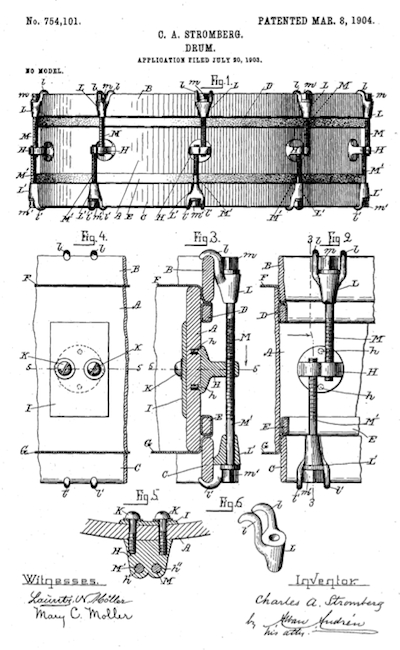
Stromberg Drum PatentStromberg Drum Patent

The significance of these patented designs cannot be understressed. The concept of separate tension, where either head can be tensioned independently of the other, was still a relatively new one at the turn of the 20th century and this drum was likely the first of its kind in Boston. And a fully functioning snare throw-off capable of not only tightening and loosening the snares, but fully engaging them with or releasing them completely from the bottom head with the turn of a single lever was almost unheard of at the time.

Stromberg's background as a cabinet maker is clearly on full display here. A beautiful outer ply of birds-eye maple, a perfectly turned ebony grommet, and engraved, faux rosewood counter hoops are all examples of his impressive craftsmanship. Such touches were not uncommon in the early decades of the 1900s, but Stromberg's work is of exceptionally high quality. The counterhoops for example have been painted to resemble rosewood veneer and have then been scored or engraved with a series of lines as ornamentation. This also gives the drum a more high end look and even a certain lightness in appearance considering the height of the wooden hoops necessary to maintain tension on the heads. Stromberg drums in general have a certain elegance about them and that characteristic is certainly apparent here.

Maybe the most astonishing feature of this drum is its staggered, THREE PLY maple shell with no reinforcing rings. Gretsch often claims that this is an innovation of their own dating from sometime in the 1920s and later popularized in the 1940s, but this drum provides us with hard evidence that Stromberg was forming such shells in his Boston workshop several decades earlier.
Lee's 1906 Charles A. Stromberg Invincible Orchestra Drum

Despite the rather rudimentary design of the separate tension lugs, they still have a certain low mass quality about them so as not to give the drum a bulky or heavy appearance. And the quality of construction in general is of the highest level. The three ply shell is as sturdy as the day it was built and the solid brass lugs, which maintain their bright nickel plating, function just as they should after 109 years.

The makers label present inside of the drum shell is significant in its own right. It is in fact a Thompson & Odell label that has been modified with what was apparently Stromberg's own address at the time, 767 Washington St., Boston, Mass., U.S.A. The handwritten date, March 30, 1906, positions this as one of the first drums made by Stromberg after his departure from Thompson & Odell upon their bankruptcy in 1905.

1906 Stromberg Drum LabelStromberg Snare Throw-off
Stromberg Snare ButtStromberg Snare Drum Lug

The drum is outfitted with period correct calfskin heads and what looks to be the original gut snares which are quite thin and of high quality. This instrument won't receive any playing time as it will be preserved purely as a historical collectible, but a few light taps on the head produce a surprisingly bright sound due to the shallow three inch shell depth and firm head tensioning provided by the design of the drum.

Do you have a drum made by Charles A. Stromberg? I want to hear from you! Feel free to drop Lee an email anytime at lee@vinson.net. And for more on the early 20th century snare drum makers of Boston, Massachusetts, please visit BostonDrumBuilders.com.

Sunday, March 1, 2015

Boston's Black Beauties

The term 'Black Beauty', as it applies to antique snare drums, is typically attached to the blackened shell, ornately engraved snare drums of the 1920s and 1930s manufactured by Ludwig & Ludwig of Chicago. Hardware on these drums, when not actually gold plated which is rare, was commonly lacquered and or plated to achieve a color similar to the metal exposed by the engraving on the blackened shell. The end result is an instrument with a striking appearance.

Originally catalogued as the "DeLuxe Model", Ludwig's engraved drums date as early as the late 1910s. It wasn't until 1931 or 1932 that Ludwig adopted the name 'Black Beauty'. Leedy of Indianapolis of course had the "Black Elite" and Duplex of St. Louis made a very small number of "Black Jewels", but it was Ludwig's cross town rival Slingerland with their engraved Artist model who supposedly first used the moniker 'Black Beauty' to describe an engraved, blackened metal shell drum in their advertising around 1928.

Ludwig Black Beauty Snare Drum, ca. 1932 - 1934

But in 1925, several years before Slingerland began using the term, Boston's George B. Stone & Son described in Catalog K (see page 27) the inclusion of a black Separate Tension Drum which they called a Black Beauty. So while no snare drums built by any of the early 20th century Boston makers could truly match Ludwig, Leedy, or Slingerland's metal shell mastery, there are examples of New England-made drums which aimed to emulate the brass against black appearance of such drums.

This George B. Stone & Son Master-Model drum dates from the late 1920s or early 1930s by which time the company was fading from its prime. For better or worse, this drum was subjected to a full restoration at the hands of a previous owner. That much is certain as it arrived with the receipts for the replating work tucked away into the drum case.

Faux gold plating, or "Knobby Gold" finish as Stone referred to it in their catalogs, was indeed a factory option meaning that the brass hardware against the black lacquered three ply maple shell seen here may very well be how this instrument looked straight from Stone's shop on Hanover Street.

Short of a few All-Metal Master-Models, Stone was never much for making their own metal shell drums. Of the small number of brass shell drums they distributed and the much smaller number of aluminum shell drums they built out, none are known to have been engraved. So this is as close as Stone would come to producing their own 'black beauty'.

Nokes & Nicolai also apparently offered a brass over black snare drum. Their All Metal Drums were built around a thick single sheet of aluminum riveted together at the seem. Most shells were buffed and lacquered leaving them to shine in a polished silver color. This particular example however is dressed in black enamel so that the faux gold hardware stands out nicely.

It is possible that these finishing touches could have been later modifications, but a close inspection of the drum is inconclusive. Whatever the case, factory original or aftermarket, the drum has not been touched in a very long time so that a nice patina is in place which suits the drum well considering its age. And assuming that the brass over black configuration is original, it is a clear attempt by Nokes & Nicolai to stack up against the black beauties of the world.

It's worth mentioning that an engraved, metal shell Stromberg snare drum does supposedly exist. But despite the good word of a highly reputable collector, the drum hasn't surfaced. So for now, the two drums pictured here are the closest we have to what most would think of as a Boston Black Beauty.

Geo. B. Stone & Son Master-Model Drum, ca. late 1920s - early 1930s


No-Nic All Metal Drum, ca. early - mid 1920s

Do you have a drum built by one of the early 20th century Boston makers? I'd love to hear from you! Feel free to send Lee an email any time at lee@vinson.net.

Sunday, February 1, 2015

J. B. Treat, Drummer

Joseph B. Treat was a well-known drummer and drum maker in Boston during the mid to late 19th century. A native of Connecticut, Treat arrived in Boston by 1860 and became active as an instrument repairman by 1863. His most wide reaching contributions as an instrument maker were his drums built for Boston-based music house Thompson & Odell during the 1880s and 1890s.

Treat served briefly as a drummer in the Boston Corps of Cadets during the Civil War. An independent infantry company, the Cadets were called into federal service for a period of just over one month. The unit was mustered into service on May 26, 1862 and mustered out on July 2, 1862. Treat would have been in his early 40s by this time and apparently never came close to the battle field. The Cadets worked closely with the Governor of Massachusetts and the unit remained small in size. Their main obligation while active for the federal government was to stand watch at Fort Warren in Boston Harbor where they guarded Confederate prisoners. Made up largely of well educated men, the Cadets were widely known as a breeding ground for officers who would go on to lead other regiments of the Massachusetts Volunteer Militia.

Joseph B. Treat
Through the 1860s and 1870s, directory listings place Treat at 86 Tremont and then 50 Bromfield where he worked for the shop of Asa Warren White. Makers labels place the two men in business together as late as 1879. Beginning in 1881, Treat is listed at 177 Washington Street, home of Thompson & Odell.

Billed as "The Celebrated Artist Drum", J. B. Treat's drums for Thompson & Odell were large, rope tension drums intended for military and semi-military purposes. Shells were typically single ply maple, tacked at the seam, with single ply maple reinforcing rings. Hoops were commonly painted black around the outside with the rope connecting to the hoops via cast iron hooks as seen in the example here dating from around 1890.

1890s Joseph B. Treat Rope Tension Drum
A brief mention in the Philadelphia Times on Saturday, January 26, 1895 suggests Treat maintained a sharp mind and a keen sense of humor well into his later years.

"Joseph B. Treat, of Boston, is living proof that the forbearance of the American public is wonderful. Had it not been so he would have been killed long ago. He has been a drummer for nearly seventy years and has hardly ever passed a day without pounding his unfortunate instrument more or less."

The last months of Treat’s life were spent at the Soldiers' Home in Chelsea, Massachusetts where he succumbed to heart disease on January 7, 1899 at the age of 78. He was laid to rest at Forest Dale Cemetery in nearby Malden, Massachusetts.

Do you have a drum by J. B. Treat? I'd love to hear from you! Feel free to send Lee an email at lee@vinson.net. And for more on the Boston Drum Builders of the early 20th century, please visit BostonDrumBuilders.com.

Sunday, January 4, 2015

A Grand Gran Cassa

The ties between Boston's Oliver Ditson Company and Chicago's Lyon & Healy are evident in the similarities between the two firms' products. It is no mystery as to why, since in 1864 it was Oliver Ditson & Co. who provided the capital to help establish P. J. Healy and George W. Lyon in Chicago. The companies obviously maintained some form of business relationship for many decades to come and the instrument featured here is just another example of that arrangement.

From Elise Abrams Antiques in Great Barrington, Massachusetts comes an enormous rope tension bass drum dating from circa 1890 which bears a label telling us that it manufactured by Lyon & Healy for Ditson. The geometrically patterned wooden marquetry adorning the shell is a common feature on Lyon & Healy's "Monarch" drums around the end of the 19th century. The hand engraved silver plaques, or oversized 'badges', are beautifully engraved with wording stating, again, that this instrument was manufactured for Oliver Ditson, not by Ditson.

Late 1800s Ditson Bass Drum
Oliver Ditson Bass Drum by Lyon & Healy, ca. 1890
Late 1800s Ditson Bass Drum Detail
Ditson Bass Drum Wooden Marquetry

But the most striking thing about this bass drum is its sheer size. The reported diameter is a whopping 40 inches! Instruments of this size were not frequently produced for a number of reasons. For one, shells this large were difficult to build and drumheads of the necessary size were challenging to locate. Also, transporting such a behemoth would have presented logistical problems for most drummers. And given the amount of sound that a 40 inch bass drum could generate, an instrument of this scale would have been best suited for performance applications involving a very large group of musicians such as a full concert band or symphony orchestra. From the lettering on the drumhead, it appears that this instrument hasn't traveled far from its home in Bangor, Maine where it belonged to the Bangor Band.

Late 1800s Ditson Bass Drum Label
Lyon & Healy for Oliver Ditson Drum Label
Late 1800s Ditson Bass Drum Badge
Lyon & Healy for Oliver Ditson Drum Badge

Amazingly, after more than 100 years, the Bangor Band still exists. And even more incredibly, a historical photo on the band's website taken on Memorial Day in 1898 shows a group of musicians posed for a picture with their instruments including what may be this very drum! The wording on the head is a very close match to the one still mounted on the drum minus the logo in the center. And if nothing else, the size of the drum looks to be quite large, the height reaching higher than the waist of anyone who stands next to it.

Late 1800s Ditson Bass Drum Label
Bangor Band, Memorial Day, 1898
Late 1800s Ditson Bass Drum Badge
Oliver Ditson Bass Drum by Lyon & Healy, ca. 1890

Do you have a drum made by or for Oliver Ditson & Co.? I'd like to hear from you! Feel free to send Lee an email at lee@vinson.net. And for more on Ditson and many other Boston based drum makers of the early 20th century, please visit www.BostonDrumBuilders.com.

Tuesday, December 23, 2014

A Christmas Master-Model

Nothing says Happy Holidays like a Master-Model drum from Boston's own George B. Stone & Son! This instrument, which has been in the collection for several years now, is date stamped December 23, 1923 making it exactly 91 years old today.

This particular example bears its original "Black De Luxe Finish" with nickel plated hardware and is in very good condition. The rosewood grommet, cylindrical tension nuts, long arm throw-off, and Stromberg butt plate are all indicative of the first generation Master-Models produced in 1922 and 1923. Look for a more comprehensive dating guide for the Stone Master-Model drums during the coming year.

There is of course no way to know, but I'd like to think that once upon a time this drum was gift wrapped and placed under the Christmas tree. It would have been a nice way for some young New England drummer to bang in the new year almost a century ago.
1923 George B. Stone & Son Master-Model Drum

George B. Stone & Son Drum Label
George B. Stone & Son Drum Badge

Do you have a Master-Model drum or another instrument by Geo. B. Stone & Son? I would love to hear from you! Send Lee an email at lee@vinson.net.